



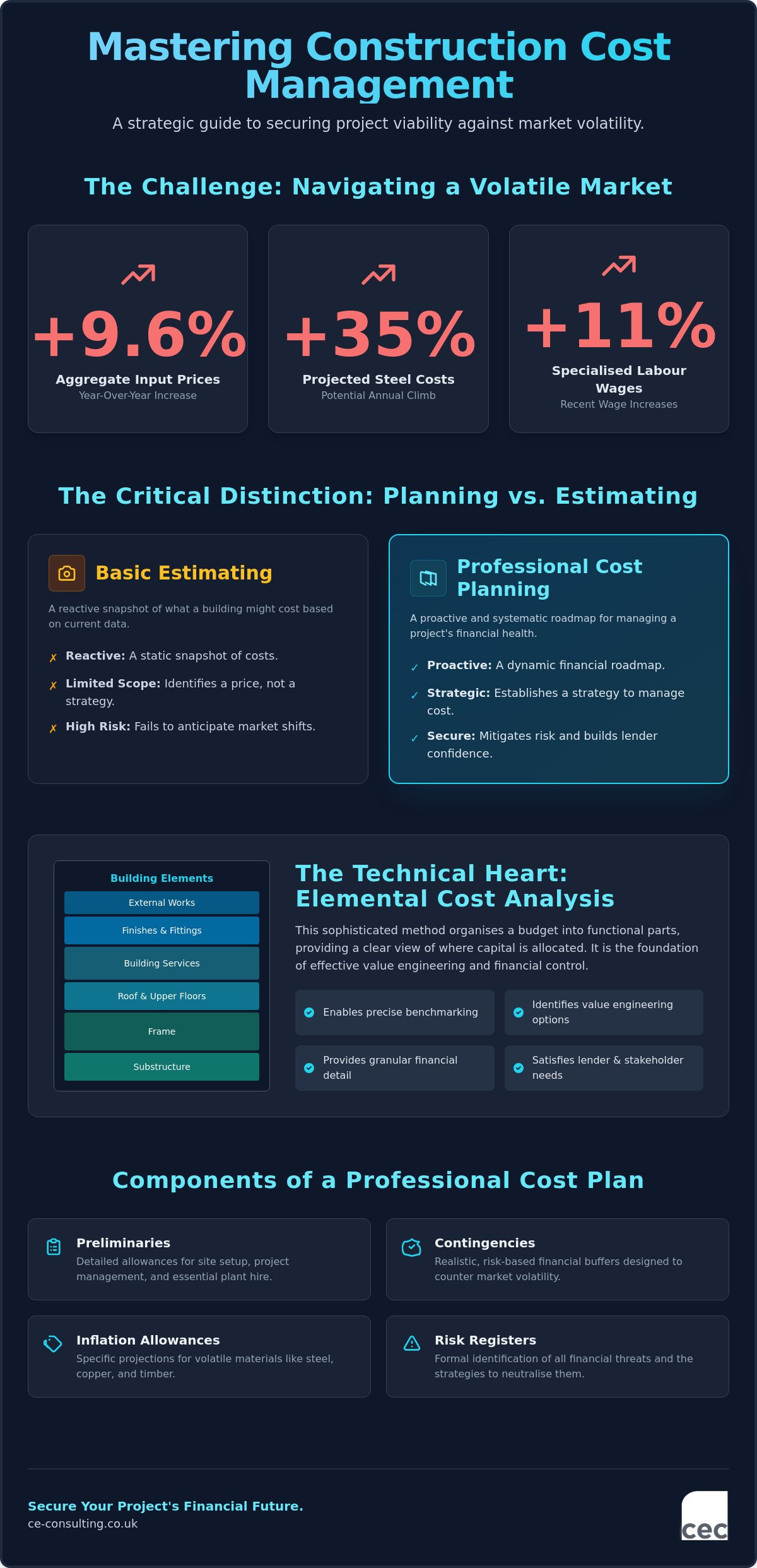
Did you realise that aggregate construction input prices surged by 9.6% year-over-year by May 2026, whilst steel costs alone are projected to climb by as much as 35% before the year concludes? In a market defined by such intense volatility, failing to utilise expert construction cost planning services can lead to rapid profit erosion. You likely feel that maintaining financial control is no longer just about tracking spend; it’s about anticipating shifts in labour and material costs that others might miss. It’s a high-stakes environment where precision is your only true safeguard.
This guide provides the technical insights needed to master the complexities of modern cost management, ensuring your project remains viable and attractive to lenders. We’ll examine how a meticulous financial roadmap identifies value engineering opportunities and provides the grounded confidence required to secure commercial success. From mitigating risk to ensuring long-term stability, we provide the clarity you need to move forward with absolute certainty.
Key Takeaways
- Discover why systematic budget management is the essential safeguard against the significant material and labour price volatility projected throughout 2026.
- Understand the critical distinction between a basic estimate and professional construction cost planning services to ensure you are managing costs rather than simply reacting to them.
- Learn how elemental cost analysis enables precise benchmarking across different functional building parts to secure project viability and identify value engineering options.
- Master the criteria for evaluating consultancy partners, ensuring they possess the multi-sector experience necessary to produce a reliable financial roadmap for lenders and stakeholders.
Understanding Construction Cost Planning Services in the 2026 Market
Construction cost planning services represent the systematic management of a project’s financial health from the earliest feasibility studies through to final completion. It is a disciplined process that ensures every design decision is weighed against its commercial impact. In the 2026 UK market, where construction input prices have risen by approximately 9.6% year-over-year, the margin for error has narrowed significantly. Developers can no longer rely on broad estimates. They require a rigorous framework that anticipates market shifts before they compromise the project’s viability.
Many professionals confuse cost planning with simple estimating, but the two serve vastly different purposes. An estimate is a reactive snapshot of what a building might cost based on current data. In contrast, professional construction cost planning services provide a proactive roadmap. Whilst an estimate identifies a price, a cost plan establishes a strategy to manage that price through procurement, design development, and construction. This distinction is vital when presenting to credit committees or boards. Lenders in the current high-interest environment demand granular financial detail and evidence of risk mitigation before releasing development finance.
The Evolution of Cost Management: From Spreadsheets to Strategic Planning
The industry has transitioned from fragmented, manual spreadsheets towards sophisticated, integrated financial models. This evolution allows for greater commercial rigour at project inception, ensuring that the initial budget is grounded in reality rather than optimism. Modern cost planning provides a “safe pair of hands” for complex procurement routes, particularly when dealing with the specialised trades that have seen wage increases of up to 11% this year. By establishing a strategic plan early, developers can maintain control over their capital expenditure and avoid the common pitfall of “designing to a dream and building to a nightmare.”
Key Components of a Professional Cost Plan
A professional cost plan is a comprehensive document that evolves alongside the project. It typically starts at RIBA Stage 1 and becomes increasingly detailed as the design progresses to Stage 4. Central to this process is Elemental Cost Analysis, which breaks the building down into functional components to allow for accurate benchmarking. A robust plan must include:
- Preliminaries: Detailed allowances for site setup, management, and plant.
- Contingencies: Realistic risk-based buffers that reflect the current 2026 volatility.
- Inflation Allowances: Specific projections for materials like steel and copper, which are currently facing supply constraints.
- Risk Registers: A formal identification of financial threats and the strategies used to neutralise them.
By integrating these components, a cost plan transforms from a simple budget into a strategic risk-management tool. It provides the transparency needed to identify value engineering opportunities early, ensuring that the final project meets both architectural aspirations and commercial requirements.
Elemental Cost Analysis: The Technical Heart of Project Viability
Elemental cost analysis is more than just a list of materials; it is a sophisticated method of organising a budget into functional building parts. By breaking down costs into elements such as the substructure, frame, and internal finishes, developers gain a clear view of where capital is being allocated. This structure allows for precise benchmarking against historical data from similar projects. If the cost of the structural frame per square metre appears disproportionately high, it triggers an immediate review of the design efficiency before contracts are signed. Precision is paramount in this phase.
This granular breakdown forms the foundation of effective value engineering. Rather than making arbitrary cuts that might compromise the building’s quality, developers can target specific elements that offer the best return on investment. Professional construction cost planning services ensure these decisions are based on technical data rather than guesswork. This methodical approach provides the commercial rigour required to satisfy both internal stakeholders and external lenders.
The Role of Conquest Estimating Software in Precision Planning
We utilise Conquest Estimating software to maintain the highest levels of accuracy in our cost consultancy. It remains the industry standard for professional planners because it integrates detailed quantification with live market data. By using software-driven take-offs, we eliminate the human error often found in manual calculations. This technology allows us to produce rapid “what-if” scenarios for our clients. For instance, if a developer needs to assess the impact of a 15% to 35% rise in steel prices projected for 2026, the software provides an immediate and reliable cost comparison against alternative materials.
Sector-Specific Cost Planning Nuances
Different sectors demand distinct financial priorities. In residential developments, the budget often leans heavily towards high-end internal finishes and stringent acoustic requirements. For those managing complex housing schemes, residential developer quantity surveying has become a strategic necessity, particularly with the introduction of the Building Safety Levy adding significant cost pressure to every new home. Commercial projects, by contrast, prioritise structural flexibility and the capacity of mechanical systems to accommodate future tenant needs. Healthcare and education projects introduce further complexity, requiring a deep understanding of specialist regulations and technical standards that must be costed with extreme care. For educational builds in particular, the challenge of maintaining operations during construction makes cost planning for school extensions a highly specialised discipline that demands rigorous adherence to DfE design standards and grant-funding deadlines. For industrial builds, the focus typically shifts to the speed of delivery and the long-term lifecycle costs of durable materials.
While our focus here is on UK commercial developments, the principles of direct cost management apply globally; for example, those looking at residential projects in other markets can explore HDB BTO Renovation Packages to see how Direct Renovation Contractor Singapore helps homeowners bypass middleman fees.
Managing these variables requires a partner who understands the technical nuances of every sector. If you are looking to secure the financial stability of your next development, engaging with specialist cost planning experts ensures your budget is both robust and realistic from day one.
Cost Planning vs. Estimating: Addressing the Critical Misconception
A common pitfall for developers is the assumption that a standard estimate is “good enough” for the pre-construction phase. This is a dangerous misconception that often leads to significant profit erosion. A static estimate merely predicts a price at a specific moment in time; it does not account for the rapid shifts in the 2026 market. Professional construction cost planning services, however, provide the strategic framework needed to navigate these fluctuations. Whilst an estimate tells you what a project might cost, a cost plan tells you how to manage that cost to ensure commercial survival.
This proactive approach is the cornerstone of effective commercial construction cost management. By identifying potential overruns before the first spade hits the ground, you protect your margin and maintain the project’s viability. It is about moving from a reactive snapshot to a strategic blueprint. Relying on an estimate alone leaves you vulnerable to market volatility, whereas a cost plan provides the grounded confidence required to present a robust case to lenders and stakeholders.
Risk Mitigation through Strategic Oversight
Professional cost planning identifies “black swan” risks in the supply chain that a standard estimator might overlook. We utilise sensitivity analysis to stress-test your budget against sudden price hikes, such as the projected 35% rise in steel or the 50% increase in copper prices seen in early 2026. This level of oversight ensures you aren’t caught off guard by external economic pressures. An estimate is a static observation of potential cost, whereas a cost plan is a dynamic strategy for financial control. By preparing for these scenarios early, you ensure the project remains on a firm financial footing regardless of market shifts.
Value Engineering: Optimising without Compromising
How to Evaluate Construction Cost Planning Services
Selecting a partner for construction cost planning services requires looking beyond the bottom line of their fee proposal. In the current 2026 climate, you need a consultant who acts as a strategic extension of your team. The value of a consultancy lies in its combined industry experience. A firm might only be ten years old, but if its principals share a century of collective wisdom, their insights into market trends and procurement risks will be far superior to a larger, less experienced outfit. You are looking for a “safe pair of hands” that understands the high stakes of the industry.
A robust evaluation should focus on technical depth and reliability. You need a partner who can provide a meticulous financial roadmap, identifying risks before they become liabilities. Use the following criteria to assess potential consultants:
- Technical Accreditation: Ensure they hold recognised professional qualifications and adhere to industry standards.
- Software Proficiency: Verify they use high-register platforms like Conquest to ensure data accuracy.
- Multi-Sector History: Look for a proven track record across Residential, Healthcare, and Industrial projects.
- Granular Reporting: Ask for samples of their elemental breakdowns to ensure they provide the depth required for board approvals.
Assessing Technical Competency and Software Capability
You should always verify the technical toolkit your consultant employs. High-register software like Conquest Estimating is essential for producing the granular data needed for modern development finance. A shallow cost plan that lacks elemental depth is a significant risk; it often hides omissions that only surface once the project is underway. A robust service should provide comprehensive bills of quantities as a core component of the plan. This level of detail ensures that every material and labour requirement is accounted for, leaving no room for the “surprises” that lead to budget overruns. If a consultant cannot provide this level of quantification, they aren’t providing a true cost plan.
The Importance of Sector-Specific Expertise
Multi-sector experience is a non-negotiable requirement. A specialist in high-end residential projects may lack the technical knowledge required to cost a complex healthcare facility, where specialist ventilation and medical gas systems drive the budget. You must ask direct questions about their history with specific building types. A truly effective consultant bridges the gap between the architect’s vision and the contractor’s reality. They translate complex design intent into a commercially viable framework that both parties can agree upon. This ability to facilitate communication across the project team is what ensures long-term financial stability. For a comprehensive overview of how to select the right partner, our quantity surveying consultancy UK buyer’s guide provides the detailed criteria needed to make an informed decision.
Your chosen partner should provide the grounded confidence required to navigate the complexities of 2026 construction. If you require this level of technical rigour and strategic oversight, contact our expert cost planning team to discuss how we can secure the commercial success of your next development.
Consulting Estimating Consultants: A Century of Precision in Cost Planning
Consulting Estimating Consultants stands as the UK’s premier choice for developers and contractors seeking meticulous financial oversight. Our reputation is built upon a foundation of technical mastery and an unwavering commitment to precision. With over 100 years of combined professional experience within our team, we offer a level of insight that transcends standard consultancy. We don’t just process numbers; we provide the strategic foresight needed to safeguard your project’s commercial health in a volatile 2026 market. This extensive heritage allows us to act as a “safe pair of hands” for even the most complex developments.
We understand that the stakes are high. Our disciplined approach is designed to instill a sense of total financial control in every client. By utilising Conquest Estimating software for every project, we ensure that our data extraction is both granular and reliable. This software-backed precision, combined with our decades of industry wisdom, allows us to identify risks and opportunities that others might miss. It is this blend of modern technology and traditional expertise that ensures your budget remains robust from inception to completion.
Our Approach to National Cost Consultancy
Our expertise is not limited by geography. We provide comprehensive construction cost planning services to clients across the entire UK, adapting our methods to meet local market conditions and specific regulatory requirements. Our process is methodical and exhaustive. It begins with a detailed take-off and culminates in high-level strategic advice that guides your procurement decisions and board presentations. Our expertise is not limited by geography.
We serve a diverse range of sectors, ensuring that our cost plans are tailored to the unique drivers of each building type. Our portfolio includes:
- Care homes and healthcare facilities with complex technical specifications.
- Primary and secondary schools requiring strict budget adherence and safety standards, where our approach to cost planning for school extensions ensures grant-funded capital projects remain financially viable despite evolving DfE standards.
- Large-scale industrial warehouses and distribution centres.
- High-density residential developments and luxury bespoke housing, where specialist residential developer quantity surveying ensures margins are protected against rising material costs and new regulatory levies.
Secure Your Project’s Financial Future
The peace of mind that comes from professional, software-backed cost planning is a vital asset for any developer. Whether you are preparing a complex tender or launching a new multi-million-pound development, our team provides the commercial rigour needed to ensure success. We invite you to discuss your upcoming requirements with our consultants to see how our century of experience can benefit your bottom line. We provide the clarity you need to move forward.
Don’t leave your project’s viability to chance. Enquire about our construction cost planning services today and secure a robust financial roadmap for your next venture.
Securing Commercial Stability for Your Next Development
Navigating the financial complexities of the 2026 construction market requires more than just hope; it demands a disciplined, technical approach to budget management. By prioritising professional construction cost planning services, you move beyond the limitations of static estimates and embrace a dynamic strategy for project viability. You have seen how elemental cost analysis and the identification of value engineering opportunities can protect your margins against rising material costs. This level of commercial rigour is what separates successful developments from those plagued by profit erosion and unforeseen overruns.
Our team brings over 100 years of combined professional experience to every project, acting as a dependable guide through the procurement process. We are specialists in Conquest Estimating software, providing national coverage across all major sectors including residential, healthcare, and industrial. This technical mastery ensures that your financial roadmap is as accurate as it is reliable. We provide the grounded confidence you need to present a robust case to lenders and stakeholders alike.
Partner with our expert quantity surveyors for your next project to ensure your venture stands on a foundation of precision and expertise. We look forward to helping you achieve lasting commercial success.
Frequently Asked Questions
What is the difference between a cost estimate and a cost plan?
A cost estimate provides a snapshot of the anticipated price at a specific point in time, whereas a cost plan is a dynamic strategy for managing that budget throughout the project lifecycle. Whilst an estimate tells you what you might pay, a cost plan establishes how to control expenditure through proactive risk management and value engineering. It’s the difference between a reactive prediction and a proactive financial blueprint.
At what stage of a construction project should cost planning begin?
Cost planning should ideally begin at the project inception or feasibility stage, typically aligned with RIBA Stage 1. Engaging construction cost planning services early ensures that the design development is commercially grounded from the outset. This early intervention prevents the costly redesigns that occur when architectural aspirations exceed the realistic budget during later stages of the development.
How much does professional construction cost planning cost?
Professional fees for cost planning are typically calculated as a percentage of the total project value or based on the complexity of the required documentation. Industry data indicates that construction management and consultancy fees often range from 5% to 15% of the total project cost depending on the scope. For specific bills of quantities or take-offs, consultants may also work on a fixed-fee basis tailored to the project’s scale.
Can cost planning help in securing development finance?
A detailed cost plan is often a mandatory requirement for securing development finance from high-street lenders or private equity firms. Lenders require a transparent financial roadmap that demonstrates project viability and includes a robust risk register. Providing a professional cost plan instils confidence in stakeholders by proving that all financial variables, including market volatility and contingencies, have been meticulously analysed.
What software is best for accurate construction cost planning?
Conquest Estimating is widely regarded as the industry standard for producing the high-register data required for complex cost consultancy. Other essential tools include Bluebeam Revu for precise PDF markups and Autodesk Takeoff for projects utilising Building Information Modelling (BIM). The best software is one that integrates live market data with detailed quantification to eliminate the risk of human error during the planning phase.
How often should a construction cost plan be updated during a project?
You should update your cost plan at every major design milestone, specifically moving between RIBA Stages 1 through 4. In the current volatile market, it’s also prudent to conduct interim reviews if significant price fluctuations occur in key materials. Consistent monitoring ensures that your financial strategy remains aligned with the reality of the 2026 supply chain.
What is elemental cost planning in construction?
Elemental cost planning involves breaking down the total building cost into functional components such as the substructure, frame, and internal finishes. This methodology allows for easier comparison and benchmarking against historical data from similar projects. It provides a clear view of where capital is being allocated, making it easier to identify specific areas where value engineering can be applied without compromising quality.
Why should I outsource my cost planning instead of doing it in-house?
Outsourcing provides access to specialised technical expertise and high-register software without the substantial overhead of an in-house team. An independent consultant provides an unbiased perspective on project viability, offering the “safe pair of hands” needed for complex procurement. Utilising external construction cost planning services often carries more weight when presenting financial data to boards, lenders, or project partners. To understand the full scope of what a professional quantity surveying consultancy UK can deliver, reviewing a structured buyer’s guide will help you define your requirements and select the right partner with confidence.