



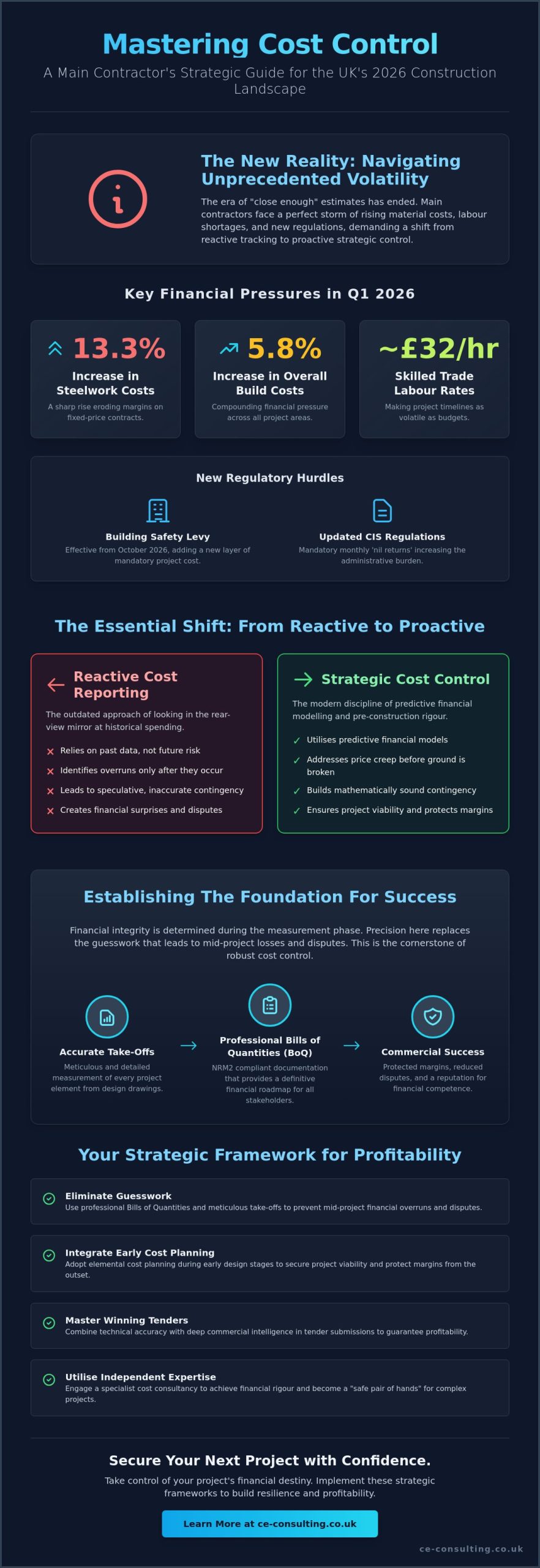
With steelwork costs rising by 13.3% in the first quarter of 2026 alone, the traditional buffer in your tender is no longer a safety net; it’s a liability. You likely recognise that the era of “close enough” estimates has ended, replaced by a landscape of material volatility and stringent new Building Safety Act requirements. Effective cost control for main contractors UK now demands more than just vigilant site management. It requires a meticulous, technical approach to pre-construction that addresses price creep before the first spade hits the ground.
We understand the pressure of maintaining robust project viability whilst navigating the new Building Safety Levy and updated CIS regulations. This guide provides the strategic roadmap you need to eliminate inaccurate take-offs and vague tender documentation. By mastering these technical frameworks, you can submit competitive, profitable tenders that account for every risk. We will explore the essential pre-construction strategies, from precise materials schedules to advanced cost planning, that ensure your firm remains a safe pair of hands in an unpredictable market.
Key Takeaways
- Understand why proactive cost control for main contractors UK is essential for navigating the 2026 landscape of material volatility and new regulatory levies.
- Discover how professional Bills of Quantities and meticulous take-offs eliminate the guesswork that often leads to mid-project financial overruns.
- Learn to integrate elemental cost planning into early design stages to secure project viability and protect commercial margins from the outset.
- Master the anatomy of winning tender submissions that combine technical accuracy with deep commercial intelligence to ensure profitability.
- Explore the strategic advantages of utilising independent cost consultancy to achieve financial rigour and a “safe pair of hands” for complex builds.
The Landscape of Cost Control for Main Contractors in the UK (2026)
In 2026, the definition of financial success for UK construction firms has shifted. It’s no longer enough to simply track expenses against a budget as they occur. True cost control for main contractors UK is now a proactive, lifecycle-long discipline that begins well before the first site hoarding is erected. As the central pillar of project financial stability, the main contractor bears the burden of protecting margins against a backdrop of increasing regulatory complexity. With the Building Safety Levy coming into force in October 2026 and the mandatory reintroduction of monthly nil returns for CIS, the administrative and financial stakes have never been higher.
Navigating Market Volatility and Resource Constraints
The first quarter of 2026 saw build costs rise by 5.8%, with steelwork experiencing a sharp 13.3% increase. These figures aren’t just statistics; they’re margin-eroding realities for those tied to fixed-price contracts. Labour shortages continue to drive hourly rates for skilled trades like bricklayers and joiners toward the £32 mark, making project timelines as volatile as the budgets themselves. To maintain project viability, contractors must build contingency that is mathematically sound rather than speculative. This involves deep-tier supply chain engagement and more frequent price refreshes during the pre-construction phase to ensure tender competitiveness doesn’t compromise the eventual bottom line.
Cost Reporting vs. Strategic Cost Control
Relying on historical spend is a reactive habit that modern contractors can’t afford. Strategic control moves away from looking in the rear-view mirror and focuses on predictive financial modelling. This transition requires a shift in mindset across the entire project team. By utilising Elemental cost planning, contractors can break down the build into functional elements from the earliest design stages. This method, supported by RICS standards, allows for a more granular understanding of where capital is allocated. It moves the conversation from “what was spent” to “what will be required,” allowing for real-time adjustments before costs spiral out of reach.
Establishing a culture of commercial accountability is the final piece of the puzzle. Every member of the project team, from the site manager to the procurement head, must understand their impact on the final margin. When data is shared transparently and updated in real-time, unquantified risks are identified earlier. Ultimately, robust cost control for main contractors UK ensures that financial surprises are eliminated, providing the peace of mind that comes from technical mastery and strategic oversight.
Establishing the Foundation: Accuracy in Bills of Quantities and Take-offs
The integrity of your project’s financial outcome is determined long before the first subcontractor arrives on site. It’s established during the measurement phase, where technical precision replaces the guesswork that so often leads to mid-project losses. For those overseeing complex builds, robust cost control for main contractors UK begins with a commitment to NRM2 compliant documentation. This level of rigour doesn’t just protect the main contractor; it creates a transparent environment for the entire supply chain, reducing the likelihood of costly disputes and the claims culture that can paralyse a project’s progress. Adhering to the government’s Cost Estimating Guidance ensures that your initial figures aren’t just estimates, but verified data points that reflect the true scope of work.
Why Measurement Precision Dictates Commercial Success
There’s a direct and undeniable correlation between the accuracy of your initial measurement and the stability of your final account. When items are missed or quantities are under-measured, the resulting variations don’t just erode your margin; they damage your reputation for commercial competence. Utilising professionally prepared bills of quantities provides a level of detail that generic estimates simply cannot match. The Bill of Quantities serves as the definitive financial roadmap for the main contractor, ensuring every element of the project is quantified before work commences. This clarity allows for fixed-price agreements with subcontractors that are actually enforceable, as there’s no ambiguity regarding the required deliverables.
Leveraging Conquest Software for Technical Rigour
In 2026, relying on traditional spreadsheet methods for complex take-offs is a significant commercial risk. Digital precision is no longer optional for main contractors managing multi-sector projects across residential, healthcare, and education. We utilise Conquest Estimating software to ensure absolute consistency, allowing our team to produce technical measurement that is both rapid and reliable. These digital take-offs facilitate faster tender iterations, enabling you to respond to design changes without losing your grip on the budget. This level of technical oversight is a hallmark of a disciplined commercial strategy. For firms looking to strengthen their submissions, securing accurate tender support can be the difference between a project that merely breaks even and one that delivers a healthy, protected margin.
Ultimately, a well-structured Bill of Quantities acts as the anchor for all subsequent cost control activities. It provides the benchmark against which every purchase order and progress payment is measured. By eliminating unquantified risks at this foundational stage, you position your firm as a safe pair of hands, capable of delivering complex UK builds with financial certainty and professional poise.
Strategic Cost Planning: Beyond the Initial Estimate
Cost planning isn’t a static event. It’s a continuous dialogue between the design intent and the commercial reality. Effective cost control for main contractors UK requires this integration at the concept stage, long before procurement begins. By acting as a commercial bridge between the architect’s vision and the developer’s budget, the main contractor ensures that the project remains viable as the design evolves. It’s about providing a “safe pair of hands” that guides the project through the transition from a conceptual estimate to a locked-down construction budget, ensuring every design decision is weighed against its financial impact.
Elemental Cost Analysis as a Risk Mitigation Tool
Breaking a project down into functional building elements allows for a more sophisticated level of risk management. Instead of looking at a single lump sum, we analyse spend across substructure, frame, and envelope to identify “hot spots” where costs may exceed benchmarks. We align our processes with RICS construction standards to ensure that every analysis is grounded in industry-recognised methodology. This data-driven approach allows us to provide pre-construction advice that informs better design decisions. If a specific structural approach is driving costs beyond the first-quarter 2026 average increase of 5.8%, we identify it early. This foresight prevents the need for painful value engineering exercises later in the programme, which often compromise the architect’s original intent.
Integrating Materials Schedules into Procurement Workflows
A precise take-off is only as valuable as its application on site. We transform these technical measurements into functional materials schedules that serve as the primary directive for the site team. Accurate scheduling is a direct antidote to the 2.1% increase in material prices seen in early 2026. It prevents over-ordering and drastically reduces on-site waste, ensuring that every pound spent on materials is justified. This level of detail allows for more accurate waste management plans, which are increasingly critical for meeting modern sustainability targets and reducing disposal costs. It bridges the gap between the initial budget and the actual physical requirements of the build.
Aligning these schedules with the project programme is essential for maintaining a healthy cash flow. When procurement is synchronised with the build sequence, capital isn’t tied up in stock sitting in a yard for months. This methodical approach ensures that materials arrive precisely when needed, minimising the risk of damage or theft whilst keeping the commercial team in total control of the project’s financial rhythm. It provides the site manager with a clear list of what’s coming, when it’s due, and exactly where it fits into the budget. This discipline eliminates the “just in case” ordering mindset that so often erodes profit margins on complex builds.
Professional Tender Support: Securing Profitable Contracts
Winning a contract is a hollow victory if the margins are non-existent. For many firms, the pressure to secure work can lead to rushed submissions that fail to account for the technical complexities of 2026 regulatory standards. Professional cost control for main contractors UK begins with a tender that is as compliant as it is competitive. This requires a level of commercial intelligence that goes beyond simple arithmetic; it involves a deep understanding of market trends, resource availability, and the hidden risks within the client’s documentation. By utilising independent tender support, your commercial team gains a “safe pair of hands” that ensures every submission is grounded in technical reality.
Mitigating Risk through Comprehensive Tender Documentation
Identifying project risks at the earliest possible stage is the only way to protect your eventual bottom line. A meticulous review of tender queries and clarifications often reveals gaps in the initial design or vague specifications that could lead to significant financial exposure. We ensure that every potential “hot spot” is addressed through clear, technical documentation that leaves no room for misinterpretation. Establishing this level of detail during the bid stage is vital. Clear and unambiguous documentation serves as the primary defence against future variations and scope creep once the project moves to site.
Evaluating Subcontractor Bids with Precision
Subcontractor price creep is a frequent cause of margin erosion on complex UK builds. To prevent this, it’s essential to standardise enquiries so that you’re comparing “apples for apples” across all returns. We use our professional take-offs to verify the quantities submitted by subcontractors, ensuring they haven’t under-measured to win the work or over-measured to pad their own margins. This process also helps identify “front-loading,” where costs are shifted to the early stages of the project to improve the subcontractor’s cash flow at your expense. Negotiating from a position of technical strength allows you to secure the best value without compromising on quality or safety. If you’re looking to enhance the rigour of your next submission, our team provides professional tender support to help you secure profitable, sustainable contracts.
This methodical approach to bid management ensures that the tender documentation sets a firm stage for post-contract cost control. It transforms the tender from a mere price submission into a robust commercial framework that protects the interests of the main contractor throughout the project lifecycle. When your bids are backed by precise data and technical measurement, you move forward with the confidence that your margins are secured against the unpredictability of the modern construction market. This discipline ensures that your firm remains commercially viable whilst delivering high-quality results for your clients.
Optimising Commercial Viability with Expert Cost Consultancy
Maintaining a large internal commercial department often creates a significant overhead that doesn’t always align with the fluctuating demands of a construction firm’s tender pipeline. In the current market, outsourcing quantity surveying services isn’t merely a tactical fix for a busy month; it’s a strategic move to enhance cost control for main contractors UK. By partnering with external experts, firms access a level of technical rigour that’s often difficult to sustain in-house during peak periods. This independent perspective acts as a vital safeguard, ensuring that project costs are viewed through an unbiased lens, free from the internal pressures of a site team or a frantic procurement department.
This commitment to financial rigour should also extend to the business owner’s personal wealth; for those with international assets or Australian tax considerations, venta.com.au offers the specialist advisory needed to manage global income and maintain personal profitability.
Beyond managing existing tenders, maintaining a consistent stream of new opportunities is vital for long-term commercial success; services provided by Virtual Sales Limited can assist contractors in identifying and securing the right B2B appointments to keep their pipeline healthy in the competitive 2026 market.
The Value of Independent Quantity Surveying Expertise
Peak tender periods often stretch commercial teams to their breaking point, which can lead to the very measurement errors that cause mid-project losses. Accessing over 100 years of combined professional experience allows main contractors to scale their operations rapidly without the permanent burden of full-time salaries or expensive software licences. This expertise ensures that every detail, from the initial take-off to the final materials schedule, is handled with the meticulous care your commercial reputation depends on. Beyond supporting the contractor, independent consultants provide reliable, technical cost planning that adds immense value to architects and developers, fostering a collaborative environment where financial surprises are eliminated from the outset.
Partnering for Long-Term Project Stability
Transitioning from a transactional service to a strategic commercial partnership provides a foundation for long-term project stability. It’s not just about winning a single bid; it’s about establishing a consistent methodology for financial oversight across your entire portfolio. Whether you’re managing residential developments in London or healthcare facilities in Manchester, having a “safe pair of hands” to oversee the commercial lifecycle ensures that margins are protected from the first measurement to the final account. Consulting Estimating Consultants supports national projects across all sectors, providing the technical backbone required for success in the 2026 market. We ensure that the data driving your decisions is accurate, compliant, and commercially sound.
In a landscape defined by 5.8% build cost inflation and new regulatory levies, the margin for error has effectively disappeared. Securing your next project requires more than just a competitive price; it demands a technical framework that guarantees viability throughout the build. If you’re ready to master these frameworks and eliminate financial overruns on your next complex build, the next step is simple. Contact us today for professional tender support and discover how our expertise can protect your project’s future and your firm’s profitability.
Securing Financial Certainty for Your Next Build
Success in the 2026 market requires a fundamental shift from reactive accounting to technical, pre-construction rigour. By establishing a foundation of NRM2 compliant measurement and integrating elemental cost analysis into early design stages, your firm can navigate material volatility and regulatory changes with grounded confidence. Robust cost control for main contractors UK isn’t merely about tracking spend; it’s about eliminating unquantified risks through precise Bills of Quantities and strategic materials schedules before the first spade hits the ground. This methodical approach ensures that every tender submission is both competitive and commercially viable.
Our team brings over 100 years of combined industry experience and specialist mastery of Conquest Estimating software to every project. We provide national coverage across the residential, commercial, and industrial sectors, acting as a dependable “safe pair of hands” for your commercial team. We invite you to discuss your next project with our expert estimators today to ensure your margins remain protected from day one. By choosing a partner committed to technical excellence, you can focus on delivery whilst we secure the financial stability of your portfolio. We look forward to supporting your firm’s continued growth amongst the challenges of the modern industry.
Frequently Asked Questions
How does a Bill of Quantities (BoQ) improve cost control for a main contractor?
A Bill of Quantities improves cost control by providing a definitive, measured basis for all subcontractor prices, ensuring that every tender return is based on the same technical scope. This prevents the guesswork that often leads to mid-project claims. It acts as a primary benchmark for progress payments and variations, allowing for more precise financial oversight throughout the build.
What are the main causes of cost overruns in UK construction projects?
The most significant causes of overruns include material price volatility and inaccurate initial take-offs. When the scope of work isn’t fully quantified at the outset, contractors face unexpected variations that erode project margins. Vague tender documentation also allows for subcontractor price creep, making robust cost control for main contractors UK a technical necessity rather than a clerical task.
Why is Conquest software preferred for construction estimating?
Conquest Estimating software is preferred because it provides a structured, technical framework that eliminates the human error inherent in traditional spreadsheet methods. It allows for rapid iterations during the tender phase and ensures that measurement remains consistent across complex, multi-sector projects. This digital precision is essential for maintaining the golden thread of information required by modern UK building safety regulations.
Can outsourcing my estimating services save money in the long run?
Outsourcing saves money by providing access to senior-level expertise without the permanent overhead of a full-time commercial team. You gain the benefit of over 100 years of combined industry experience only when you need it, such as during peak tender periods. Professional measurement reduces the risk of costly under-estimation or missed items that can result in significant losses on complex builds.
What is the difference between a material take-off and a Bill of Quantities?
A material take-off is the raw process of extracting quantities from drawings to determine exactly what physical materials are required. In contrast, a Bill of Quantities is a formal document that organises these quantities into a standardised structure, typically following NRM2. Whilst a take-off informs procurement, a BoQ serves as the legal and commercial basis for the contract price and subsequent valuations.
How often should a cost plan be updated during the pre-construction phase?
A cost plan should be updated at every significant design milestone to ensure project viability is maintained as the architect’s vision evolves. This typically occurs at the end of each RIBA stage or whenever major design changes are proposed. Frequent updates allow the main contractor to identify potential hot spots of high spend early, preventing the need for disruptive value engineering later in the programme.
Does Consulting Estimating Consultants work across all construction sectors in the UK?
We provide comprehensive national coverage across all primary construction sectors, including residential, commercial, industrial, healthcare, and education. Our team is experienced in handling the unique technical requirements of each sector, from complex multi-storey residential blocks to specialised industrial facilities. This breadth of experience ensures that cost control for main contractors UK is tailored to the specific risks and regulatory standards of each individual project.
What information is required to produce an accurate material schedule?
Producing an accurate material schedule requires a complete set of construction-issue drawings and a detailed specification document. It’s also essential to have a project programme to ensure that materials are scheduled in alignment with the build sequence. This level of detail ensures that procurement is synchronised with the site’s physical requirements, which reduces on-site waste and prevents capital from being tied up in excessive stock.