



The most ambitious architectural visions aren’t destroyed by a lack of imagination; they’re dismantled by a lack of financial precision during the tender stage. It is a disheartening reality that many projects face significant design compromises when initial estimates fail to align with market realities. You likely understand the strain of defending a concept whilst facing pressure to cut costs, often at the expense of the project’s integrity or your professional reputation. Strained client relationships are frequently the result of these late-stage budgetary shocks when tenders come back over budget.
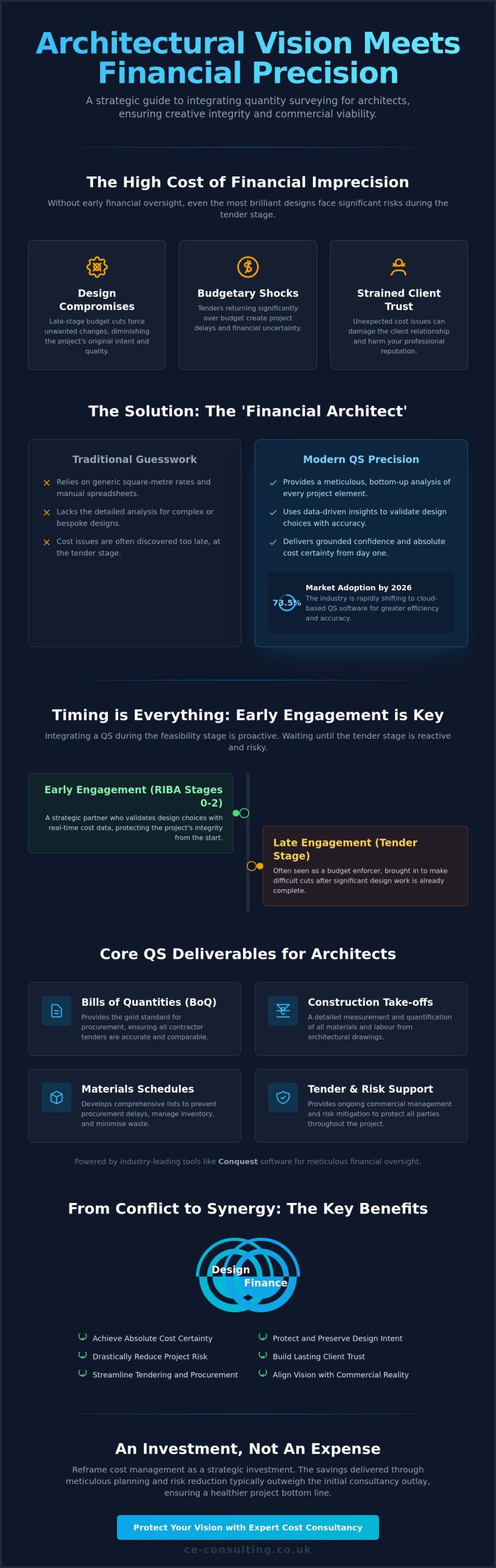
Integrating professional quantity surveying for architects from the concept stage provides the grounded confidence required to navigate these challenges. By moving away from manual processes and adopting cloud-based software, which now accounts for 73.5% of the market in 2026, you can achieve greater cost certainty. This article demonstrates how meticulous cost planning empowers you to deliver bold designs whilst maintaining absolute control over the project’s commercial viability. We will explore how data-driven validation and smoother tender processes ensure your design intent remains protected from the first sketch to the final handover.
Key Takeaways
- Understand how quantity surveying for architects acts as a strategic financial framework, aligning your creative vision with commercial reality from the earliest stages.
- Learn how proactive cost planning and value engineering protect your design intent from late-stage compromises and budgetary shocks.
- Discover why professional Bills of Quantities are the gold standard for procurement, ensuring all contractors provide comparable and accurate tender submissions.
- Reframe cost management fees as a strategic investment that builds client trust and typically delivers savings that outweigh the initial consultancy outlay.
- Explore the technical advantages of partnering with experienced consultants who use industry-leading tools like Conquest software to provide meticulous financial oversight.
What is Quantity Surveying for Architects?
Quantity surveying for architects is a strategic cost management service designed to align architectural vision with commercial reality. It isn’t merely about counting bricks or calculating floor areas. Instead, it serves as the financial framework that allows a design to flourish without exceeding the client’s budgetary constraints. Many architects find that as projects become more complex, the risk of financial misalignment grows. This has led to a significant shift where design firms increasingly outsource cost consultancy to dedicated specialists rather than attempting to manage complex estimates in-house.
To define What is a Quantity Surveyor? in a modern context, you should view them as a financial architect. They provide the same level of precision with numbers that you provide with space and form. Unlike a basic estimate, which often relies on generic square-metre rates, professional quantity surveying involves a meticulous, bottom-up analysis of every project element. This technical mastery ensures that the data driving your design decisions is both accurate and dependable. It provides a level of grounded confidence that a standard spreadsheet simply cannot replicate.
The Core Responsibilities of a Modern QS
A specialist surveyor manages the commercial health of a project through several critical functions. Their work begins with detailed cost planning, where they translate your initial concept into a viable financial model. This process involves several key deliverables:
- Production of accurate Bills of Quantities and detailed construction take-offs to ensure precise tendering.
- Developing comprehensive materials schedules that prevent procurement delays and waste.
- Providing ongoing tender support and commercial risk management to protect all parties.
This oversight creates a “safe pair of hands” that manages the financial complexities whilst you focus on the creative output. By outsourcing these tasks, you ensure that the project’s commercial viability is monitored with a serious, meticulous mindset.
When Should an Architect Engage a Surveyor?
Timing is everything. Engaging a surveyor during the feasibility stage is the most effective way to ensure cost control. Waiting until the tender stage is often too late; by then, significant design work has been completed, and any necessary cost-cutting can feel like a compromise on quality. By integrating quantity surveying for architects into the early RIBA Stages, you can validate design choices with data-driven insights. This proactive approach builds immense client trust, as it demonstrates a commitment to delivering their vision within a predictable financial structure. It turns the surveyor from a budget enforcer into a strategic partner who protects the project’s integrity from the first sketch to the final handover.
Key Benefits of Integrating Cost Consultancy into Architectural Design
Integrating quantity surveying for architects is not an admission of financial limitation. It is a strategic decision to fortify your creative process with technical rigor. When cost consultancy is embedded early, it transforms the relationship between design and finance from one of conflict to one of synergy. This integration ensures that the project remains commercially viable without sacrificing the aesthetic standards that define your practice. By aligning these two pillars, you create a project environment where ambitious design is supported by financial reality rather than hindered by it.
Achieving absolute cost certainty is the primary advantage of this partnership. By using detailed cost planning, you eliminate the guesswork that often plagues early-stage estimates. This precision reduces project risk and drastically lowers the potential for budget overruns during construction. For complex or high-end residential developments, including those sourced through specialist auctioneers like Auction Property Ltd, having a dedicated cost consultant provides the stability needed to progress with confidence. It also results in more streamlined procurement, as contractors receive higher-quality data, leading to more competitive and accurate tender returns.
Protecting Your Design Intent
A common fear amongst architects is the “slash-and-burn” approach to budget cutting often seen at the eleventh hour. Data-driven cost planning prevents this by identifying financial pressures before they become crises. Through proactive analysis, a quantity surveyor can suggest cost-effective material alternatives that maintain your desired aesthetic whilst aligning with the budget. Value engineering is a strategic tool for design preservation, not just cost reduction. It allows you to protect the core elements of your vision by optimising secondary components, ensuring the final build reflects your original intent. This foresight prevents the disheartening design compromises that usually occur when tenders come back significantly over budget.
Building Client Trust and Practice Reputation
Your reputation as an architect depends as much on your commercial awareness as it does on your design talent. Presenting accurate financial data at every project milestone demonstrates a level of professionalism that builds deep client trust. It reduces the likelihood of project abandonment; a scenario that is often devastating for both the client’s goals and your practice’s portfolio. By positioning yourself as a commercially savvy partner, you offer “reputational insurance” against the fallout of inaccurate early-stage estimates. Providing this level of financial security is essential for long-term stability and client satisfaction. For those seeking to enhance their project delivery through technical mastery, professional cost planning services provide the necessary foundation for success.
The Strategic Role of Bills of Quantities in Architectural Tenders
The tender stage is often where the most robust architectural visions face their greatest test. Without a precise framework for procurement, contractors are forced to interpret vague drawings, leading to inconsistent pricing and significant financial risk. A professional Bill of Quantities (BoQ) serves as the gold standard for construction procurement, providing a definitive document that translates your design into a structured list of items and quantities. By integrating quantity surveying for architects into the tendering process, you ensure that every contractor bids on a level playing field using identical data. This transparency eliminates the “guesswork” that often leads to vastly different tender returns.
Contractors naturally add a “risk premium” to their bids when faced with ambiguous tender documents. They do this to protect their own margins against unforeseen requirements or quantity discrepancies. A meticulous BoQ removes this ambiguity. When a contractor knows exactly what is required, they can price more competitively and with greater accuracy. This clarity is essential for maintaining the project’s commercial viability and ensures that the client isn’t paying a premium for uncertainty. For a deeper understanding of this process, you may wish to consult The Definitive Guide to Bills of Quantities (BoQ), which details the standards required for modern UK construction.
Comparing BoQs to Schedules of Works
Whilst a schedule of works provides a broad overview of tasks, it lacks the technical depth required for complex architectural projects. A professional Bill of Quantities provides a granular breakdown of materials and labour, which facilitates much easier valuation of design changes during the construction phase. If a client decides to alter a specification mid-build, the BoQ provides the pre-agreed rates needed to adjust the contract sum fairly. Contractors generally prefer tendering against detailed quantities because it reduces their administrative burden and provides a clear roadmap for the build, fostering a more collaborative project environment.
Using Take-offs to Inform Design Choices
Strategic quantity surveying for architects extends beyond the final tender document. Detailed construction take-offs are invaluable during the design development phase, as they allow you to assess the feasibility of specific elements before they’re finalised. Precise measurement identifies “cost hotspots” in a floor plan, such as particularly complex junctions or expensive material transitions that might otherwise go unnoticed. When specifying bespoke features, such as those from Countertops and Cabinetry By Design, having precise cost data ensures that high-end finishes remain viable. Automated take-offs reduce human error in complex geometries; this ensures that even the most intricate architectural forms are measured with absolute precision. This data-driven approach allows you to justify design choices to the client with technical evidence rather than mere intuition.
Overcoming the “Fee” Hurdle: Demonstrating Value to Clients
One of the most persistent challenges for any practice is justifying the appointment of an additional consultant. When clients are already managing significant professional fees, the introduction of another specialist can feel like an unnecessary burden. However, professional quantity surveying for architects should be positioned as a form of financial insurance. It’s a strategic investment in project security that protects the client’s capital from the volatility of the construction market. In many instances, the precision of a professional cost plan identifies efficiencies that save considerably more than the consultancy fee itself.
Meticulous cost management ensures that the architectural vision remains within the commercial envelope. By refining material choices and optimising procurement early, a surveyor prevents the need for expensive redesigns later in the project lifecycle. This grounded confidence is particularly valuable when presenting a project to a client for the first time. You aren’t just selling a design; you’re presenting a viable financial plan that respects their investment.
Independent vs Contractor-Led Estimating
Clients are frequently tempted by “free” estimates offered by building contractors. Whilst these might seem cost-effective initially, they often carry hidden costs and lack the necessary independence. Contractor-led estimates typically include opaque margins or inflated contingencies designed to protect the builder’s interests rather than the client’s budget. By contrast, a third-party quantity surveyor provides unbiased, technical advice that keeps the architect in control of the commercial narrative. This independence ensures that every pound spent is accounted for, preventing the gradual “scope creep” that can derail a project’s viability.
Risk Management as a Cost-Saving Exercise
True value in quantity surveying comes from identifying financial risks before they manifest as expensive problems on-site. A meticulous professional doesn’t just track costs; they anticipate them. By establishing a clear contingency strategy based on historical data and market trends, a surveyor provides a safety net for the project. This foresight is critical for maintaining the construction programme. The cost of a two-week delay on a high-end residential site can be staggering; a QS prevents these bottlenecks by ensuring cash flow is managed and valuations are accurate.
For projects requiring external finance, the presence of a qualified surveyor is often non-negotiable. Lenders and investors demand the grounded confidence provided by professional feasibility studies and detailed Bills of Quantities before approving funding. This level of technical oversight signals that the project is being managed with a serious, disciplined mindset. If you’re looking to bolster your project’s financial foundations, our tender support and cost planning services provide the technical mastery your clients expect.
Collaborating with Consulting Estimating Consultants: A Partnership for Precision
Choosing a consultancy partner requires a balance of technical expertise and shared values. At Consulting Estimating Consultants, we provide a “safe pair of hands” for architectural practices by leveraging over 100 years of combined professional experience. This extensive background allows us to approach every project with the steady, composed mindset necessary for high-stakes construction environments. Our role is to act as a seamless extension of your practice, providing the financial rigor that supports your creative output across the residential, commercial, and healthcare sectors. For commercial projects, such as office fit-outs involving Excel Business Environments Ltd, our cost management ensures the project remains viable from inception to completion.
Effective quantity surveying for architects is built on a foundation of reliability and absolute precision. We understand that your reputation is tied to the accuracy of the data we provide. By maintaining a meticulous focus on detail, we ensure that every Bill of Quantities or material schedule reflects the true commercial reality of the build. This disciplined approach ensures that your projects remain commercially viable from the feasibility stage through to final completion, instilling a sense of security in both you and your clients. For practices working on warehouse, manufacturing, or logistics facilities, our dedicated industrial project cost planning expertise provides the specialist financial oversight these complex builds demand.
Technical Mastery with Conquest Software
Precision in modern construction requires more than just experience; it demands the right tools. We utilise industry-leading Conquest Estimating software to deliver unmatched accuracy in our financial reporting. This software-driven approach is essential for managing complex architectural specifications where manual calculations often fall short. It ensures that every project complies with NRM2 and other critical industry standards, providing a level of grounded confidence that traditional methods cannot match. By automating the technical aspects of measurement, we focus our expertise on strategic cost advice and risk analysis, ensuring that your design intent is never compromised by calculation errors.
Tailored Support for Your Practice
Every practice operates differently, and our engagement models are designed to reflect that reality. Whether you require a one-off set of construction take-offs for a small residential extension or full cost planning for a large-scale healthcare facility, we offer flexible support tailored to your specific needs. Our goal is to help you deliver projects on time and within budget whilst protecting the design intent that makes your work unique. Consulting Estimating Consultants provides the technical mastery required to validate your design choices through data-driven cost planning.
Getting started with a professional cost plan is a straightforward process that begins with a serious discussion of your project goals. By integrating professional quantity surveying for architects into your workflow, you gain a partner dedicated to the financial success of your designs. Contact our team today to discuss your upcoming project and discover how our meticulous approach can provide the financial precision your clients demand.
Securing the Financial Future of Your Architectural Vision
Protecting the integrity of a design requires more than creative excellence; it demands a disciplined approach to financial management. By integrating professional quantity surveying for architects into your workflow, you transition from reactive cost-cutting to proactive value preservation. We’ve explored how meticulous cost planning and the strategic use of Bills of Quantities provide the technical framework necessary to navigate complex tenders with grounded confidence. This level of oversight ensures that your projects remain commercially viable whilst maintaining the high aesthetic standards your clients expect.
Our team brings over 100 years of combined industry experience to every partnership, utilising industry-leading Conquest Estimating software to deliver unmatched precision. Whether you are delivering ambitious residential developments, commercial hubs, or specialised healthcare facilities, we act as a safe pair of hands for your practice. It’s time to move beyond the uncertainty of late-stage budget shocks and embrace a future of absolute financial control. Partner with our expert quantity surveyors to secure your next project budget and ensure your architectural vision is delivered exactly as intended. We look forward to supporting your next success.
Frequently Asked Questions
Why should an architect recommend a quantity surveyor to their client?
Architects should recommend a quantity surveyor to provide independent financial oversight and protect the project’s commercial viability. This recommendation shifts the burden of cost management to a specialist, allowing the architect to focus on design whilst ensuring the client receives accurate, unbiased budget advice. It builds deep client trust and ensures that the project remains feasible from inception to completion, preventing the reputational damage caused by inaccurate early estimates.
What is the difference between a quantity surveyor and a construction estimator?
A quantity surveyor provides comprehensive commercial management throughout the project lifecycle, whereas a construction estimator typically focuses on initial cost projections for tendering. While estimators often work for contractors to win work, a quantity surveyor offers strategic advice on contracts, risk, and value management. This broader scope makes quantity surveying for architects a more holistic solution for long-term project stability and design preservation.
How does a quantity surveyor help during the design phase?
During the design phase, a surveyor provides iterative cost planning to ensure that every design choice aligns with the client’s budget. They identify expensive “cost hotspots” early, allowing for adjustments before significant time is invested in detailed drawings. This proactive approach prevents the need for disruptive redesigns later and ensures that the design intent remains protected through data-driven validation rather than mere intuition.
Can a quantity surveyor work with small-scale architectural practices?
Yes, quantity surveyors frequently support small-scale practices on bespoke residential projects; for instance, as you explore House Extensions for a client, budget control becomes critical to prevent overspending. Smaller projects often have tighter margins, making the precision of a professional cost plan even more vital. Flexible engagement models allow smaller firms to access high-level expertise for specific tasks, such as construction take-offs or tender support, without needing a full-time in-house specialist.
What information does a quantity surveyor need from an architect to start a cost plan?
To begin a cost plan, a surveyor typically requires initial concept drawings, site location details, and a clear brief regarding the client’s budget and quality expectations. As the project progresses, more detailed information such as structural designs and mechanical and electrical specifications will be necessary. Providing comprehensive data early allows for the creation of a more accurate and dependable financial framework that respects the project’s commercial constraints.
How does professional quantity surveying help with value engineering?
Professional quantity surveying for architects facilitates value engineering by identifying cost-effective material alternatives that don’t compromise the project’s aesthetics. Instead of arbitrary budget cuts, the surveyor uses technical data to optimise secondary components. This ensures that the primary design intent is preserved whilst achieving the necessary financial efficiencies required to keep the project on track and within the agreed budget.
Is it better to outsource quantity surveying or keep it in-house?
Outsourcing to a specialist consultancy is often superior as it provides access to a wider breadth of experience and industry-leading software like Conquest. Most architectural practices find that maintaining an in-house surveyor is cost-prohibitive and lacks the independent perspective required for unbiased advice. External consultants act as a “safe pair of hands,” offering flexible support that scales with your practice’s current project load and technical requirements.
How do quantity surveyors handle inflation and fluctuating material costs in 2026?
In 2026, surveyors manage inflation by utilising real-time market data to track nonresidential construction input prices, which saw a 12.6% annualised increase early in the year. They build robust contingency strategies into cost plans and advise on procurement routes that mitigate the risk of price hikes. This methodical approach provides clients with the grounded confidence needed to proceed with ambitious projects even in a volatile economic climate.