



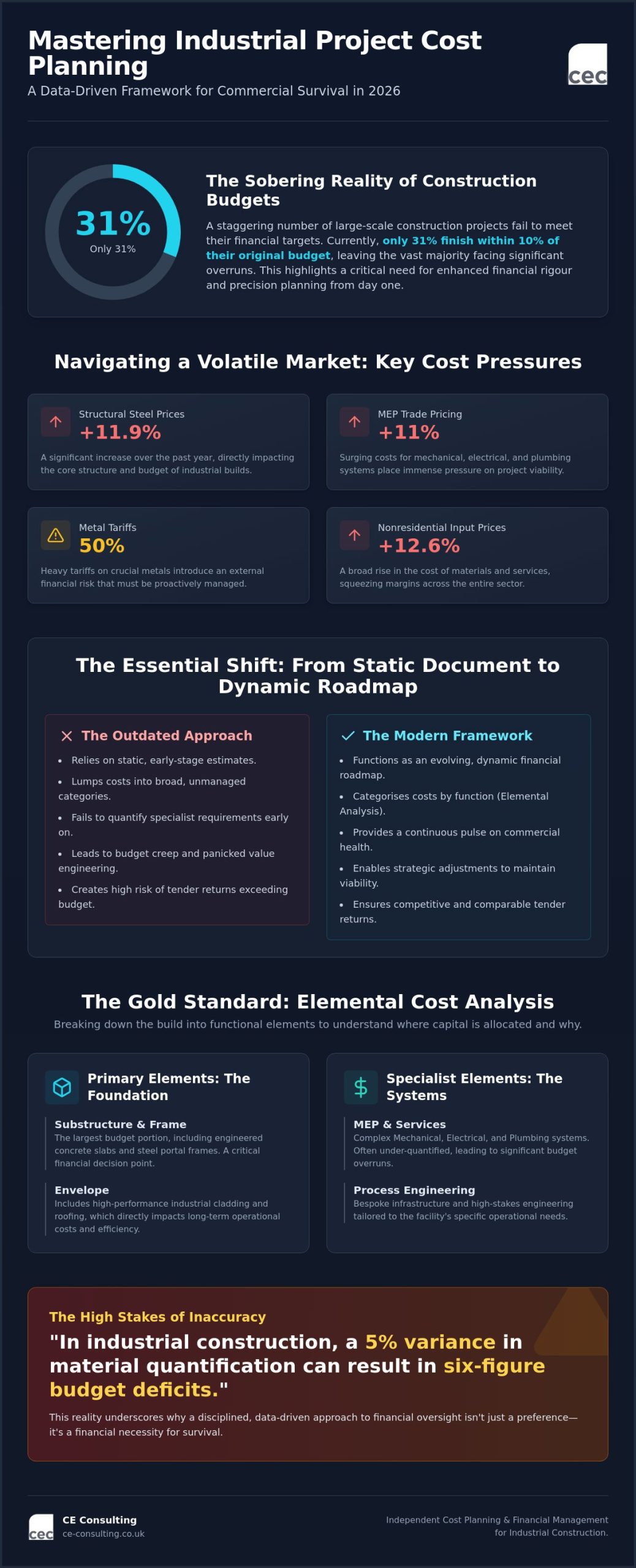
Only 31% of large-scale construction projects currently finish within 10% of their original budget. With structural steel prices rising by 11.9% and MEP trade pricing surging by 11% over the past year, the margin for error has effectively vanished. We recognise the significant pressure you face when managing volatile material costs and the intricate requirements of specialist industrial installations. Achieving precision in industrial project cost planning is no longer just a fiscal exercise; it’s a fundamental requirement for commercial survival in 2026.
This guide will help you master the complexities of industrial financial management to ensure your projects remain viable and strictly within budget. We’ll provide a clear framework for elemental cost analysis and show you how to gain greater financial control from the initial concept through to final completion. By the end of this article, you’ll have the data-driven strategies needed to improve your tender success rates and eliminate the uncertainty that often plagues the early stages of a development. We’ll explore how to mitigate risks associated with the 50% tariffs on metals and the 12.6% rise in nonresidential input prices, providing you with a steady hand in a volatile market.
Key Takeaways
- Understand why shifting from static documents to a dynamic roadmap is essential for maintaining financial rigour in complex industrial builds.
- Learn to apply elemental cost analysis to categorise expenses by functional elements; this provides a more accurate reflection of project requirements.
- Discover how transitioning to detailed Bills of Quantities ensures granular data for more competitive and comparable tender returns.
- Master strategies for industrial project cost planning to effectively mitigate risks associated with volatile material prices and market fluctuations.
- Identify the strategic advantage of partnering with specialist consultants to provide an independent, technical second pair of eyes on your project finances.
The Strategic Value of Industrial Project Cost Planning in 2026
Industrial project cost planning isn’t a static document gathered at the start of a build. Rather, it serves as a dynamic financial roadmap that evolves alongside the project’s technical specifications, providing a continuous pulse on commercial health. Whilst a residential project might focus on standard finishes and repeatable units, industrial developments involve bespoke infrastructure and high-stakes engineering. This distinction is why industrial builds require a significantly higher level of financial rigour. Every decision, from the choice of structural frame to the specification of floor loadings, carries a substantial price tag that must be managed with meticulous care.
Securing early-stage cost advice is the most effective way to protect a developer’s initial investment. By engaging with a quantity surveyor during the concept phase, you establish a baseline of commercial viability before a single spade hits the ground. These professionals apply Cost Engineering Principles to forecast expenditure with a level of detail that generic estimates simply cannot match. This foresight allows for strategic adjustments when the data suggests a design path is becoming commercially unsustainable.
Why Industrial Projects Demand Specialist Cost Frameworks
The sheer scale of modern logistics hubs and manufacturing plants introduces complexities that standard cost models often fail to capture. Specialist cost frameworks are essential because they identify potential “deal-breakers”, such as inadequate power supply or unforeseen ground remediation costs, before significant capital is committed. We often see a tension between “top-down” estimating, which sets a budget based on high-level goals, and “bottom-up” approaches that build costs from individual components. In an industrial context, a hybrid approach is vital to ensure that the broad vision remains anchored in technical reality.
The Consequences of Poor Financial Planning in Construction
Inaccurate initial estimates create a dangerous ripple effect that often doesn’t surface until the tender phase. When tender returns come back significantly higher than the initial cost plan, it’s usually because specialist requirements like heavy-duty HVAC systems or high-tolerance flooring were never properly quantified. These unquantified elements lead to panicked value engineering and project delays. Precision isn’t just a preference; it’s a financial necessity. “In industrial construction, a 5% variance in material quantification can result in six-figure budget deficits.” This reality underscores why a disciplined approach to financial oversight is the only way to maintain control over large-scale developments.
Elemental Cost Analysis: Breaking Down the Industrial Build
Elemental cost analysis represents the gold standard for managing large-scale developments. Rather than simply listing materials, this method categorises expenditure by functional elements, such as the frame, envelope, or internal services. This structure allows developers to understand exactly where capital is being allocated and how each component contributes to the building’s operational performance. Effective Project Cost Planning and Control relies on this level of detail to prevent the budget creep that often occurs when costs are lumped into broad, unmanaged categories.
Primary Elements: Substructure, Frame, and Envelope
The substructure and frame often represent the largest portion of the budget in large-span industrial buildings. Reinforced concrete slabs must be engineered to withstand specific floor loadings, making them a primary cost driver. With structural steel prices having increased by 11.9% according to 2025 data, the choice between traditional steel portal frames and hybrid structural systems has become a critical financial decision. High-performance industrial cladding and roofing systems also require careful quantification, as their thermal performance directly impacts long-term operational costs. Precision in these early stages ensures that the fundamental skeleton of the project remains commercially viable.
Specialist Elements: MEP and Process Engineering
Modern industrial facilities are increasingly defined by their internal complexity. Mechanical, Electrical, and Plumbing (MEP) services now frequently account for a disproportionate share of the total budget, particularly in manufacturing plants with high-voltage distribution needs. MEP trade pricing has seen an increase of approximately 11% over the last 12 months, making it vital to account for complex power requirements and fire suppression systems early on. The same MEP complexity that challenges industrial builds is equally critical in regulated environments; developers expanding into the healthcare sector will find that hospital extension cost planning demands an even more rigorous approach to quantifying clinical MEP requirements. When you utilise professional construction cost planning services, these specialist elements are integrated into the financial model from the outset.
Accounting for automated racking systems and specialist plant equipment is equally important. These aren’t merely fit-out items; they often dictate the structural requirements of the building itself. If you’re currently reviewing a complex proposal, you might find it beneficial to assess your current cost plan against these elemental benchmarks to ensure no specialist requirement has been overlooked. A meticulous industrial project cost planning exercise ensures that every functional element, no matter how technical, is fully quantified and protected against market volatility.
From Concept to Tender: Transitioning to Detailed Bills of Quantities
The transition from a high-level elemental cost plan to a detailed Bill of Quantities (BoQ) marks a critical shift in the project lifecycle. Whilst the initial stages of industrial project cost planning focus on feasibility and broad budget allocations, the procurement phase requires a much finer level of detail. A BoQ translates the design intent into a comprehensive list of items, quantities, and specifications. This document serves as the foundation for competitive tendering, ensuring that every contractor is pricing the exact same scope of work. Without this granular data, developers risk receiving incomparable tender returns that are difficult to equalise and often hide significant financial gaps.
In the UK industrial sector, adhering to professional measurement standards such as NRM2 is essential for maintaining consistency. These rules provide a standardised framework for the measurement of building works, which is particularly vital for the complex installations found in modern manufacturing and logistics facilities. When contractors receive a vague specification, they often include “tender padding” to mitigate their own risk against unquantified items. By providing accurate take-offs and a structured BoQ, you eliminate this ambiguity, leading to more transparent pricing and higher tender success rates.
The Five Steps of Industrial Procurement Planning
Achieving financial certainty during the tender phase requires a methodical approach to data preparation. We follow a structured progression to ensure every material and labour requirement is accounted for:
- Step 1: Finalise the elemental cost plan based on the developed design at RIBA Stage 3 to lock in the project’s commercial parameters.
- Step 2: Conduct detailed digital take-offs using technical drawings to ensure every cubic metre of concrete and tonne of steel is precisely measured.
- Step 3: Produce a comprehensive Bill of Quantities that provides a clear, itemised breakdown of the entire build.
- Step 4: Align the BoQ with the project schedule and current material lead times to identify potential inflationary pressures.
- Step 5: Issue the finalised documentation for tender and perform a rigorous analysis of returns to ensure full commercial alignment.
Leveraging Conquest Estimating Software for Industrial Precision
Relying on manual spreadsheets in complex industrial projects is a significant risk factor that can lead to catastrophic calculation errors. Modern industrial project cost planning demands a more robust solution. We utilise specialised platforms to manage the vast datasets involved in large-span constructions. Utilising industry-leading software like Conquest ensures that every material schedule is grounded in technical reality, not just estimation.
Conquest software allows us to run rapid “what-if” scenarios, enabling you to see the immediate financial impact of changing a material specification or structural system. This level of responsiveness is vital when navigating the volatile market conditions of 2026. It provides an audit trail of every quantity, giving both developers and lenders the confidence that the project’s financial foundation is secure and meticulously verified.
Mitigating Financial Risk: Addressing Market Volatility and Contingencies
Industrial project cost planning is the primary safeguard against the persistent volatility of the UK construction market. In 2026, material price fluctuations for structural steel, timber, and high-performance insulation continue to challenge even the most experienced developers. A robust cost plan doesn’t just list current prices; it incorporates sophisticated forecasting for price inflation and market risk. This foresight ensures that the project remains commercially viable even if market conditions shift during the construction phase. By accounting for the 11.9% increase in structural steel prices seen in 2025 and the projected 10-12% rise in HVAC equipment costs, you can build a more resilient financial foundation, which is further strengthened by the specialised tax and regulatory services provided by CiDATax SRL for developers with international interests.
It’s vital to differentiate between design and construction contingencies. Design contingency accounts for the natural evolution of technical drawings during the pre-construction phase, whilst construction contingency is reserved for unforeseen site conditions or logistical delays. Managing provisional sums for specialist industrial sub-contracts, such as automated racking or bespoke process engineering, requires a disciplined approach. These placeholders must be grounded in realistic market data to ensure they don’t become budget-breaking liabilities as the design matures.
Strategies for Managing Material Price Inflation
Early procurement of key industrial components can effectively hedge against future price hikes. Fixed-price agreements provide certainty, but they often require a higher initial commitment and earlier capital outlay. Alternatively, fluctuation clauses in contracts allow for price adjustments based on industry indices, sharing the risk between the client and contractor. If the initial budget is exceeded, value engineering should be used to re-align costs. This process involves identifying alternative materials or construction methods that provide the same functional performance at a lower cost, rather than simply reducing the project’s scope.
Allocating Realistic Contingency Funds
Calculating contingency isn’t a matter of applying a flat percentage across the board. It requires a structured framework based on project complexity, site conditions, and the level of design detail available. Engaging a professional quantity surveying consultancy UK provides the objective oversight needed to establish a realistic risk register. This document tracks every potential financial threat, from ground remediation issues to supply chain delays for specialist plant. A well-managed risk register ensures that your contingency funds are appropriately allocated and only spent when absolutely necessary.
If you are concerned about the impact of market volatility on your current development, you can book a consultation for a detailed cost plan audit to ensure your risk mitigation strategies are fit for purpose.
Partnering for Precision: Why Specialist Consultancy is Essential
The complexity of modern industrial builds means that internal teams often face a significant burden when attempting to manage every financial variable. Independent, technical cost consultancy provides the necessary distance to perform an objective assessment of a project’s commercial health. By engaging an external estimator, you gain an unbiased “second pair of eyes” that can identify discrepancies or omissions before they manifest as costly site variations. This independent oversight is a fundamental component of effective industrial project cost planning, ensuring that every figure is verified against current market conditions rather than optimistic historical averages.
Outsourcing the production of Bills of Quantities and material schedules to technical experts allows your core team to focus on design and delivery. Precision in these documents is non-negotiable. As we explored in previous sections, even a minor error in a concrete take-off or a steel schedule can lead to significant budgetary deficits. When these tasks are handled by specialists, the resulting data is more granular and reliable, providing a stable platform for the entire pre-construction phase. This methodical approach to financial documentation ensures that the project’s commercial viability is protected from the concept stage through to the final account.
Supporting Architects with Financial Precision
Architects often find themselves caught between ambitious design goals and the hard reality of a client’s budget. Specialist cost planning allows architects to protect their design intent without compromising on financial rigour. By integrating quantity surveying for architects into the workflow, you create a collaborative environment where creative vision and commercial reality are aligned. Cost consultants act as a vital bridge, providing the data needed to justify specific design choices whilst ensuring the project remains within its defined fiscal parameters. For practices seeking a comprehensive approach to financial oversight, understanding the full scope of construction estimating for architects UK is an essential step towards protecting both design integrity and professional indemnity.
The “Safe Pair of Hands” Approach to Industrial Projects
At Consulting Estimating Consultants, we bring over 100 years of combined experience to every development we support. We understand that in the industrial sector, reliability is just as important as technical mastery. Our commitment to meticulous detail ensures that every material take-off and cost plan we produce is grounded in accuracy. We position ourselves as a “safe pair of hands” for developers and contractors who cannot afford the risks associated with vague or unverified financial data. Our steady, composed approach aims to instill a sense of security and financial control in every client we partner with.
Precision in the pre-construction phase is the only way to achieve long-term project stability in the volatile market of 2026. If you require a partner who values discipline and technical excellence, we invite you to contact Consulting Estimating Consultants for professional industrial cost planning. Our team is ready to provide the strategic oversight and detailed documentation needed to ensure your next large-scale project is a commercial success.
Securing Commercial Viability in a Volatile Industrial Market
Navigating the complexities of the current construction landscape requires a shift from static estimates to dynamic financial roadmaps. By adopting elemental cost analysis and transitioning to detailed Bills of Quantities, you eliminate the ambiguity that often leads to tender padding and budget overruns. Precise industrial project cost planning is the only reliable method to protect your capital against rising input prices and ongoing material volatility. It’s a strategic necessity that ensures every technical specification is grounded in commercial reality from the very first concept.
At Consulting Estimating Consultants, we provide the technical rigour needed to maintain absolute financial control. With over 100 years of combined professional experience and mastery of Conquest Estimating software, our team offers specialist expertise across the industrial, healthcare, and education sectors. We act as a dependable partner, ensuring your project’s financial foundation is as robust as its physical structure. Ensure your project’s commercial viability with professional cost planning from Consulting Estimating Consultants. With the right strategic oversight, you can approach your next large-scale development with grounded confidence and certainty.
Frequently Asked Questions
What is the primary difference between a cost estimate and an industrial cost plan?
A cost estimate is a static calculation of anticipated expenditure at a single point in time. In contrast, an industrial cost plan is a dynamic financial roadmap that evolves with the design to maintain commercial viability. It incorporates risk analysis, inflation forecasting, and elemental breakdowns to provide continuous oversight. This proactive approach allows developers to adjust specifications before capital is committed, ensuring the project remains within the defined budgetary parameters throughout its lifecycle.
At what RIBA stage should industrial project cost planning begin?
Industrial project cost planning should ideally commence at RIBA Stage 1 (Preparation and Briefing) or at the latest by Stage 2 (Concept Design). Engaging a consultant early allows for the establishment of a realistic budget before significant design work is undertaken. This early-stage advice identifies potential financial “deal-breakers”, such as inadequate utility capacity or ground conditions, protecting the developer’s initial investment and ensuring that the creative vision remains anchored in commercial reality.
How much contingency should be allowed for a large-scale industrial warehouse project?
Contingency allowances for large-scale industrial warehouses typically range between 5% and 10% of the total construction cost. The specific percentage depends on the project’s complexity, site conditions, and the maturity of the design. A robust cost plan differentiates between design contingency for pre-construction refinements and construction contingency for unforeseen site issues. This structured allocation ensures that funds are available for genuine risks without unnecessarily inflating the initial investment or restricting capital flow.
Why is Elemental Cost Analysis preferred over traditional estimating for factories?
Elemental Cost Analysis is preferred because it categorises expenditure by functional elements, such as the frame or services, rather than just materials. This is vital for factories where Mechanical, Electrical, and Plumbing (MEP) requirements often represent a disproportionate share of the budget. By breaking costs down elementally, developers can better understand how specific technical requirements impact the overall finances. It provides a more accurate reflection of the building’s operational needs compared to traditional methods.
Can professional cost planning help in securing project finance from UK lenders?
Professional cost planning is instrumental in securing project finance from UK lenders as it demonstrates a disciplined approach to risk mitigation. Banks and institutional investors require a high degree of cost certainty before approving funding for large-scale industrial developments. A detailed cost plan, backed by technical expertise and market data, provides the reassurance that the project is commercially viable. It shows that the developer has a meticulous strategy for managing inflation and unforeseen expenditure.
What role does Conquest software play in ensuring the accuracy of an industrial cost plan?
Conquest software serves as the technical engine for ensuring precision within an industrial cost plan. It allows consultants to manage vast datasets and perform rapid “what-if” scenarios, such as comparing the financial impact of different structural systems. The software eliminates the risk of human error associated with manual spreadsheets and provides a transparent audit trail. This level of technical rigour is essential for maintaining accuracy in large-span projects with complex material schedules and specialist installations.
How does an industrial cost plan account for specialist MEP and plant requirements?
An industrial cost plan accounts for specialist MEP and plant requirements by integrating these elements into the financial model from the outset. Rather than using generic allowances, consultants use current market data and technical specifications to quantify high-voltage distribution, automated systems, and fire suppression. When specific details are unavailable, realistic provisional sums are used. This ensures that these high-value components are properly funded and don’t cause budget deficits as the technical design matures.
Is it better to manage cost planning in-house or outsource to a specialist consultancy?
Outsourcing to a specialist consultancy is generally superior due to the requirement for independent oversight and technical mastery. External consultants provide an unbiased “second pair of eyes” and possess deep experience across diverse industrial sectors. They also provide access to sophisticated estimating software and current market intelligence that may not be available in-house. This partnership ensures a “safe pair of hands” approach, allowing architects and developers to focus on delivery whilst maintaining absolute financial control.