



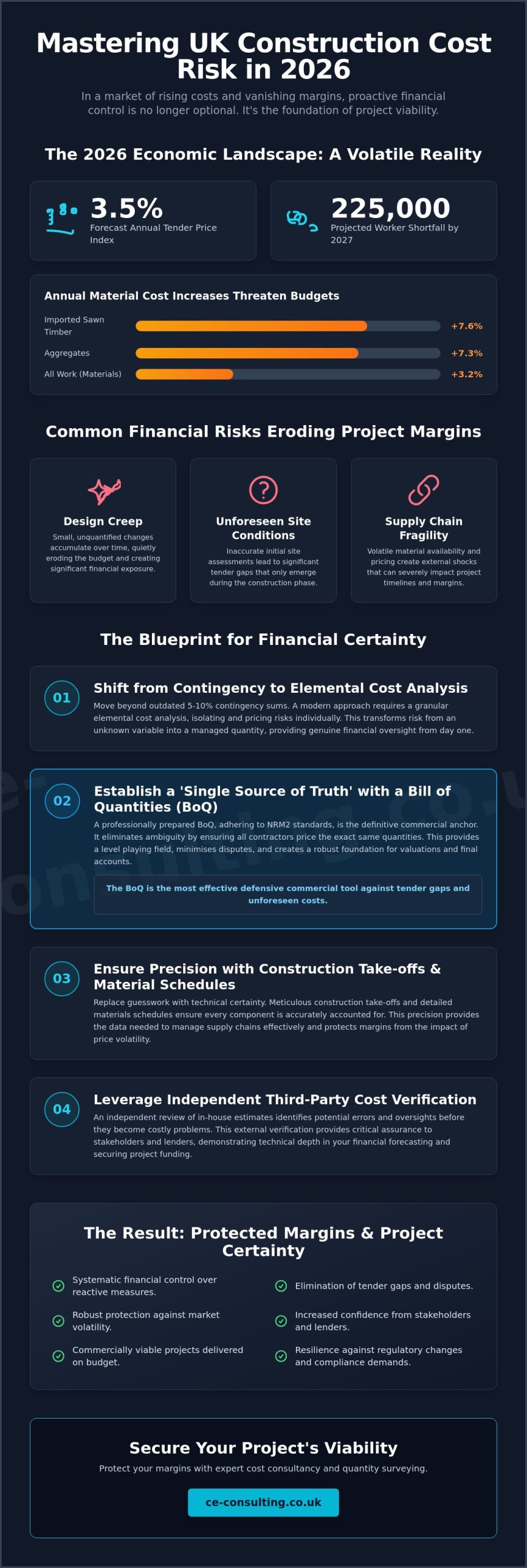
With the annual Tender Price Index forecast at 3.5% for 2026 and material costs for “All Work” already climbing by 3.2%, the margin for error in your project budget has effectively vanished. It’s a reality most developers and contractors know well; yesterday’s estimates are no longer enough to secure today’s project viability. In an environment where imported sawn timber costs have risen by 7.6% in a single year, effective construction cost risk management UK wide now requires more than just a contingency fund. It demands absolute technical precision.
We understand that unpredictable inflation and tender gaps are keeping you from the financial certainty your stakeholders require. This guide will show you how to master these complexities through precise quantification, strategic cost planning, and expert quantity surveying. We’ll explore how to navigate the standalone Building Safety Regulator’s requirements and build robust tender documentation that minimises your financial exposure. By the end of this article, you’ll have a clear strategy to ensure your 2026 projects remain both commercially viable and resilient against market volatility.
Key Takeaways
- Learn how to navigate the 2026 economic landscape by implementing proactive construction cost risk management UK strategies that prioritise systematic financial control over reactive measures.
- Discover how a professionally prepared Bill of Quantities provides a definitive “single source of truth” to eliminate tender gaps and ensure every material component is precisely accounted for.
- Master the transition from simple contingency sums to sophisticated elemental cost analysis, allowing for the precise quantification of risk at every project stage.
- Understand the commercial value of independent third-party cost verification in identifying potential estimating errors before they impact your project’s bottom line.
- Explore how tailored tender support and meticulous materials schedules can secure project viability and protect margins amidst evolving regulatory requirements.
Understanding Construction Cost Risk Management in the UK Market
In the current commercial environment, construction cost risk management UK is defined by the systematic identification and mitigation of financial uncertainty. It’s no longer sufficient to treat risk as a vague “unknown” to be covered by a broad contingency sum. Instead, successful project delivery relies on the rigorous application of cost engineering principles to quantify every variable before a spade hits the ground. This methodical approach ensures that financial control remains with the developer, rather than being dictated by market fluctuations.
The UK construction sector in 2026 presents a complex picture of growth tempered by volatility. Whilst total output grew by 1.5% in March 2026, the industry continues to grapple with a Tender Price Index (TPI) averaging 3.5%. This inflation, coupled with a projected shortfall of 225,000 workers by 2027 according to CITB data, means that labour and material costs are moving targets. Relying on traditional 5% or 10% contingency percentages is a precarious strategy. Modern projects require a more granular level of oversight where risks are isolated, priced, and managed individually. The relationship between your chosen procurement strategy and your ultimate financial exposure has never been more direct.
The 2026 Economic Landscape for UK Developers
Material price volatility remains a primary concern for developers. For instance, sawn timber prices rose by 7.6% in the year leading to February 2026, whilst aggregates saw a 7.3% increase. These aren’t just statistics; they’re direct threats to project viability. The full independence of the Building Safety Regulator (BSR) as of January 2026 has also introduced stricter compliance pathways. Precise early-stage cost advice is now a prerequisite for securing project funding, as lenders demand evidence of technical depth in financial forecasting before releasing capital. Accuracy at this stage isn’t optional; it’s the foundation of project solvency.
Common Financial Risks in Major Developments
Financial exposure often stems from three critical areas: design creep, unforeseen site conditions, and supply chain fragility. Design creep can quietly erode a budget as small, unquantified changes accumulate over time. Similarly, inaccurate initial site assessments lead to significant tender gaps that only emerge during the construction phase. Managing these risks requires meticulous Construction Take-offs and Materials Schedules to ensure that the “knowns” are as accurate as possible. In a market where supply chains remain fragile, this level of detail provides the reassurance that margins are protected from sudden external shocks. It’s about replacing guesswork with technical certainty.
The Critical Role of Bills of Quantities in Mitigating Risk
In the context of construction cost risk management UK, the Bill of Quantities (BoQ) acts as the definitive commercial anchor for any major development. It transforms abstract design intent into a tangible materials schedule, ensuring that every stakeholder operates from a single source of truth. By adhering to NRM2 standards, a professional BoQ eliminates the ambiguity that often leads to protracted disputes. It provides a level playing field during the procurement phase, where contractors price the same quantities rather than interpreting drawings in isolation. This consistency is vital for maintaining the integrity of the tender process.
This transparency extends beyond the initial appointment into interim valuations and final account negotiations. When a project is broken down into its constituent parts, from the volume of concrete to the specific number of fixings, assessing progress becomes a mathematical exercise rather than a subjective negotiation. Aligning your project documentation with the UK government cost estimating guidance ensures that your financial reporting remains robust and defensible. This level of detail is exactly what protects your margins when market volatility strikes. To ensure your project documentation meets these rigorous standards, professional Bills of Quantities are essential.
BoQ as a Defensive Commercial Tool
A meticulously prepared BoQ prevents “front-loading,” a practice where contractors assign higher values to early-stage work to improve their cash flow at the developer’s risk. Detailed measurement also limits the scope for costly variations. In UK commercial law, standardised measurement provides a clear framework for resolving claims, making it much harder for costs to spiral due to minor design adjustments. It’s a shield against the “death by a thousand cuts” that unquantified variations represent. It ensures that any changes are priced at the agreed rates, maintaining budget control throughout the construction phase.
Technical Precision: Beyond Simple Take-offs
Rough estimates are the primary cause of tender gaps. Whilst a basic take-off might capture the main elements, it often misses the technical nuances that drive up costs in high-density residential projects or complex commercial builds. Integrating precise materials schedules into your procurement workflow ensures that every hour of labour and every nut and bolt is accounted for. This technical depth is what separates a successful development from one plagued by financial exposure. It’s about replacing broad assumptions with verified data to secure project viability.
Strategic Cost Planning: Moving Beyond Contingency Sums
Strategic cost planning represents a fundamental shift in how developers approach financial security. It’s about replacing the blunt instrument of a generic contingency percentage with a surgical approach to risk. This process begins at the feasibility stage and continues until the final account is settled, ensuring that commercial discipline is maintained throughout the project lifecycle. By utilising elemental cost analysis, we break a project into manageable components. This allows for a more nuanced understanding of where financial exposure lies, rather than burying potential issues in a broad budget line. Adhering to RICS cost analysis and benchmarking standards ensures that every project is measured against historical data and industry norms, providing a robust foundation for all financial decisions.
A critical aspect of this discipline is the distinction between value engineering and simple cost-cutting. Cost-cutting often involves removing quality to reduce immediate spend, which can lead to long-term maintenance issues or reduced asset value. Value engineering, however, is a strategic exercise. It seeks to achieve the same functional requirements at a lower cost through smarter design or more efficient material selection. This is where the quantity surveyor acts as a dependable guide, ensuring that construction cost risk management UK strategies are applied to protect the project’s commercial viability without compromising its core objectives.
Cost Planning for Residential and Commercial Sectors
Different sectors demand bespoke cost frameworks. For large-scale residential developments, current costs for detached homes range between £2,000 and £2,800 per m², whilst high-rise apartments can exceed £4,000 per m². Managing these variables requires a robust elemental breakdown. In contrast, retail and healthcare fit-outs often operate on fast-track schedules where the primary risk is time-related cost escalation. Education projects, typically costing between £2,200 and £2,800 per m², require unique frameworks that account for specific operational requirements and fixed funding limits. Each sector has its own “red flags” that must be identified early to prevent budget creep.
Proactive Budget Monitoring and Reporting
Effective financial control relies on a disciplined reporting cycle that prioritises foresight over hindsight. This involves establishing a monthly cost reporting cycle to track variances against the original cost plan in real-time. By identifying anomalies in subcontractor tenders, such as unusually low prices that suggest a lack of technical depth, we can mitigate risks before they manifest on site.
- Establishing a monthly cost reporting cycle to track variances against the original cost plan in real-time.
- Identifying anomalies in subcontractor tenders, such as unusually low prices that suggest a lack of technical depth or a misunderstanding of the scope.
- Linking cost plans directly to project milestones to ensure that cash flow remains predictable and secure for all parties.
Early identification of these issues allows for corrective action before they impact the project’s bottom line. It’s about being proactive rather than reactive, ensuring that the project stays within its financial parameters from commencement to completion.
To ensure your broader business finances are as precisely managed as your project budgets, you can visit Switch My Books for professional advice on migrating to more efficient accounting software.
In-House Estimating vs. Specialist Cost Consultancy
The choice between maintaining an internal estimating department and engaging a specialist consultancy is a fundamental strategic decision. In-house teams often face the challenge of balancing day-to-day operations with the intense technical requirements of modern construction cost risk management UK projects. Hidden costs, such as training, software licensing, and the financial impact of missed errors, often exceed the fees of an external partner. Independent, third-party cost verification acts as a fail-safe. It provides an objective assessment of project viability; this ensures that the financial foundation is robust enough to withstand the scrutiny of lenders and stakeholders alike.
Scalability is another critical factor. Internal overheads remain fixed regardless of your tender pipeline. Engaging a consultancy allows you to manage tender peaks effectively without the long-term commitment of increasing permanent headcount. This flexible approach ensures that you don’t pay for idle capacity during quieter periods. It’s a methodical way to maintain commercial discipline whilst keeping your business lean and responsive to market opportunities.
In the same way that specialist cost consultants protect your project margins, professional accountants safeguard your broader business health; to manage your tax returns effectively, check out Stewart Accounting Services.
The “Safe Pair of Hands” Argument
Engaging a consultant with over 100 years of combined industry experience offers more than just technical data; it provides peace of mind. This deep institutional knowledge is invaluable when navigating the complexities of the current UK market. By delegating the commercial heavy lifting to specialists, you alleviate the pressure on architects and project managers. They shouldn’t be expected to manage granular financial risk whilst overseeing design and site delivery. Our role is to act as a dependable guide, providing the grounded confidence needed to move projects from the feasibility stage to a successful final account.
Leveraging Technical Mastery and Software
Precision in 2026 is driven by technology. Whilst many in-house teams still rely on manual spreadsheets, we utilise advanced software like Conquest Estimating to ensure absolute consistency across complex tenders. Digital take-offs remove the inherent risks of manual measurement, providing a level of accuracy that protects your margins. This software allows us to generate detailed materials schedules and Bills of Quantities that contractors can trust implicitly. It eliminates the need for contractors to add “risk premiums” to their bids due to vague documentation. If you are looking to secure this level of technical rigour, our specialist tender support provides the data-led certainty your project requires.
Securing Project Viability with Consulting Estimating Consultants
At Consulting Estimating Consultants, we translate the high-level strategies of construction cost risk management UK into granular, project-specific workflows. Our meticulously prepared Bills of Quantities do more than just list materials; they act as a commercial safeguard for your margins. By providing main contractors and developers with documentation of the highest technical depth, we ensure that every project is built on a foundation of commercial reality. Precision is our baseline, and our national reach allows us to support developments across the country with a steady, experienced hand.
We understand that the stakes of the industry require more than just clerical accuracy. Our approach is designed to instill a sense of security in our clients, acting as a seasoned partner who approaches every task with a serious, meticulous mindset. This professional oversight is what allows our clients to maintain control over their budgets whilst navigating the evolving regulatory and economic landscapes of 2026.
Our Comprehensive Suite of Cost Services
We provide a full spectrum of consultancy services tailored to the specific needs of modern construction projects. This comprehensive approach supports architects in delivering ambitious designs whilst maintaining strict budgetary control. Our proven success across diverse sectors ensures that we understand the unique commercial pressures of each project type.
- Detailed Construction Take-offs and Materials Schedules that provide contractors with data they can trust implicitly.
- Strategic Cost Planning that moves beyond simple estimates to provide a granular analysis of elemental risks.
- Specialist Tender Support for main contractors, ensuring that bids are both competitive and commercially viable.
Partnering for Long-Term Commercial Success
The technical production of our cost plans is a strategic asset for your business. It allows you to approach lenders and stakeholders with evidence-based forecasts, reducing the perceived risk of your development. We don’t believe in broad assumptions; instead, we offer the disciplined oversight required to manage the high stakes of the industry. It’s about providing a safe pair of hands that values long-term stability and meticulous detail above all else.
Starting your next project with this level of financial confidence is the most effective way to ensure its eventual success. To secure your project’s future, enquire about our professional BoQ and estimating services today.
Securing Financial Control for Your 2026 Projects
Mastering construction cost risk management UK projects requires a shift from broad estimates to technical precision. We’ve explored how a professionally prepared Bill of Quantities acts as a commercial shield; it eliminates the tender gaps that erode project margins. By replacing generic contingency sums with elemental cost analysis, you gain the foresight needed to navigate a volatile market with grounded confidence. This disciplined approach ensures that financial control remains firmly in your hands throughout the construction phase.
Our team brings over 100 years of combined professional experience to your development. As specialists in Conquest Estimating software, we provide national UK coverage across all major sectors, ensuring your data is both accurate and defensible. This level of technical mastery is what transforms a safe pair of hands into a strategic commercial asset. It’s time to move beyond the uncertainty of manual spreadsheets and secure the financial viability of your next build. To take the first step towards total budget certainty, please Request a Professional Quote for your Bills of Quantities. We look forward to helping you deliver your project with complete commercial discipline and peace of mind.
Frequently Asked Questions
What is the most significant cost risk in UK construction today?
Material price volatility and labour scarcity are the primary financial risks facing the sector in 2026. The “All Work” material price index rose by 3.2% in April 2026, whilst the CITB forecasts a shortfall of 225,000 workers by 2027. These factors make construction cost risk management UK projects particularly challenging without precise, data-led quantification to protect margins from sudden market shifts.
How does a Bill of Quantities reduce financial risk for a developer?
A Bill of Quantities (BoQ) reduces risk by providing a standardised materials schedule that serves as a “single source of truth” for all tendering parties. It ensures that every contractor prices the exact same scope, which eliminates the tender gaps that often lead to costly disputes. It also serves as a defensive tool against contractor front-loading, ensuring that interim valuations remain fair and transparent.
Can I outsource my estimating and still maintain control over my project?
Outsourcing your estimating to a specialist consultancy actually enhances your control by providing an independent, objective verification of project costs. It offers a “safe pair of hands” that is free from internal operational bias. This approach allows you to manage tender peaks effectively whilst maintaining a lean business model, as you aren’t burdened by the fixed overheads of a permanent internal department.
What is the difference between cost planning and estimating?
Estimating is the process of calculating the likely cost of a project at a specific point in time, usually for a tender or bid. Cost planning is a broader, strategic discipline that manages the budget throughout the entire project lifecycle. It involves breaking the project into elemental risks and utilises benchmarking to ensure commercial viability remains intact from the initial feasibility stage to the final account.
How does Conquest software improve the accuracy of construction tenders?
Conquest software eliminates the inherent risks and inconsistencies associated with manual spreadsheets. It ensures absolute technical rigour across complex tenders by utilising digital take-offs and standardised measurement protocols. This technical mastery provides contractors with data they can trust implicitly, which reduces the need for them to add high risk premiums to their bids due to vague documentation.
Why should residential developers hire an independent quantity surveyor?
Independent quantity surveyors provide the financial rigour necessary to protect a residential developer’s margins in an uneven market. With detached residential costs reaching up to £2,800 per m² in 2026, even minor quantification errors can be catastrophic for project solvency. A specialist ensures that every technical requirement and regulatory compliance cost is precisely accounted for before any capital is committed.
What role does the architect play in construction cost risk management?
Architects are responsible for managing design-related risks and ensuring the project meets the client’s aesthetic and functional requirements. However, they aren’t commercial specialists. A quantity surveyor supports the architect by providing the granular financial oversight needed to deliver these designs within strict budgetary constraints, preventing design creep from eroding the original project budget.
How often should a construction cost plan be updated?
A cost plan should be updated on a monthly basis to maintain effective commercial discipline. Establishing a regular reporting cycle allows you to track variances against the original budget in real-time. This frequency is essential for identifying “red flags” in subcontractor tenders early, ensuring that construction cost risk management UK strategies remain proactive rather than reactive throughout the build.