



With fabricated structural steel prices rising by 8.5% over the past year, is your current estimating process precise enough to protect your margins? Most contractors recognise the intense pressure of the 2026 regulatory landscape, where the full implementation of the Building Safety Act 2022 and updated procurement thresholds demand absolute transparency. You likely understand the frustration of losing bids due to minor compliance errors or finding that a lack of professional tender bid preparation support has led to inaccurate cost estimations. Balancing the need for detailed Bills of Quantities whilst maintaining daily operations is a constant challenge that often leads to overlooked details and project losses.
We understand it’s your goal to secure a higher bid-to-win ratio without compromising on technical rigour or financial control. We promise to help you master the complexities of modern construction tendering through a disciplined framework designed for commercial viability. This article provides a comprehensive checklist to guide your team through the essential stages of bid development. By following this structured approach, you’ll gain confidence in the accuracy of your cost data and ensure your next submission meets the highest industry standards.
Key Takeaways
- Learn how to align project costs with client requirements through strategic tender bid preparation support to ensure every submission is commercially viable.
- Understand why independent construction take-offs and precise Bills of Quantities are essential for identifying technical errors and ensuring accuracy.
- Discover how professional cost planning services allow you to justify pricing through strategic risk mitigation and superior value.
- Access a rigorous 5-point pre-submission checklist to verify that your bid is fully compliant with complex Invitation to Tender (ITT) requirements.
- Realise the benefits of outsourcing quantity surveying tasks to expert partners, whilst allowing your internal team to focus on project delivery.
The Fundamentals of Effective Tender Bid Preparation Support
Effective tender bid preparation is the strategic process of aligning projected construction costs with specific client requirements. It requires a meticulous approach that goes beyond mere administrative completion. In the current UK market, procurement has shifted decisively towards “value over cost,” particularly following the full implementation of the Building Safety Act 2022. Clients are no longer simply seeking the lowest price; they’re looking for evidence of technical competence, safety compliance, and financial stability. Professional tender bid preparation support ensures that your submission reflects this level of sophistication, providing the technical rigour needed to stand out in a competitive field.
Engaging with professional support is vital when navigating complex Invitation to Tender (ITT) documents. These packages often contain hundreds of pages of technical specifications, contractual obligations, and compliance standards that can overwhelm internal teams. As part of the wider construction bidding process, every detail must be verified against the project’s commercial reality. Before the first measurement is taken or the first rate is applied, you must understand the evaluation criteria. Knowing whether the client weights technical quality at 60% or 40% dictates how you allocate your resources during the bid phase, ensuring your efforts are focused on the factors that actually secure the win.
Deciphering the Invitation to Tender (ITT)
A successful bid begins with a forensic review of the ITT. You must identify mandatory requirements whilst simultaneously spotting latent project risks that could erode your margins. We recommend organising a structured query list early in the process to clarify any ambiguities in the project scope. This proactive communication demonstrates professional oversight to the client and prevents costly assumptions. Additionally, reviewing contractual terms is essential to ensure they align with your firm’s commercial risk appetite, particularly regarding liquidated damages or inflation-linked cost fluctuations.
The Strategic Bid/No-Bid Decision
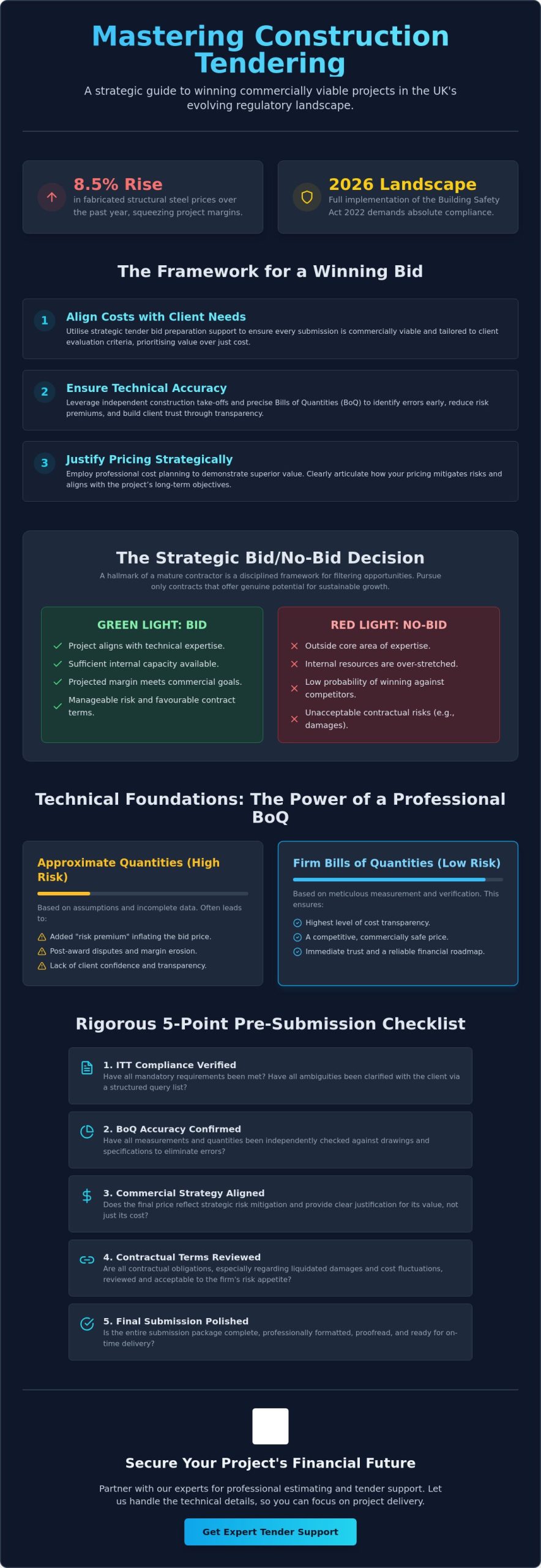
Not every project is the right fit for your business. Establishing a disciplined framework to evaluate if a project matches your technical expertise and current capacity is a hallmark of a mature contractor. You should analyse the competition and the likelihood of a successful outcome before committing significant resources to a submission. The bid/no-bid threshold is defined as the point where a project’s projected margin and technical requirements align with available internal resources and long-term commercial objectives. Using tender bid preparation support at this early stage helps you filter opportunities, ensuring you only pursue contracts that offer genuine potential for sustainable growth.
Technical Foundations: Why Accurate Measurement Wins Tenders
While many contractors focus on the persuasive prose of a bid, the technical foundation of a winning submission is built on the absolute accuracy of its bills of quantities. Precision in measurement is not merely a clerical task; it’s a strategic defence against margin erosion. When you engage professional tender bid preparation support, you’re investing in a “second pair of eyes” that can identify discrepancies between drawings and specifications that internal teams might overlook under tight deadlines. This technical rigour reduces the “risk premium” often added to uncertain bids, allowing you to submit a more competitive figure without sacrificing commercial safety.
The Role of Detailed Bills of Quantities (BoQ)
A professionally prepared BoQ provides the highest level of cost transparency. During the tendering phase, the distinction between approximate quantities and firm BoQs is critical. Firm quantities offer the client a fixed basis for comparison, which simplifies the work of their quantity surveyors and builds immediate trust. A structured document allows evaluators to see exactly how your price is constructed, making it easier for them to justify your selection based on technical detail rather than just the bottom line. It transforms your bid from a simple estimate into a reliable financial roadmap.
Precision Take-offs and Material Schedules
Modern tender bid preparation support utilises digital take-off methods to ensure every project element is accounted for. These precise measurements form the basis of detailed material schedules, which are invaluable for proving your supply chain readiness to the client. By providing subcontractors and suppliers with exact requirements, you secure more accurate quotes and reduce the likelihood of costly variations during the construction phase. Adhering to standardised measurement codes, such as NRM2, ensures consistency across all documentation and signals your professional standing. Engaging with specialists for tender support ensures these technical foundations are robust, allowing your internal team to focus on delivery whilst we secure the data. This methodical approach to measurement doesn’t just win tenders; it protects the long-term profitability of your projects by eliminating the guesswork that leads to financial instability.
Aligning Commercial Strategy with Technical Data
A successful submission requires more than just filling in a price; it demands a synergy between technical accuracy and commercial strategy. Balance is key. Integrating construction cost planning services at the tender stage allows you to move beyond reactive estimation. By using detailed technical data to justify your price point, you can demonstrate superior value or comprehensive risk mitigation to the client. This level of commercial rigour ensures that your bid remains profitable if won, protecting your business from the “winner’s curse” of securing work at an unsustainable margin.
Presenting your cost data in a format that aligns with the client’s specific budget structure is equally vital. Whether they require an elemental breakdown or a trade-based analysis, providing information in their preferred language shows professional maturity. It simplifies their evaluation process and reduces the likelihood of misunderstandings regarding your project scope. This alignment is a core component of effective tender bid preparation support, transforming raw figures into a persuasive commercial narrative that resonates with the client’s financial objectives.
Competitive Pricing whilst Maintaining Viability
Maintaining a competitive edge whilst protecting project margins is a delicate balance. You can achieve this by identifying “value engineering” opportunities early in the process. These alternatives allow you to offer the client cost savings or improved performance without compromising the project’s integrity. Transparency in your overhead and profit calculations also plays a significant role in building trust. When a client sees a logical, well-defended profit margin based on accurate data, they’re more likely to view your firm as a reliable, long-term partner rather than a high-risk option. It’s about showing that your price is fair, sustainable, and grounded in reality.
Identifying and Mitigating Project Risks
The bid phase is the ideal time to construct a robust project risk register. With construction material price inflation for all work rising by 3.2% in the 12 months to April 2026, failing to account for market volatility is a significant risk. Accurate estimating allows you to quantify the financial impact of potential delays or further price fluctuations in materials like fabricated structural steel. By addressing these risks head-on in your submission, you demonstrate a level of strategic oversight that reassures the client of your capability. Ultimately, professional tender bid preparation support acts as a commercial insurance policy against the dangers of under-pricing and unforeseen project liabilities.
A Pre-Submission Checklist for Construction Tenders
The final hours before a deadline are often the most critical for ensuring the commercial viability of a project. A meticulous review process prevents the small oversights that can lead to immediate disqualification or, worse, a contract that is impossible to deliver profitably. Utilising professional tender bid preparation support provides the necessary distance to evaluate the submission with objective rigour. This structured checklist serves as a final gateway to ensure your bid is compliant, professional, and technically sound.
- Verify ITT Responses: Ensure every mandatory question in the Invitation to Tender has been addressed directly. Responses should be concise and specifically mapped to the client’s stated objectives.
- Cross-Reference Scope: Reconcile the technical proposal with the Bills of Quantities to ensure no scope gaps exist. Discrepancies between the written methodology and the measured quantities are a common source of post-contract disputes.
- Arithmetic Sanity Check: Perform a manual validation of all rates and totals. Whilst modern systems are reliable, a final human review of the commercial summary prevents simple spreadsheet errors from undermining your credibility.
- Validate Evidence: Confirm that all supporting documentation, including case studies, staff CVs, and insurance certificates, is current and relevant to the specific project requirements.
- Format Compliance: Review the submission requirements to ensure the bid meets the exact digital or physical delivery standards specified by the client.
Document Compliance and Quality Assurance
Adopting a “safe pair of hands” approach requires multiple levels of internal review before the final button is pressed. Common compliance pitfalls amongst UK contractors include failing to sign mandatory declarations or ignoring specific word counts, both of which can lead to a bid being rejected regardless of its technical quality. Consistent formatting across all documents signals a level of professional discipline that reassures the client of your organisational capability. High-quality presentation reflects the meticulous mindset you will bring to the construction site itself.
Final Technical Review and Software Validation
The use of specialist tools like Conquest Estimating software is essential for maintaining a clear audit trail for all cost data. This digital transparency allows for a senior quantity surveyor to perform a final commercial review with absolute confidence in the underlying figures. It’s vital that the bid reflects the specific market conditions of 2026, particularly regarding the latest procurement thresholds and material price fluctuations. Engaging with specialists for professional tender support ensures your submission is not just a collection of numbers, but a technically validated document that stands up to the most intense scrutiny.
Professional Estimating: Securing Your Project’s Financial Future
Securing the financial future of a construction firm requires more than just winning the next job; it requires winning the right jobs at the right price. A quantity surveying consultancy UK serves as a strategic partner for growth, providing the technical oversight necessary to ensure every project is built on a foundation of cost certainty. By outsourcing your tender bid preparation support to specialists, you allow your internal team to remain focused on project delivery and operational excellence. This division of labour ensures that whilst your site teams are managing construction, your commercial interests are being protected by professionals with a meticulous mindset and deep industry knowledge.
Our team brings over 100 years of combined professional experience to every submission, offering a level of seasoned authority that is difficult to replicate in-house. This depth of expertise is particularly valuable when navigating the high-stakes environment of 2026, where regulatory compliance and financial rigour are non-negotiable. Independent cost advice provides an essential layer of protection, ensuring that your bids are not only competitive but also resilient against the unforeseen challenges of the construction lifecycle. Many firms are now exploring outsourced estimating for developers as a strategic solution to reduce fixed overheads and improve tender accuracy without sacrificing commercial control. It’s a commitment to long-term project viability that fosters trust with clients and stakeholders alike.
The Advantage of Conquest Estimating Software
Manual spreadsheets are inherently prone to broken formulas and version control issues, which can be catastrophic during a high-value tender. We utilise industry-leading Conquest Estimating software to ensure a level of accuracy and technical validation that traditional methods simply cannot match. This platform allows us to produce detailed material schedules and Bills of Quantities rapidly, meeting even the most demanding tender deadlines without compromising on detail. Clients increasingly prefer bids backed by recognised technical software platforms, as it provides a transparent audit trail that simplifies their own due diligence processes. Using such tools signals that your firm operates with modern, disciplined standards.
Partnering with Experienced Quantity Surveying Consultants
There is immense reassurance in partnering with a team that understands the specific nuances of diverse sectors, from high-specification residential projects to complex healthcare and industrial facilities. Each sector carries its own set of risks and measurement requirements, and our experience allows us to tailor your bid accordingly. Professional tender bid preparation support translates into a more sophisticated image for your company, positioning you as a “safe pair of hands” in the eyes of the client. This professional standing is often the deciding factor in close-run procurement processes; if you wish to further strengthen your brand’s authority, you might explore Social Media Management to showcase your expertise online. To ensure your next submission is technically precise and commercially viable, contact Consulting Estimating Consultants to organise your professional tender support.
Master Your Future Tender Submissions
The path to construction success in 2026 is paved with technical precision and strategic foresight. A winning bid is not merely a collection of persuasive words; it is a meticulously measured document built on accurate Bills of Quantities and robust cost planning. By adhering to a disciplined pre-submission checklist, you eliminate the arithmetic errors and compliance gaps that frequently lead to disqualification. This methodical approach ensures that every figure is defensible and every project is commercially viable from the outset.
Professional tender bid preparation support provides the commercial rigour needed to protect your margins whilst demonstrating superior value to your clients. Our team offers over 100 years of combined industry experience and utilises industry-leading Conquest Estimating software to ensure your data is beyond reproach. We are specialists in BoQs and cost planning across all UK sectors, providing the steady, expert guidance your business requires to grow with confidence. It’s time to replace uncertainty with technical mastery.
Secure your next project with professional tender bid preparation support from Consulting Estimating Consultants. We look forward to helping you achieve greater cost certainty and a significantly higher bid-to-win ratio.
Frequently Asked Questions
What is the most important part of tender bid preparation?
The most critical element is the accuracy of technical measurement and the subsequent validation of cost data. Without a precise Bill of Quantities, even the most persuasive bid is commercially unstable and prone to margin erosion. Professional tender bid preparation support ensures that every project requirement is quantified correctly, providing a solid foundation for both the client’s evaluation and your firm’s eventual project delivery.
Can I outsource just the Bill of Quantities for a tender bid?
You can certainly outsource the production of the Bill of Quantities as a standalone service. This approach is highly effective for contractors who have internal estimating teams but lack the resources to perform forensic measurement under tight deadlines. We provide detailed BoQs and construction take-offs that integrate seamlessly into your existing commercial workflow, allowing your team to focus on pricing strategy and subcontractor engagement.
How does professional tender support improve my win rate?
Professional support improves your win rate by instilling confidence in the client regarding your technical competence and financial stability. By submitting bids that are technically robust and clearly structured, you reduce the perceived risk for the evaluator. This level of precision often distinguishes a “safe pair of hands” from competitors who may provide less detailed or transparent cost information, particularly in high-stakes sectors like healthcare or industrial construction.
What technical software is best for construction tender preparation?
Conquest Estimating is widely considered the industry standard for high-precision construction tender preparation. It provides a comprehensive audit trail for all cost data and allows for the rapid generation of material schedules and BoQs. Using recognised platforms ensures that your submission meets the technical expectations of professional quantity surveyors and procurement officers, providing a level of transparency that manual spreadsheets cannot match.
Is tender bid preparation support suitable for subcontractors?
Yes, specialised support is highly beneficial for subcontractors, particularly those managing complex trade packages. Precise material schedules and take-offs allow subcontractors to secure more accurate quotes from their own supply chain, reducing the “risk premium” in their pricing. This technical rigour protects margins and ensures that the subcontractor’s bid is both competitive and commercially viable for the main contractor.
How long does it typically take to prepare a full tender bid?
The timeline for preparing a full tender bid varies based on project complexity and the level of detail required in the Invitation to Tender (ITT). Generally, a comprehensive submission for a medium-to-large project requires between two and four weeks of dedicated preparation. Early engagement with a consultancy ensures that there is sufficient time for forensic measurement and a thorough commercial review before the final deadline.
What are the common mistakes to avoid in construction tendering?
Common mistakes include simple arithmetic errors, failing to account for scope gaps between drawings and specifications, and ignoring mandatory ITT instructions. Many contractors also fail to account for current market volatility, such as the 3.2% increase in construction material prices seen in the 12 months to April 2026. Professional tender bid preparation support acts as a safeguard against these avoidable oversights, ensuring every figure is technically validated.
How do I ensure my bid is compliant with UK procurement regulations?
Ensuring compliance requires a deep understanding of the current regulatory landscape, including the Building Safety Act 2022 and the new public procurement thresholds effective from 1 January 2026. You must verify that your submission addresses all safety accountability requirements and technical standards relevant to the project. Partnering with a consultancy that maintains an up-to-date knowledge of these regulations is the most reliable way to ensure your bid remains compliant and competitive; if you also need to validate your adherence to digital security standards like NIS2 or ISO 27001, you can find out more.
One Comment