



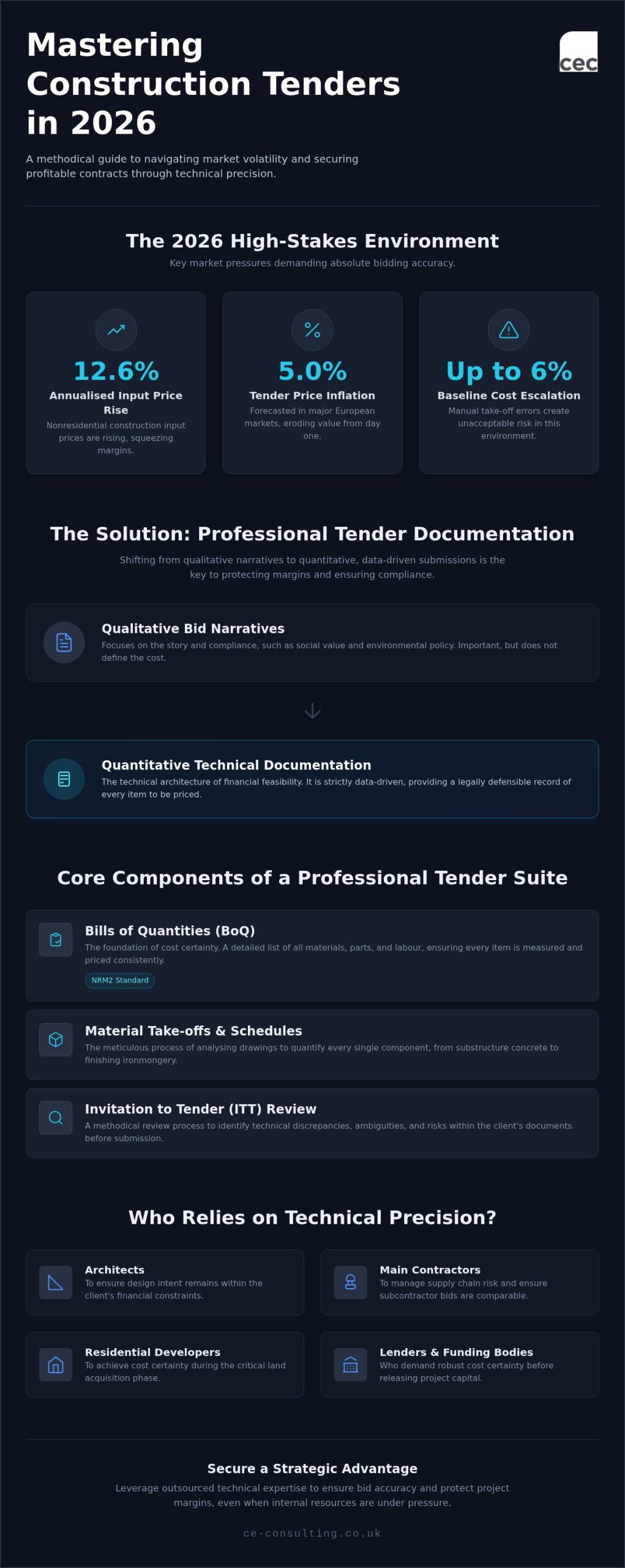
With nonresidential construction input prices rising at a 12.6% annualised rate in early 2026, the margin for error in your bid has effectively vanished. You’ve likely seen tender price inflation erode project margins before the first spade hits the ground, whilst manual take-off errors continue to threaten your commercial stability. It’s a high-stakes environment where stretched internal resources often lack the capacity to maintain the precision required for complex financial modelling.
Mastering the technical requirements of your documentation is the only reliable defence against this volatility. By securing professional construction tender pricing support, you can establish cost certainty, eliminate take-off discrepancies, and ensure every submission is fully compliant with the latest regulations, such as the Procurement Act 2023. This 2026 reference guide provides a methodical breakdown of the essential components needed to reduce risk and secure profitable contracts in a challenging market. We will explore how technical precision and strategic oversight can transform your bidding process into a reliable engine for growth.
Key Takeaways
- Differentiate between qualitative bid narratives and the quantitative technical documentation essential for maintaining rigorous financial control.
- Utilise professional construction tender pricing support to eliminate manual take-off errors and protect project margins against 2026 inflation.
- Master the production of Bills of Quantities and materials schedules to provide a transparent, level playing field for all subcontractors.
- Implement a methodical review process for Invitations to Tender to identify technical discrepancies and raise essential queries before submission.
- Secure a strategic advantage by leveraging outsourced technical expertise to ensure bid accuracy whilst internal resources are under pressure.
What Are Construction Tender Documentation Services?
Construction tender documentation services represent the technical architecture of a project’s financial feasibility. Whilst bid writing focuses on the qualitative narrative, such as social value or environmental policy, documentation services are strictly quantitative. This technical discipline involves the production of precise Bills of Quantities (BoQs), construction take-offs, and detailed materials schedules. In the current construction bidding process, these documents serve as the definitive record of what is being bought and sold between parties.
Securing professional construction tender pricing support ensures that every item, from substructure concrete to finishing ironmongery, is accounted for with meticulous detail. A quantity surveyor acts as the final gatekeeper in this process. They validate architectural drawings against physical requirements to ensure the data is robust and legally defensible. Without this technical oversight, contractors often find themselves exposed to significant commercial risk before a project even starts. It’s the difference between a speculative estimate and a disciplined financial commitment.
The Strategic Importance of Technical Precision in 2026
The 2026 market is defined by volatility. With baseline construction cost escalation expected to sit between 4% and 6% this year, there’s no room for “guesstimation”. Precise documentation prevents the dangerous “race to the bottom” where contractors underbid due to measurement errors. This accuracy protects your profit margins against tender price inflation, which is forecasted at approximately 5.0% in major European markets. When every millimetre is measured correctly, project viability is easier to prove to lenders. Banks and funding bodies increasingly demand cost certainty before releasing capital, making technical precision a prerequisite for project approval.
Key Stakeholders: Who Relies on Tender Documentation?
Technical documentation isn’t just for the estimator; it’s a vital tool for the entire project team. Architects rely on these cost plans to ensure their design intent remains within the client’s financial constraints. For main contractors, a professional BoQ is essential for managing supply chain risk. It provides a uniform document for subcontractors to price against, ensuring bids are comparable and fair. Residential developers also utilise these services to achieve cost certainty during the land acquisition phase. Knowing the exact material requirements allows for more disciplined budgeting during the early stages of development. Professional construction tender pricing support provides the “safe pair of hands” needed to navigate these complex requirements with confidence.
The Core Components of a Professional Tender Documentation Suite
Technical integrity defines a robust tender package. Whilst many firms focus on the qualitative aspects of a bid, the most successful contractors prioritise the quantitative data that underpins a project’s commercial viability. This suite of documents serves as the definitive financial roadmap, ensuring that every stakeholder operates from a single, verified source of truth. A professional suite typically includes Bills of Quantities, detailed take-offs, and elemental cost plans, each serving a specific function in the procurement lifecycle.
Securing expert construction tender pricing support allows you to outsource the production of these complex documents to a dedicated partner. This strategic move ensures that your submissions are not only professional but also technically unassailable. By providing a clear and transparent breakdown of costs, you build trust with clients and supply chain partners alike.
Bills of Quantities (BoQ): The Foundation of Cost Certainty
The Bill of Quantities remains the primary instrument for pricing and valuation. In 2026, the New Rules of Measurement (NRM2) is the essential industry benchmark for preparing these documents. Using a standardised method ensures that every item is measured consistently, reducing the likelihood of costly disputes during the construction phase. Whether you require a “firm” BoQ for a lump-sum contract or an “approximate” version for early-stage budgeting, the precision of these documents is paramount. You can find further technical detail in our The Definitive Guide to Bills of Quantities (BoQ).
Material Take-offs and Detailed Schedules
Translating architectural drawings into quantifiable data is a meticulous process. Our specialists utilise Conquest Estimating software to perform construction take-offs, ensuring that every brick, bolt, and timber length is accounted for. This level of detail is a core component of professional standard bidding documents for construction. By providing subcontractors with accurate material schedules, you enable them to submit more competitive and professional quotes. This transparency establishes a level playing field and significantly reduces the commercial risk of project overruns.
Elemental cost plans provide the final layer of strategic oversight. They allow developers to track financial performance against specific project elements, such as the substructure or internal finishes, throughout the project. This methodical approach ensures that your construction tender pricing support provides a “safe pair of hands” for even the most complex financial modelling. When every component is documented with precision, you can move forward with the grounded confidence that your project is commercially viable.
Technical Accuracy vs Commercial Risk: Why Documentation Fails
Commercial viability in the construction sector is not merely a matter of competitive bidding. It’s the direct result of technical precision. When documentation fails to reflect the physical reality of a project, the result is an immediate increase in commercial risk. Many contractors fall into the trap of “guesstimating” costs based on historical data that no longer applies to the 2026 market. This reliance on manual spreadsheets creates a significant liability. A single formula error or a missed cell in a complex workbook can lead to catastrophic project losses.
Professional construction tender pricing support provides a necessary buffer against these technical failures. By conducting a meticulous review of tender packages, specialists identify discrepancies between architectural drawings and structural specifications before they materialise as project delays. Discrepancies often include mismatched material quantities or a failure to align the BoQ with site-specific constraints. Identifying these gaps early ensures that the project begins on a foundation of cost certainty rather than speculative hope. It’s the difference between a project that returns a healthy margin and one that erodes your capital.
Common Pitfalls in Manual Measurement and Pricing
Manual measurement is inherently susceptible to human error, particularly in large-scale residential developments. Double counting of structural elements or the total omission of specialised finishing items can skew a bid by thousands of pounds. Manual processes often neglect essential waste factors and site-specific logistics, such as limited access for plant machinery or specific storage requirements. In a market where nonresidential input prices rose at a 12.6% annualised rate early in 2026, using outdated pricing data is a critical failure. Professional oversight acts as a “safe pair of hands” for developers, ensuring that every variable is quantified with rigorous discipline.
The Role of Estimating Software in Reducing Financial Exposure
Moving beyond the limitations of Excel is essential for modern risk management. Integrated database estimating, such as that provided by Conquest software, ensures that every take-off is consistent across the entire tender suite. Software-led processes allow for real-time updates. If a design revision occurs, the documentation adjusts automatically, maintaining the integrity of the financial model. This systematic approach eliminates the fragmentation found in manual systems. It provides a strategic advantage by allowing contractors to respond to changes with speed and accuracy, ensuring their construction tender pricing support remains robust throughout the procurement cycle. By adopting these disciplined methods, you secure your position as a reliable and professional partner.
Managing the Tender Process: From Invitation to Submission
Efficiency in the tender process begins with a cold, analytical review of the Invitation to Tender (ITT). This initial phase is the most critical for identifying the technical boundaries of a project. A standard ITT should encompass comprehensive drawings, detailed specifications, and a clear set of preliminaries. However, red flags often emerge during this stage, such as missing structural details or unrealistic project timelines that suggest a high degree of commercial risk. Organising a thorough review within the typical 4 to 6 week tender window requires a disciplined approach to ensure no detail is overlooked.
Securing expert construction tender pricing support allows your team to move beyond superficial reviews. Our methodical process involves identifying ‘gaps’ in the provided documentation early in the cycle. When discrepancies are found, raising Technical Queries (TQs) becomes a strategic necessity rather than an administrative burden. This proactive stance ensures that your final submission is based on verified data, protecting you from the hidden costs that often surface during the construction phase. By the time you reach the submission deadline, every figure in your bid should be data-backed and professionally validated.
Reviewing the Invitation to Tender (ITT) Package
A meticulous review of the ITT package is your first line of defence against project losses. You must verify that the architectural intent aligns with the structural requirements and that the preliminaries accurately reflect site-specific logistics. Spotting omissions in the early stages allows for more accurate cost planning. For a structured approach to this phase, refer to our Tender Bid Preparation Support Checklist for further guidance on maintaining bid integrity under tight deadlines.
Ensuring Compliance and Level Playing Fields
Standardised documentation is essential for establishing a level playing field amongst subcontractors. When you provide a professional Bill of Quantities or a detailed materials schedule, you ensure that every supply chain partner is pricing the exact same scope of work. This transparency makes subcontractor comparison straightforward and fair. Furthermore, professional construction tender pricing support ensures your bid meets rigorous industry standards, such as PAS 91. Final verification involves a multi-layered check of all quantitative data, ensuring that your submission is not only compliant but also commercially robust. This methodical coordination transforms a stressful tender window into a controlled, professional exercise in financial management.
Consulting Estimating Consultants: Technical Mastery for Competitive Bidding
Achieving commercial success in a volatile market requires more than just effort; it demands a disciplined, technical approach to every bid. Consulting Estimating Consultants provides the professional construction tender pricing support needed to navigate the complexities of 2026 procurement. Our team brings over 100 years of combined professional experience to the table, acting as a steady, experienced partner for architects, developers, and contractors nationwide. We understand that in a high-stakes environment, your peace of mind stems from knowing your financial data is unassailable.
Outsourcing your estimating requirements provides a significant strategic advantage, particularly when internal resources are stretched by tight deadlines. By entrusting your Bills of Quantities and materials schedules to our specialists, you secure a level of accuracy that is difficult to replicate in-house. This technical precision directly correlates with higher bid success rates. Clients who utilise our construction tender pricing support often find that their submissions are viewed with greater confidence by procurement boards, as they are backed by rigorous quantity surveying and cost consultancy standards.
Utilising Conquest Software for Unrivalled Accuracy
We choose Conquest Estimating software as our primary tool for producing Bills of Quantities and construction take-offs. This structured, software-driven approach allows us to maintain a level of detail that manual methods simply cannot match. Digital measurement improves the speed of delivery without compromising the integrity of the data. By using an integrated database, we ensure that every item is measured consistently according to NRM2 standards. This systematic process eliminates the fragmentation often found in traditional spreadsheets, providing our clients with a clear, logical, and highly organised financial model that is ready for immediate use in the bidding process.
A Safe Pair of Hands for Complex Multi-Sector Projects
Our expertise extends across a diverse range of sectors, including healthcare, education, retail, and industrial projects. We provide the financial rigour necessary for large-scale residential developments, where even minor measurement errors can have significant commercial consequences. Whether you are a main contractor managing a complex supply chain or a developer seeking cost certainty for a new scheme, we offer a “safe pair of hands” for your project. For those focused on the housing market, our Outsourced Estimating for Developers guide offers sector-specific insights into maintaining commercial viability. By combining traditional quantity surveying values with modern technical mastery, we ensure your projects are built on a foundation of absolute financial control.
Achieving Commercial Stability Through Technical Precision
The construction landscape of 2026 demands a shift from speculative bidding to technical mastery. We’ve explored how professional documentation, including NRM2-compliant Bills of Quantities and precise materials schedules, creates the cost certainty required to protect your margins against inflation. By identifying ITT gaps early and eliminating the liability of manual spreadsheet errors, you transform commercial risk into a strategic advantage. It’s about ensuring every submission is a disciplined financial commitment rather than a speculative hope.
Our team brings over 100 years of combined industry experience and specialist expertise in Conquest Estimating software to every project. We provide comprehensive national coverage across all construction sectors, acting as a dependable guide for developers and contractors alike. By securing dedicated construction tender pricing support, you ensure your bids are technically unassailable and professionally validated. Take the next step toward disciplined growth and financial control today.
Secure your next project with professional tender documentation support and bid with the grounded confidence that only technical mastery can provide.
Frequently Asked Questions
What are the main components of construction tender documentation?
The primary components include the Invitation to Tender (ITT), architectural drawings, technical specifications, and the Bill of Quantities. These documents define the project’s scope and financial boundaries with absolute precision. Preliminaries and contract conditions are also essential; they outline the logistical and legal framework for the works. Together, these elements form a comprehensive package that allows contractors to submit a data-backed, professional bid.
How does professional documentation reduce construction project risk?
Professional documentation provides a precise financial roadmap that eliminates the need for speculative estimates. By identifying technical gaps and measurement discrepancies during the tender stage, you prevent the commercial erosion that occurs when unforeseen costs arise on-site. This rigorous approach ensures that all parties understand their obligations before a contract is signed. It creates a “safe pair of hands” for the project’s commercial viability.
Why is a Bill of Quantities (BoQ) essential for a compliant tender?
A Bill of Quantities ensures all contractors price the exact same scope of work using a standardised measurement method like NRM2. This creates a transparent, level playing field for comparison. Without a BoQ, the risk of measurement errors increases significantly, often leading to non-compliant bids that fail to meet the technical requirements of the procurement process. It remains the definitive instrument for valuation and financial control.
What is the difference between a material take-off and a material schedule?
A material take-off is the initial technical process of measuring quantities directly from architectural or structural drawings. In contrast, a material schedule is a refined procurement document that lists specific items required for the project. Whilst the take-off provides the raw data, the schedule organises it into a format suitable for supply chain management. This allows for precise ordering and reduces the risk of site-level waste.
Can I outsource the preparation of my tender documentation?
You can certainly outsource these technical tasks to secure professional construction tender pricing support. Outsourcing allows your internal team to focus on project delivery whilst specialist consultants handle the meticulous production of BoQs and take-offs. This strategy ensures your bids are technically robust and commercially viable even when your internal resources are under significant pressure. It provides a strategic advantage in a competitive market.
What software is best for preparing construction tender documents?
Conquest Estimating software is widely regarded as the industry benchmark for producing accurate tender documentation. It facilitates integrated database estimating, which ensures consistency across all project elements. Unlike traditional spreadsheets, this software-led approach allows for rapid adjustments when design revisions occur. This maintains the integrity of the financial model throughout the procurement cycle, ensuring that your construction tender pricing support is based on reliable data.
How long does it typically take to prepare a professional tender package?
The timeline for preparing a comprehensive package depends on project complexity and the quality of the initial design data. Most technical reviews and documentation sets are completed within the standard four to six week tender window. Engaging a specialist early in the process is essential for ensuring that queries are raised and resolved. This methodical approach ensures that the final submission is not rushed and remains technically unassailable.
How do tender documentation services support subcontractors?
These services provide subcontractors with a clear, quantified scope of work, which significantly reduces the risk of pricing errors. By receiving a professional Bill of Quantities or materials schedule, subcontractors can provide more competitive and accurate quotes. For subcontractors looking to strengthen their own bidding process, our guide on tender support for subcontractors winning bids in 2026 provides targeted strategies for maintaining profitability in a competitive market. This clarity fosters stronger supply chain relationships and ensures that the main contractor’s final bid is based on reliable, transparent data. It eliminates the guesswork that often leads to project disputes.