



Could a single decimal point error in your material schedule be the difference between a profitable contract and a significant financial deficit? In a 2026 market defined by material price volatility and tightening margins, there’s no longer any room for “guesstimates” or rough approximations during the tender stage. Most contractors recognise that inaccurate quantities lead directly to wasted materials and costly site delays. You’ve likely felt the pressure of performing detailed measurements in-house whilst trying to manage live projects, only to find the results lack the precision required for modern commercial viability. Professional construction take off services bridge this gap by providing the technical rigour necessary for success.
This guide demonstrates how expert construction take off services provide the precise material data you need to protect your bottom line and secure competitive tenders. By leveraging sophisticated software and decades of technical mastery, you can regain financial control and eliminate the risk of budget overruns. We’ll examine the strategic importance of precise measurement standards and how a meticulous approach to data ensures your project begins on a foundation of absolute certainty.
Key Takeaways
- Understand how digital extraction has replaced manual scaling to provide the technical accuracy required for complex 2026 construction projects.
- Discover the critical role of NRM2 measurement standards in maintaining consistency and rigour across substructures, frames, and MEP services.
- Learn how professional construction take off services leverage Conquest software to eliminate human error and protect your commercial margins.
- Explore the strategic benefits of outsourcing to a “safe pair of hands” to overcome the capacity constraints and overheads of in-house estimating.
- Gain insight into how precise material schedules form the essential foundation for accurate Bills of Quantities and comprehensive cost planning.
Understanding Construction Take Off Services in Modern Procurement
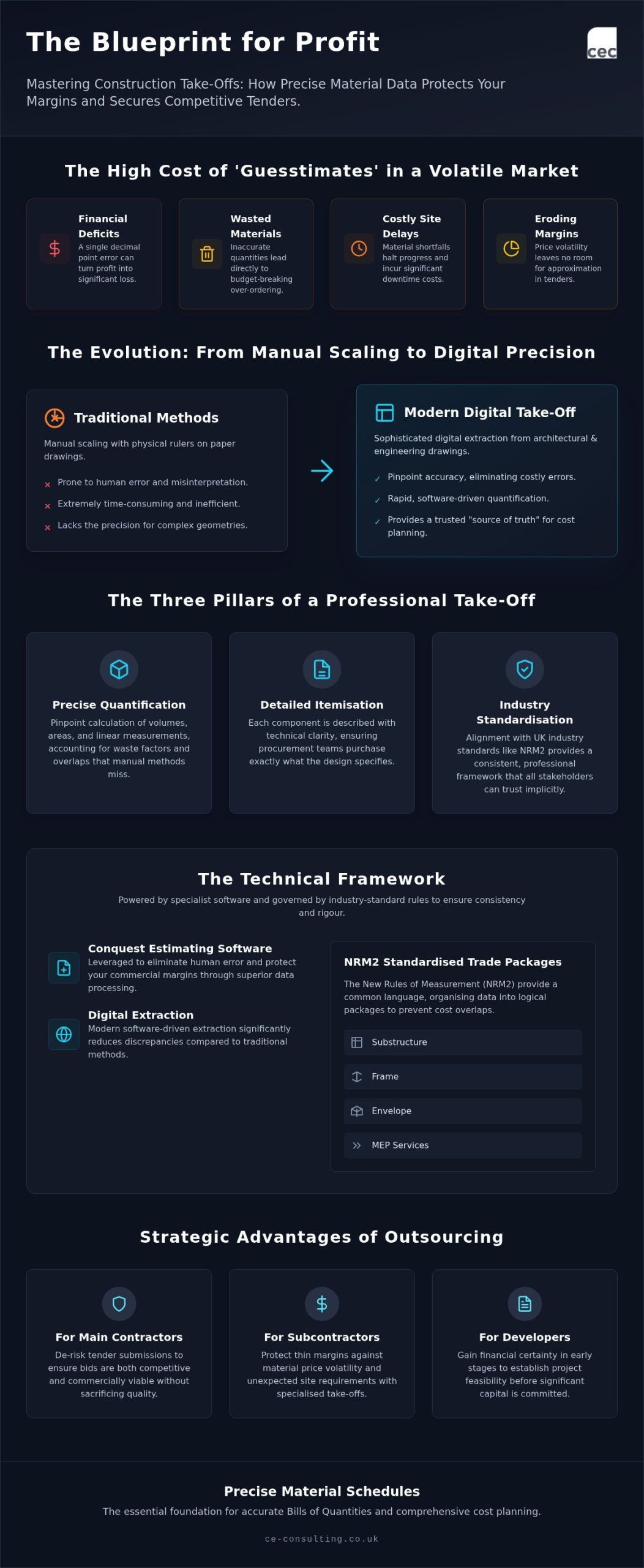
At its most fundamental level, a Takeoff (construction) is the process of extracting every physical material requirement from architectural and engineering drawings. However, in the 2026 procurement environment, the definition has evolved significantly. Whilst traditional methods once relied on manual scaling and physical rulers, modern construction take off services utilise sophisticated digital extraction to ensure absolute precision. This data serves as the primary “source of truth” for a project, acting as the bedrock for every subsequent financial decision. Without a reliable take-off, cost planning becomes mere guesswork, and the risk of commercial failure increases exponentially.
A professional service differs significantly from a simple material list. It isn’t just about counting bricks or doors; it’s about interpreting complex design intent and translating it into a structured, actionable data set. This meticulous approach ensures that nothing is missed, from the cubic volume of concrete required for a foundation to the exact linear metres of skirting in a residential fit-out. It transforms raw drawings into a strategic asset that allows for precise financial control.
The Core Components of a Professional Take-off
True accuracy requires more than basic arithmetic. Professional quantification involves calculating volumes, areas, and linear measurements with pinpoint precision, accounting for waste factors and overlaps that manual methods often overlook. Detailed itemisation is equally vital. Each component must be described with technical clarity to ensure procurement teams purchase exactly what the design specifies, avoiding the “near enough” approach that leads to site delays. Finally, standardisation is non-negotiable. By aligning every measurement with UK industry standards like NRM2 (New Rules of Measurement), we provide a consistent, professional framework that all stakeholders, from quantity surveyors to project managers, can trust implicitly. This adherence to industry-standard rules ensures that your data is compatible with modern cost-management systems.
Who Benefits from Outsourced Take-off Services?
Outsourcing this critical task to professional construction take off services provides a strategic advantage across the supply chain. Main contractors use these services to de-risk tender submissions, ensuring their bids are both competitive and commercially viable without sacrificing project quality. For those operating within specific trades, specialised take-off services for subcontractors are essential for protecting thin margins against material price volatility and unexpected site requirements. Developers also find immense value here. Early-stage take-offs provide the financial certainty needed to establish project feasibility before significant capital is committed. This collaborative approach ensures that every project participant, regardless of their role, operates with the same high level of financial rigour and technical oversight.
The Technical Framework: Measurement Standards and Trade Classifications
The technical integrity of a project depends on a standardised approach to measurement. In the UK, the New Rules of Measurement (NRM2) provide the essential framework for quantity surveying, ensuring that every professional involved speaks the same commercial language. Professional construction take off services utilise this structure to categorise data into logical trade packages such as Substructure, Frame, Envelope, and MEP services. This methodical organisation prevents the overlapping of costs and ensures that tender documentation remains compliant with industry expectations, providing a clear audit trail for all stakeholders.
Digital precision has become the benchmark for modern procurement. An academic study on BIM accuracy highlights how modern software-driven extraction significantly reduces the discrepancies found in traditional manual methods. This level of rigour is particularly crucial when dealing with complex geometries or multi-layered assemblies where human error can easily compromise the budget. By adopting these technical standards, contractors can present a robust financial case that withstands the scrutiny of developers and lenders alike.
Measurement Methods: Count, Length, Area, and Volume
Selecting the correct unit of measurement is fundamental to accuracy. Linear measurements are essential for components like cabling, lumber, and piping, where the length dictates the procurement strategy. Area measurements are reserved for flooring, roofing, and wall finishes, where coverage is the primary concern. For concrete works and earthworks, the precision of volume calculations is paramount to avoid the waste associated with over-ordering. Volumetric take-off is the calculation of 3D space requirements for materials like ready-mix concrete. Using these distinct methods ensures that every item is quantified in the way that best reflects its physical application on-site.
Sector-Specific Nuances in Quantification
Each sector presents unique challenges that alter the measurement approach. In the residential sector, the focus often lies on material takeoff for residential construction, where high-volume housing projects require repetitive but highly accurate schedules to maintain profitability. Commercial and retail projects, by contrast, often involve fast-track fit-out requirements and complex MEP schedules that demand rapid turnaround without sacrificing detail. Industrial and healthcare facilities introduce another layer of complexity, requiring heavy-duty specifications and strict adherence to regulatory compliance standards. Tailoring the take-off to these specific needs ensures that the final schedule is fit for purpose. If you’re managing a complex development, our team can provide the expert materials schedules required to ensure your tender is both accurate and competitive.
Digital Transformation: The Role of Conquest Estimating Software
By 2026, the reliance on manual measurement has become a significant commercial liability. Traditional scaling from paper drawings or basic PDFs is prone to human fatigue and calculation errors that no modern project can afford to absorb. Professional construction take off services have transitioned fully into the digital space, where speed and precision are no longer mutually exclusive. This evolution ensures that material data remains dynamic rather than static, allowing for immediate adjustments when project parameters shift or architectural revisions are issued.
At the centre of this transformation is Conquest, a software suite that has established itself as the industry benchmark for estimating excellence. Unlike generic measurement tools, Conquest allows for sophisticated digital extraction that significantly reduces the margin of error. An academic analysis of takeoff accuracy demonstrates that software-driven methodologies provide a level of consistency that manual processes simply cannot replicate. This technical rigour is vital when design changes occur; the system can quickly update quantities across the entire project, ensuring that your tender remains current and accurate throughout the bidding process.
Conquest vs Traditional Measurement Tools
The primary advantage of utilising outsourced Conquest estimating services lies in the seamless integration of data. Digital tools accelerate the quantification process, allowing for faster responses to tender deadlines without compromising on the level of detail. By linking take-off data directly to standardised pricing libraries and Bills of Quantities, we create a unified financial model that is both robust and flexible. Every measurement taken leaves a clear digital trail, providing a transparent record that simplifies internal reviews and resolves client queries with ease.
Improving Tender Accuracy with Digital Data
Precision in quantification eliminates the guesswork that often plagues material pricing in volatile markets. By employing advanced construction take off services that utilise digital extraction, contractors can generate professional, data-rich reports that instil confidence in clients and stakeholders. This transparency is a key differentiator in a competitive market where trust is as valuable as the price itself. Digital take-offs allow for ‘what-if’ scenario planning during the tender phase, enabling contractors to model the financial impact of different material choices or design variations instantly. This capability ensures that you don’t just submit a price, but a strategically considered offer that protects your margins.
Strategic Benefits of Outsourcing Material Take-offs
Outsourcing to professional construction take off services offers far more than a simple list of quantities; it provides a strategic partnership built on technical mastery. By accessing a “safe pair of hands” backed by over 100 years of combined professional experience, contractors can bypass the inherent limitations of in-house estimating teams. Many businesses find that internal capacity fluctuates significantly, which often leads to rushed measurements or missed tender deadlines during busy periods. An external partner provides a steady, disciplined resource that doesn’t carry the overhead costs of permanent staff or the distractions of live site management.
There is also immense value in an independent, third-party perspective. Internal teams can sometimes become too close to a project, potentially overlooking discrepancies in architectural drawings through familiarity or institutional bias. A professional consultant approaches the data with technical rigour and objectivity, identifying potential errors before they manifest as costly site problems. This meticulous oversight ensures that material schedules for contractors are based on verified facts rather than assumptions, providing a stable foundation for the entire procurement process.
Risk Mitigation and Cost Control
Precise ordering is your first line of defence against material shortages and site downtime. When material requirements are known with absolute certainty well in advance, cash flow management becomes more predictable and financial rigour is maintained. This level of accuracy also supports environmental sustainability by reducing the volume of over-ordered materials that eventually end up in skips. Knowing exact requirements allows for leaner, more efficient operations that protect the commercial viability of the project whilst enhancing your reputation for disciplined management.
Winning More Bids: The Competitive Edge
Tender success in 2026 relies heavily on transparency and professional presentation. Submitting a detailed, software-driven take-off demonstrates a level of technical competence that instils immediate confidence in developers and lead consultants. It shows you’ve thoroughly interrogated the project’s financial requirements and aren’t relying on “blanket” percentages to cover risks. Outsourcing the heavy lifting of measurement also allows your team to bid on a higher volume of projects simultaneously, increasing your market reach without increasing fixed costs. For subcontractors looking to maximise their strike rate, combining precise take-offs with professional tender support for subcontractors is one of the most effective strategies for securing profitable work in a competitive market. Building this reputation for dependability is how long-term commercial partnerships are forged. If you’re looking to improve your strike rate and secure more profitable work, book a consultation for our expert take-off services today.
Integrating Take-offs into a Robust Construction Cost Plan
A construction take-off is not an isolated document; it’s the essential data set that informs every stage of the financial lifecycle. In 2026, the transition from simple measurement to strategic cost consultancy is what separates successful projects from those that suffer from budget creep. Precise construction take off services provide the raw data required to produce a robust set of bills of quantities, which in turn becomes the contractual basis for the entire build. This integration ensures that the project’s financial DNA is accurate from the very first day.
The quantity surveyor plays a pivotal role in this process by interpreting the measurement data through a commercial lens. It’s not enough to simply know the quantity of steel or timber; one must understand how these materials interact with the project’s specific constraints and procurement route. This technical oversight provides developers with a high level of cost certainty, allowing for disciplined financial management from project inception through to the final account. By maintaining this rigour, contractors can navigate the complexities of modern construction with grounded confidence.
From Measurement to Management
Once the project moves beyond the tender stage, the value of a professional take-off shifts toward active budget monitoring. These schedules allow project managers to track actual usage against predicted quantities, making it far easier to manage variations as they arise. Providing architects and developers with pre-construction cost advice based on real, software-driven data allows for informed design decisions before a single brick is laid. Meticulous elemental cost analysis ensures that every part of the building, from the substructure to the internal finishes, is commercially viable and aligned with the overall investment strategy.
Conclusion: Securing Your Project’s Financial Future
Securing the financial future of a construction project requires an uncompromising commitment to technical accuracy. In the 2026 landscape, where margins are thin and material costs remain fluid, professional construction take off services are the most effective tool for risk mitigation. Consulting Estimating Consultants remains the preferred partner for UK developers and contractors because we combine technical mastery with a deep understanding of industry standards. Our team provides the “safe pair of hands” needed to transform complex drawings into reliable, actionable financial data. To protect your project’s margins and ensure a competitive edge, enquire about our construction take off services today and discover the difference that professional rigour makes to your bottom line.
Securing Commercial Stability in a Volatile Market
Commercial success in the modern construction landscape depends entirely on the technical integrity of your initial measurements. We’ve established how the transition from manual scaling to digital extraction provides the precision required to protect your margins against price volatility. By adhering to NRM2 standards and utilising specialised software like Conquest, you ensure that every tender is built on a foundation of absolute certainty. This rigour doesn’t just win bids; it sustains the long-term financial health of your projects.
Choosing to partner with a “safe pair of hands” for your construction take off services allows your team to focus on project delivery whilst we manage the meticulous detail of quantification. Our consultants bring over 100 years of combined professional experience to every project, offering a comprehensive UK national service that instils confidence in your stakeholders. This methodical approach transforms raw data into a strategic asset for project viability.
Ready to enhance your tender accuracy? Request a Professional Construction Take-off Quote today to secure your project’s financial future. We look forward to helping you build with confidence.
Frequently Asked Questions
What is the difference between a material take-off and a bill of quantities?
A material take-off is the primary process of quantifying materials from drawings, whereas a Bill of Quantities (BoQ) is a formal document that organises these quantities into a standardised format for pricing. Whilst the take-off provides the raw data, the BoQ includes detailed descriptions and preambles to ensure all contractors bid on the same basis. This distinction is vital for maintaining commercial clarity during the tender phase.
How long does a professional construction take-off typically take to complete?
The duration of a project depends entirely on its scale and technical complexity. A standard residential extension might be completed within 48 to 72 hours, whilst a large-scale commercial development or industrial facility can require several weeks of meticulous measurement. We provide clear timescales at the outset of every instruction to ensure your tender programme remains on track.
Can you provide take-offs for all construction trades?
Yes, our expertise covers the full spectrum of construction trades and sectors. We provide comprehensive construction take off services for substructures, frames, envelopes, and internal fit-outs, alongside complex MEP (Mechanical, Electrical, and Plumbing) packages. This multi-trade capability ensures that you receive a unified material schedule that accounts for every element of the building’s fabric.
What documentation do I need to provide for a take-off service?
To ensure absolute precision, we require a full set of architectural and structural drawings in PDF or CAD format. Accompanying specifications, room data sheets, and site investigation reports are also highly beneficial. Providing the most current revisions prevents discrepancies and ensures that the final take-off reflects the exact design intent of the project.
Why should I outsource my take-offs rather than doing them in-house?
Outsourcing eliminates the fixed overhead costs of maintaining an in-house estimating department whilst providing access to a higher level of technical rigour. It allows your project teams to focus on site management and delivery rather than being bogged down by repetitive measurement tasks. Professional construction take off services also offer an objective, third-party perspective that helps identify design gaps before they become costly site variations.
How do you ensure the accuracy of your measurements?
We maintain accuracy through a combination of software-driven extraction and professional oversight. By using Conquest Estimating software, we eliminate the human errors associated with manual scaling. Every project undergoes a disciplined internal review process where measurements are cross-checked against the specifications to ensure that the final data set is both robust and reliable.
Is your take-off service compliant with UK NRM2 standards?
Yes, every measurement we produce is strictly compliant with the UK NRM2 (New Rules of Measurement) standards. This adherence to RICS guidelines ensures that our take-offs are recognised and respected by quantity surveyors, main contractors, and developers across the country. Standardising our output in this way provides a consistent commercial language that simplifies the tender review process.
What software do you use for construction take-offs?
We utilise Conquest Estimating software as our primary tool for digital measurement and data extraction. This industry-leading platform allows us to link quantities directly to pricing libraries and Bills of Quantities, ensuring a seamless transition from measurement to cost planning. The software’s ability to handle complex revisions quickly is essential for maintaining accuracy in a fast-moving procurement environment.