



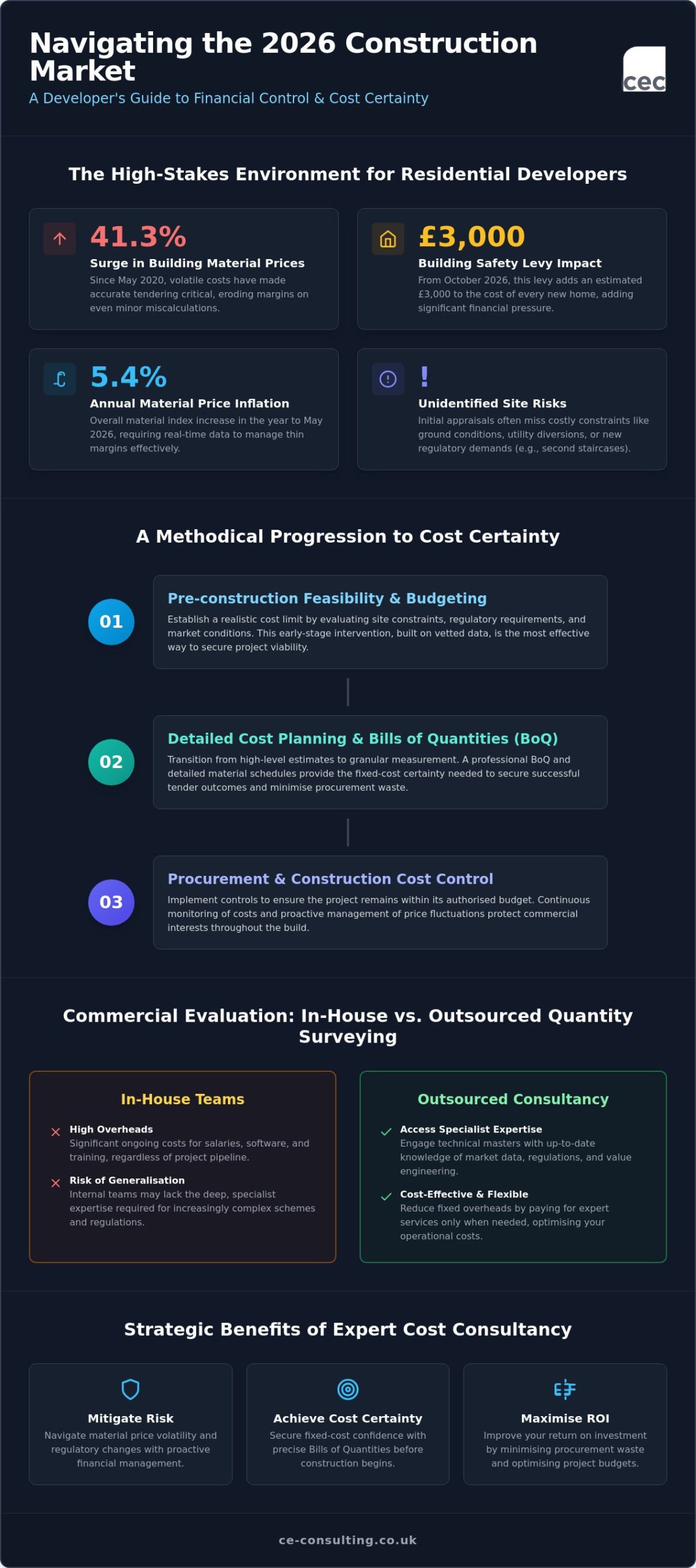
The price of building materials has surged by 41.3% since May 2020, creating a market where even a minor oversight in a tender can erode a project’s entire margin. For those managing complex schemes, the introduction of the Building Safety Levy in October 2026 adds a new layer of financial pressure, estimated to add £3,000 to the cost of every new home. You likely recognise that relying on internal estimates without specialist software often leads to unpredictable fluctuations and costly delays. Expert residential developer quantity surveying is no longer just a secondary service; it’s a strategic necessity for maintaining financial control in a highly regulated environment.
We understand the frustration of inaccurate bids and the pressure of adapting to the Future Homes Standard. This guide explains how to eliminate financial risk and optimise your margins through meticulous cost planning and professional Bills of Quantities. You will discover how vetted data and technical oversight provide the fixed-cost certainty required to secure successful tender outcomes and protect your commercial viability throughout 2026.
Key Takeaways
- Master the proactive financial management techniques required to navigate the 2026 construction market and mitigate the risks of material price volatility.
- Discover how professional residential developer quantity surveying provides a methodical progression from initial budget planning to the granular measurement needed for cost certainty.
- Compare the financial implications of in-house teams against outsourced consultancy to determine the most cost-effective route for accessing specialist expertise whilst reducing overheads.
- Learn how accurate Bills of Quantities and detailed material schedules minimise procurement waste and directly improve your project’s return on investment.
- Identify the strategic benefits of partnering with an experienced consultant to bring technical mastery and financial rigour to your residential schemes.
The Developer’s Challenge: Achieving Cost Certainty in Residential Projects
Successful residential development in 2026 requires more than just a vision for architecture; it demands an uncompromising approach to financial rigour. Professional residential developer quantity surveying serves as a proactive financial management discipline that bridges the gap between a conceptual design and a commercially viable reality. Whilst a traditional Quantity surveyor might be viewed as a mere measurer of materials, their role in the current market is that of a strategic lead who protects the developer’s capital from the outset. This discipline involves the continuous monitoring of costs, the identification of procurement risks, and the implementation of controls that ensure a project remains within its authorised budget.
Relying on ‘ballpark’ estimates or historical data is a primary cause of project failure. These rough figures often ignore the intricacies of current market shifts and regulatory changes, such as the Building Safety Levy coming into effect in October 2026. Without a ‘safe pair of hands’ to manage technical cost consultancy, developers risk committing to schemes that are fundamentally flawed. Precision in the pre-construction phase ensures that every pound is accounted for, providing the grounded confidence needed to proceed with certainty. Our approach focuses on technical mastery to turn these financial uncertainties into a structured, predictable programme of work.
The Impact of Volatile Material Costs on Margins
The UK construction industry continues to experience significant price movements, with the overall material price index rising by 5.4% in the year to May 2026. Specific commodities, such as imported sawn timber and aggregates, have seen increases of 7.6% and 7.3% respectively. These fluctuations can quickly erode the thin margins typical of residential schemes if they aren’t managed with real-time data. Elemental cost analysis mitigates market risk by breaking down project components into functional elements, allowing for targeted value engineering when specific material prices spike. By maintaining this level of detail, developers can make informed decisions about material substitutions before procurement begins.
Identifying Hidden Risks in Initial Site Appraisals
Initial site appraisals often overlook complex constraints such as abnormal ground conditions, utility diversions, or the specific safety requirements for buildings over 18 metres, which now require a second staircase as of September 2026. A meticulous QS evaluates these site-specific constraints early, preventing the ‘budget creep’ that occurs when unforeseen costs emerge during construction. It’s essential to engage professional construction cost planning services at the feasibility stage to ensure that the initial investment case is built on vetted, technical data rather than optimistic assumptions. This early-stage intervention is the most effective way to secure project viability and protect long-term commercial interests.
A Step-by-Step Guide to Managing Residential Construction Costs
Managing a residential project requires a disciplined sequence of financial controls. It’s not about making guesses; it’s about a systematic transition from high-level feasibility to surgical measurement. Effective residential developer quantity surveying ensures that every stage of the build is underpinned by technical data, allowing for a seamless flow from initial sketches to the final account. This methodical progression is the only way to maintain a “safe pair of hands” over your capital in a market that doesn’t forgive inaccuracy.
Collaborative communication between the architect and the surveyor is vital. Whilst the architect focuses on design and compliance, the surveyor ensures those designs are commercially viable. This partnership prevents the common pitfall of designing a scheme that simply cannot be built within the available budget. By integrating cost advice early, you can adjust specifications without compromising the overall vision or the project’s energy performance targets.
Phase 1: Pre-construction Feasibility and Budgeting
Establishing a realistic cost limit begins with understanding unit yields. Developers must determine the maximum allowable spend per square metre whilst accounting for regional variations, such as the £2,800 to £4,000 per sqm range seen in Inner London in 2026. Elemental cost analysis allows for early-stage decision making by breaking the project into functional components like substructure, frame, and services. For those seeking professional oversight at this critical juncture, engaging a quantity surveying consultancy UK provides the necessary Strategic Cost Consultancy to validate these figures against real-world benchmarks.
Phase 2: Technical Measurement and Tender Documentation
Once the feasibility is confirmed, the focus shifts to granular measurement. This involves the creation of detailed bills of quantities (BoQ), which serve as the definitive document for tendering. A precise BoQ eliminates ambiguity, ensuring that all subcontractors are bidding on the exact same scope of work. Precise material take-offs are equally essential; they allow for accurate procurement and prevent the waste that often occurs when quantities are estimated poorly. Professional tender support further refines this process by vetting subcontractor bids against industry-standard data, ensuring that the returned prices are both competitive and compliant with current building regulations. Refining your procurement through a technical BoQ is the most effective way to secure project viability before a single brick is laid.
In-house vs. Outsourced Quantity Surveying: A Commercial Evaluation
The decision to maintain an internal team or engage an external consultancy represents a significant commercial junction for any developer. Whilst an in-house presence might seem to offer better continuity, the reality of residential developer quantity surveying in a fluctuating market often favours the outsourced model. External consultants provide a level of financial rigour and an unbiased, third-party perspective that is difficult to replicate within a single organisation. This independent oversight ensures that project appraisals remain objective, preventing internal optimism from masking potential risks to the development’s viability.
Engaging a specialist consultancy allows you to access a wider pool of sector-specific expertise without the long-term commitment of a full-time salary. Our team brings over 100 years of combined experience across residential, commercial, and healthcare sectors, providing a breadth of knowledge that an individual hire rarely possesses. This technical mastery ensures that your project is handled by a “safe pair of hands” capable of Managing Residential Construction Costs with precision, regardless of the scheme’s complexity. Reliability is built through proven processes and disciplined methodology rather than simple physical proximity.
The Hidden Overheads of Internal Surveying Teams
The true cost of an internal surveying department extends far beyond base salaries. When you account for National Insurance, pension contributions, and professional indemnity insurance, the financial burden on the business is substantial. There is also the significant cost of office space and the recurring expense of high-end software licences. Perhaps most critically, internal teams create a fixed cost that remains even during “down-time” between development phases. In contrast, project-based estimating fees offer scalability; you only pay for the expertise when a project is active, ensuring your overheads align directly with your revenue-generating activities.
Leveraging Advanced Conquest Estimating Software
Precision in modern quantity surveying depends heavily on the tools utilised. We employ industry-leading Conquest Estimating software, which offers a depth of data and a level of accuracy that basic spreadsheet-based systems cannot match. Spreadsheets are prone to human error, broken formulas, and version control issues that can lead to catastrophic financial oversights. Conquest software facilitates a methodical approach to take-offs, using technical libraries to ensure that every component is accounted for. This software-driven process prevents the double-counting of materials and eliminates measurement errors, providing a level of cost certainty that protects your project’s margins from the earliest stages of planning.
Maximising ROI with Precise Material Schedules and BoQs
Profitability in residential development is often found in the fine details of the pre-construction phase. Precise residential developer quantity surveying transforms technical drawings into exact material requirements, ensuring that every penny of the budget is utilised effectively. By providing a granular breakdown of costs, these documents allow developers to identify efficiencies and potential savings before a single spade hits the ground. This level of oversight is essential for maintaining a healthy return on investment in a market where material costs for new housing rose by 3.9% in the 12 months leading to May 2026.
Accurate documentation doesn’t just protect your margin; it accelerates the entire project lifecycle. When every material and labour component is clearly defined, the valuation and payment process becomes significantly more efficient. A well-structured Bill of Quantities (BoQ) allows for rapid verification of work completed on site, ensuring that subcontractors are paid accurately and disputes are minimised. This steady, methodical approach to financial administration builds trust across the project team and keeps the programme on track.
Reducing Procurement Waste through Accurate Take-offs
Procurement discipline starts with knowing exactly what is needed. Granular material lists prevent the over-ordering of expensive components, such as high-performance glazing or specialist insulation, which often end up damaged or unused on site. This level of precision also supports sustainable construction practices by reducing the volume of waste sent to landfill, aligning your project with the environmental standards expected in 2026. Conquest-generated schedules ensure procurement discipline by providing a single, verified source of truth that your supply chain can rely on for every order. When you eliminate the guesswork from procurement, you remove the hidden costs of surplus stock and the logistical burden of returns.
Improving Bid Quality and Reducing Variation Claims
Vague documentation is a primary driver of costly mid-project variations. If a subcontractor is forced to guess quantities, they’ll naturally include a risk premium in their price or seek to recover costs through variations once the build begins. A professional BoQ protects the developer from “front-loading,” where contractors attempt to claim a disproportionate amount of the contract sum in the early stages of the project. This document ensures that all tenderers are pricing the exact same scope, creating a level playing field for a true comparison of bids. For developers managing larger mixed-use sites, integrating commercial construction cost management principles alongside residential data provides a comprehensive shield against financial ambiguity.
Ensuring your project is founded on accurate data is the most effective way to secure your commercial interests. If you’re ready to eliminate procurement waste and protect your margins, request a technical Bill of Quantities from our expert team today.
Partnering for Success: Strategic Cost Consultancy in 2026
The complexities of the 2026 construction market demand a shift from transactional estimating to a long-term strategic partnership. For developers seeking broader business growth and turnaround expertise, Scott Lumley provides the type of real estate leadership necessary to navigate these shifts. Successful residential developer quantity surveying is built on more than just a single project; it’s an ongoing collaboration that ensures financial rigour across your entire portfolio. By engaging a consultant with over 100 years of combined professional experience, you gain access to a reservoir of technical mastery that protects your commercial interests at every stage. We operate nationally, providing a consistent standard of excellence that serves as a “safe pair of hands” for developers navigating an increasingly volatile market. This national reach allows us to benchmark costs across different regions, providing you with a competitive edge regardless of where your site is located. Expert residential developer quantity surveying provides the steady, composed oversight required to turn high-stakes projects into predictable successes.
Collaborative Cost Management for Developers and Contractors
Future-proofing Residential Developments
The regulatory landscape is shifting rapidly. With the Building Safety Levy coming into effect in October 2026 and the Future Homes Standard mandating a 75-80% reduction in CO2 emissions by 2027, cost planning is now a tool for future-proofing. A professional QS evaluates the financial implications of green building technologies, such as air-source heat pumps and enhanced thermal envelopes, to ensure these required upgrades remain commercially viable. We provide the clarity needed to adapt to these standards without compromising your project margins. By integrating these costs into your initial feasibility studies, you prevent the reactive spending that often occurs when regulations change mid-cycle. The same disciplined approach that underpins cost planning for school extensions — where grant-funding deadlines and evolving DfE standards demand meticulous financial control — applies equally to residential schemes facing tightening regulatory requirements.
Securing your project’s financial future requires a partner committed to precision and reliability. Contact Consulting Estimating Consultants for a technical fee proposal and ensure your next development is managed with the grounded confidence it deserves.
Securing Project Viability in a Shifting Residential Market
Navigating the complexities of the 2026 residential sector requires more than high-level budgeting; it demands technical rigour and disciplined oversight. By moving from broad estimates to granular Bills of Quantities, you protect your capital from the hidden risks of material volatility and shifting building regulations. Professional residential developer quantity surveying serves as the foundation for this cost certainty, ensuring that every procurement decision is based on vetted, technical data. It’s the most effective way to transform financial uncertainty into a predictable, well-managed programme of work.
We bring over 100 years of combined professional experience to every scheme, acting as a dependable guide for developers across the UK. As specialist Conquest Estimating software experts, our team provides the national coverage and meticulous detail needed to maintain absolute financial control. You can secure your project margins with a professional cost plan today and approach your next development with grounded confidence. With the right strategic partner, the challenges of the coming years become manageable opportunities for sustained commercial success.
Frequently Asked Questions
What is the role of a quantity surveyor in residential development?
A quantity surveyor acts as the financial architect of a build, managing every cost from the initial feasibility stage to the final account. They ensure the design remains commercially viable and protect the developer’s capital by identifying procurement risks and regulatory costs early in the process. Their strategic oversight provides the grounded confidence needed to proceed with complex schemes.
How much does residential quantity surveying cost for a new build?
For cost management services on residential projects, industry fees are typically between 2% and 3% of the total project value. For smaller developments or specific technical tasks, such as producing a single Bill of Quantities, fixed fees are more common. These costs are often offset by the savings found through procurement discipline and the prevention of on-site waste.
Why should I outsource my quantity surveying instead of hiring in-house?
Outsourcing provides immediate access to a wider pool of technical mastery and industry-leading software without the overheads of National Insurance, pensions, or office space. It offers scalability, allowing you to pay for specialist expertise only when a project is active. An external consultant also provides an unbiased, third-party view of project finances that is essential for objective risk management.
What is the difference between a cost estimate and a Bill of Quantities?
A cost estimate is a high-level forecast used during the feasibility stage to determine if a project is viable. In contrast, a Bill of Quantities is a granular, technical document that measures every individual component of a build. This document is essential for residential developer quantity surveying as it provides the precise data required for competitive and compliant subcontractor tendering.
Can a quantity surveyor help with the tender process for subcontractors?
Yes, a quantity surveyor provides vital tender support by vetting subcontractor bids against vetted industry data. They ensure that all tenderers are pricing the exact same scope of work, which creates a level playing field and prevents “front-loading” by contractors. This process ensures that the returned prices are both competitive and realistic for the 2026 market.
How does Conquest software improve the accuracy of a construction take-off?
Conquest software utilises extensive technical libraries to ensure measurement discipline and eliminate human error. It prevents the double-counting of materials and provides a level of detail that basic spreadsheet-based systems cannot replicate. This software-driven approach ensures that every material take-off is underpinned by precise, reliable data.
What information does a QS need to provide an accurate cost plan?
To provide a technical cost plan, a QS requires comprehensive architectural drawings, site surveys, and a detailed specification of materials. Information regarding planning conditions, site-specific constraints, and utility requirements is also vital. The more detailed the initial information, the more precise the resulting financial programme will be.
Is quantity surveying necessary for smaller residential developments?
Professional residential developer quantity surveying is essential for smaller schemes where profit margins are often tighter and more sensitive to material price fluctuations. Even a minor measurement oversight can lead to significant financial loss on a project with fewer units. Meticulous cost planning ensures that smaller developments remain commercially viable and protected from market volatility.