



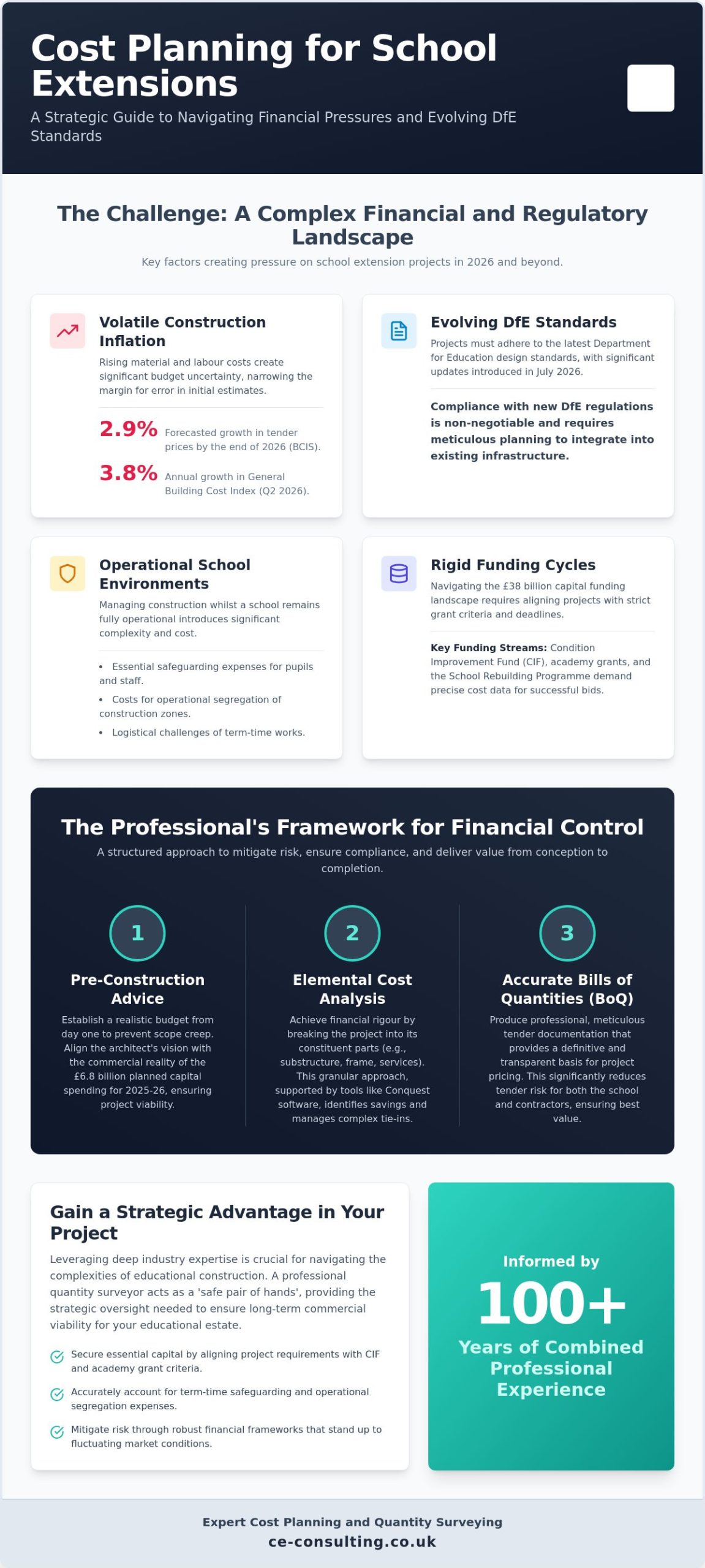
Can an educational extension project truly achieve financial certainty when Department for Education standards are evolving and construction inflation remains a volatile factor? With the BCIS forecasting a 2.9% growth in tender prices by the end of 2026, the margin for error in your initial estimates has never been slimmer. You likely recognise the intense pressure of managing a capital project whilst the school remains fully operational. It’s a complex challenge to balance essential safeguarding expenses against the rigid deadlines of grant-funding cycles that leave no room for oversight.
This guide provides the strategic framework you need to master cost planning for school extensions. We’ll show you how to maintain financial control despite the complexities of existing infrastructure and the latest DfE design standards updated in July 2026. By following this professional approach, you’ll learn to produce meticulous tender documentation that secures the best value for your school. We’ll examine how to navigate the current £38 billion capital funding landscape and ensure your project remains both compliant and commercially viable from the first technical take-off to the final handover.
Key Takeaways
- Navigate the 2026 funding landscape by aligning project requirements with CIF and academy grant criteria to secure essential capital.
- Utilise elemental cost analysis and Conquest software to achieve the high level of financial rigour required for Department for Education standards.
- Master the complexities of cost planning for school extensions by accurately accounting for term-time safeguarding and operational segregation expenses.
- Reduce tender risk for all stakeholders by producing professional Bills of Quantities that provide a definitive, transparent basis for project pricing.
- Gain a strategic advantage by leveraging over a century of combined expertise to ensure long-term commercial viability for your educational estate.
Cost Planning for School Extensions: Navigating Education Sector Requirements
Effective cost planning for school extensions is far more than a simple budgetary exercise; it represents the strategic financial management of an educational project from its initial conception through to final completion. In the current climate, where the Department for Education (DfE) recently updated its design standards as of 3 July 2026, precision is paramount. A professional cost plan provides a roadmap that balances architectural aspirations with the harsh realities of construction inflation. Whilst new builds offer a clean slate, extensions present unique challenges that demand a higher level of technical rigour. You aren’t just building a structure; you’re integrating new technology and learning environments into an existing infrastructure that may already be under significant strain.
To ensure these new environments are utilised effectively, Knowledgefront offers specialist digital learning consultancy to help educational institutions modernise their curriculum delivery alongside their physical estate.
The role of the quantity surveyor is critical in this process. With the BCIS General Building Cost Index showing an annual growth of 3.8% in the second quarter of 2026, maintaining project viability requires constant vigilance. We act as a “safe pair of hands,” ensuring that fluctuating material costs and labour shortages don’t derail your development. By establishing a robust financial framework early, we mitigate the risks associated with unforeseen site constraints and structural tie-ins that frequently plague school expansion projects. This meticulous approach ensures that every pound spent is accounted for and justified.
Understanding Different School Funding Models
The funding landscape for 2026 is complex and varies significantly depending on the school’s status. Academies and Free Trusts often rely on the Condition Improvement Fund (CIF) or specific academy grants, which come with rigid reporting requirements and strict grant-funding deadlines. The School Rebuilding Programme, for instance, remains open for applications until April 2026, requiring precise cost data for successful bids. In contrast, Local Authority schools follow different procurement routes, whilst private sector developments often utilise sophisticated financial reporting standards more akin to commercial projects. Accuracy remains the common thread. The methodology of Elemental Cost Analysis is particularly effective here, as it allows for detailed cost comparisons across different functional areas of the school, ensuring that funding is allocated where it’s needed most.
The Strategic Importance of Pre-construction Advice
Securing professional cost planning for school extensions during the early stages is essential to prevent design scope creep. In education developments, it’s easy for a project’s vision to exceed its available budget. Early-stage intervention ensures that the design remains aligned with the commercial reality of the £6.8 billion planned capital spending for the 2025-26 financial year. Professional pre-construction cost advice establishes a realistic budget from day one, linking the architect’s vision with technical feasibility studies. This disciplined approach ensures that the project remains viable amongst changing market conditions, protecting the school’s long-term financial health.
Elemental Cost Analysis: Achieving Financial Rigour in School Developments
Elemental cost analysis provides the granular detail necessary for achieving genuine financial rigour in educational construction. Rather than relying on broad cost-per-square-metre estimates, this methodology breaks the project down into its constituent parts, such as the substructure, frame, and internal services. This level of precision is vital for cost planning for school extensions, where the complexities of tying into existing utilities can often lead to budget overruns if not meticulously accounted for from the outset. By examining each element individually, we can identify potential savings and ensure that the most significant portions of the budget are allocated to areas that directly improve the learning environment.
Our approach leverages over 100 years of combined professional experience, allowing us to utilise historic data to inform future cost predictions with a high degree of accuracy. This historical perspective is particularly useful when considering life-cycle costing. With the maintenance backlog in English schools estimated at £13.8 billion as of October 2024, selecting materials that offer long-term value over lower initial capital costs is a strategic necessity. We help schools and developers look beyond the construction phase, ensuring that the extension remains affordable to maintain throughout its operational life. For those seeking a partner to manage these intricate details, our team provides dependable cost planning support tailored to the education sector.
Quantifying Material and Labour Requirements
Precision in measurement is the foundation of a successful tender. As the project progresses from initial budget estimates, it’s essential to transition to detailed construction take off services. We use industry-leading software to automate complex measurements directly from architectural drawings, which significantly reduces the risk of human error. This accuracy ensures that material schedules are realistic and that subcontractors can provide competitive, fixed-price tenders without the need for excessive risk contingencies. Reducing waste through precise quantification isn’t just a cost-saving measure; it’s a fundamental part of meeting the sustainability goals inherent in modern school developments.
Software-Driven Accuracy in Education Estimating
The use of Conquest Estimating software represents a significant advancement over traditional manual spreadsheets. In the specialised field of cost planning for school extensions, digital tools allow for the seamless integration of New Rules of Measurement (NRM) standards. This ensures that all documentation is compliant with professional industry requirements and Department for Education expectations. Digital take-offs also facilitate much faster revisions. If a school’s requirements change or if grant-funding constraints necessitate a reduction in scope, we can update the elemental analysis rapidly, providing the project team with the financial clarity needed to make informed decisions without delay.
Operational Challenges: Managing Costs Whilst Schools Remain Open
Stakeholders are often surprised when initial estimates for educational projects significantly exceed residential equivalents. This disparity isn’t due to the cost of bricks and mortar alone. It’s the financial weight of working within a live, high-risk environment. Professional cost planning for school extensions must account for the logistical constraints of a functioning campus, where pupil safety and educational continuity take precedence over construction speed. Unlike a greenfield site, a school requires constant operational access, which introduces “term-time working” premiums. Contractors frequently adjust their rates to compensate for restricted hours, such as halting noisy work during exam periods or scheduling deliveries to avoid the morning and afternoon “school run” congestion.
Managing these variables requires a meticulous mindset. We approach every project as a seasoned partner, identifying where operational needs will likely clash with construction efficiency. By quantifying these challenges during the pre-construction phase, we ensure that the school’s budget remains a reliable tool rather than a source of stress. Our role is to provide the financial control that allows headteachers and boards to focus on education whilst we manage the technical complexities of the build cost.
Safeguarding and Site Security Costs
Ensuring pupil safety is a non-negotiable priority that carries significant financial implications. A robust cost plan for an extension must budget for enhanced security measures that go far beyond standard site fencing. This includes:
- Heavy-duty temporary hoarding and physical site segregation to prevent any interaction between pupils and contractors.
- Advanced CCTV monitoring and biometric or controlled access points specifically for construction personnel.
- The administrative overhead of DBS (Disclosure and Barring Service) checks for every individual entering the site.
- Dedicated logistics managers to coordinate the movement of heavy machinery safely amongst the school population.
In 2026, with the Department for Education’s heightened focus on SEND provision and student well-being, managing acoustic disruption is more vital than ever. Exam-sensitive areas or sensory rooms may require specific sound-dampening measures or the scheduling of high-vibration work for weekends and holidays, both of which increase the total labour bill.
Hidden Costs of Infrastructure Integration
One of the most frequent causes of budget overruns is the integration with legacy infrastructure. Connecting a modern extension to aged heating, electrical, or IT systems is rarely a simple task. Given the £13.8 billion maintenance backlog reported in English schools, there’s a persistent risk that disturbing old pipework or wiring could trigger wider system failures. cost planning for school extensions must therefore include a higher contingency fund—often 10% to 15% compared to the 5% typical for new builds. This buffer isn’t a sign of uncertainty; it’s a strategic safeguard against the realities of the UK’s educational estate, ensuring that unexpected boiler upgrades or electrical board replacements don’t stall the project.
The Importance of Accurate Bills of Quantities in Education Tenders
Accurate documentation is the bedrock of any successful educational build. Whilst the initial cost planning for school extensions sets the strategic budget, the bills of quantities (BoQ) serves as the definitive technical document for the tender stage. It translates architectural drawings into a detailed list of items, quantities, and descriptions. This meticulous breakdown ensures that every contractor bids on the exact same scope of work. Without a professional BoQ, schools often face wide-ranging tender returns that are impossible to compare accurately, leading to delays and potential financial disputes that threaten project viability.
A professional BoQ reduces risk for both the school and the main contractor by providing a transparent pricing structure. It allows school governors and academy trusts to see exactly where funds are being allocated, facilitating the high-level financial reporting required for public accountability. By establishing this level of detail early, we provide a “safe pair of hands” for the project’s commercial management. To ensure your next project is underpinned by this level of precision, contact our expert team for professional BoQ production and tender support.
Reducing Tender Discrepancies
Competing bids often vary wildly when contractors are left to interpret drawings independently. A professional BoQ eliminates these “apples vs oranges” scenarios by providing a uniform measurement standard across the entire tender pack. Every main contractor and their respective subcontractors quote against the same precise material schedules, from the specific volume of concrete in the substructure to the exact number of acoustic ceiling tiles. The BoQ acts as a contractual document that ensures price certainty by defining the project scope with absolute clarity. This level of technical detail is essential for meeting Department for Education standards and ensuring that the final contract sum is both realistic and fixed.
Facilitating Post-Contract Cost Management
The utility of a BoQ extends far beyond the initial procurement phase; it provides a robust baseline for valuing interim payments and settling final accounts once construction begins. By applying a residential developer quantity surveying approach to education sites, we ensure that every variation is costed with the same technical rigour used during the initial estimate. If school stakeholders request design changes mid-build, perhaps to accommodate evolving IT requirements or sensory learning spaces, the BoQ allows us to manage the financial impact precisely. This methodical approach to cost planning for school extensions ensures that variations are handled fairly, protecting the school’s contingency funds from being exhausted by unmanaged scope changes.
Strategic Estimating Support for Education Sector Construction Projects
Outsourcing your project’s financial oversight to a specialist consultancy is a strategic decision that protects both the architectural vision and the school’s capital. In a market where tender prices are forecast to rise by 15.5% over the five years to Q2 2031, precision in cost planning for school extensions is the only way to ensure long-term commercial viability. We provide a level of technical mastery that internal teams often lack the resources to maintain. Our team brings 100 years of combined professional experience to every project, offering a “safe pair of hands” for complex educational developments. This depth of expertise allows us to anticipate sector-specific risks before they manifest as costly delays on site. For institutions needing to strengthen their initial grant applications, Dynamic Contracts Consultants LLC offers specialised proposal and grant writing services to help secure the necessary funding for these developments.
For Multi-Academy Trusts (MATs) managing diverse estates, our national UK coverage provides a consistent approach to financial control across multiple regions. Whether you’re extending a primary school in a rural setting or developing a large-scale SEND facility in an urban centre, we apply the same rigorous standards of measurement and analysis. We don’t just provide numbers; we deliver the financial certainty required to meet Department for Education expectations and secure governor approval. Our commitment to reliability is underpinned by our use of Conquest software, which ensures that every technical take-off and bill of quantities is produced with superior accuracy compared to manual methods.
Partnering with a Specialist Quantity Surveying Consultancy
Independent cost consultancy offers an unbiased view of project viability that’s essential for high-value school investments. We act as an objective partner, ensuring that architectural designs remain grounded in commercial reality. By preparing all tender documentation to the highest professional standards, we reduce the likelihood of contractor disputes and ensure the school receives truly competitive bids. This disciplined approach to cost planning for school extensions creates an atmosphere of trust amongst all stakeholders, from the headteacher to the funding body. You can move forward with confidence, knowing your project’s financial foundation is secure and meticulously managed.
Next Steps for Your School Extension Project
Engaging a consultant for a detailed initial cost plan is the most effective way to start your journey toward a successful extension. We recommend preparing your architectural drawings for our digital take-off process as early as possible. This allows us to provide technical pre-construction advice that can influence the design phase for better cost-efficiency. If you’re planning a development for the 2026 academic year or beyond, we’re ready to provide the strategic oversight you need. Contact Consulting Estimating Consultants today to discuss your requirements and ensure your next education project achieves total price certainty. For those in the early years sector, you can also check out Canavan Byrne for expert training and compliance support alongside your physical development.
Securing Financial Control for Your 2026 Educational Estate
Achieving total price certainty in the education sector requires a meticulous balance of technical accuracy and operational foresight. By integrating sophisticated elemental analysis with a deep understanding of live-site logistics, you can navigate the complexities of 2026 funding cycles with grounded confidence. We’ve explored how professional documentation and software-driven precision protect your capital from the inherent risks of legacy infrastructure and safeguarding premiums. Mastering cost planning for school extensions isn’t just about managing a budget; it’s about ensuring the long-term viability of your educational facilities through disciplined oversight.
Our team brings over 100 years of combined industry experience to every project, acting as a dependable guide for architects and developers nationwide. As specialist Conquest Estimating software users, we provide the technical rigour necessary to produce definitive tender documentation that meets the highest standards. We offer comprehensive tender support to ensure your expansion remains commercially viable whilst meeting all regulatory requirements. If you’re ready to establish a robust financial foundation for your development, Get a Professional Cost Plan for Your School Extension. We’re committed to helping you deliver exceptional learning environments with absolute precision.
Frequently Asked Questions
How much does it cost to extend a school in the UK in 2026?
Total project costs are influenced by the specific requirements of the extension, but current BCIS data indicates that tender prices are forecast to grow by 2.9% by the end of 2026. Estimates must account for the 3.8% annual growth in the General Building Cost Index whilst considering the specialised needs of SEND provision and Net Zero sustainability targets. Every project requires a bespoke elemental analysis to provide a realistic commercial outlook tailored to your specific site constraints.
What are the main factors affecting education sector construction estimating?
The primary drivers include the stringent Department for Education design standards, updated in July 2026, and the logistical complexities of working within a live campus. Labour cost inflation, which rose by 7.1% year-on-year in Q2 2025, also plays a significant role. Estimators must also consider the £13.8 billion maintenance backlog affecting existing English schools, as this often necessitates unexpected infrastructure upgrades during the connection phase.
Do school extensions require a full Bill of Quantities?
A professional Bill of Quantities is highly recommended for school developments to ensure total price certainty and transparent financial reporting. It provides a definitive document that allows school governors and academy trusts to compare tender returns on an identical basis. This level of technical rigour reduces the risk of contractors adding excessive contingencies to their bids and provides a robust baseline for managing any mid-build variations.
How long does the cost planning process take for a school extension?
The timeline for cost planning for school extensions typically ranges from two to four weeks, depending on the project’s scale and the detail of the architectural drawings. Early engagement is essential to ensure that technical take-offs are completed in time for grant-funding application deadlines. Our digital approach using specialised software allows us to produce accurate elemental analyses far more efficiently than traditional manual methods.
Can construction work be carried out whilst the school is open?
Construction frequently proceeds during term time, though it requires meticulous planning to maintain pupil safety and educational continuity. Initial cost plans must include premiums for “term-time working,” which covers the logistical challenges of restricted delivery windows and exam-sensitive scheduling. These measures ensure that the project remains viable without compromising the school’s daily operations or the well-being of the students.
What is the role of a quantity surveyor in school construction projects?
A quantity surveyor acts as a “safe pair of hands,” providing strategic financial oversight from the initial feasibility study to the final account. We are responsible for producing accurate material schedules, managing the tender process, and ensuring the project remains compliant with DfE employer’s requirements. Our role is to protect the school’s investment by identifying commercial risks early and maintaining strict financial control throughout the build.
How does Conquest software improve accuracy in school estimates?
Conquest software provides a digital framework that eliminates the human error associated with manual spreadsheet estimating. It allows for precise take-offs directly from digital drawings, ensuring that every element of the school extension is quantified to New Rules of Measurement (NRM) standards. This technology facilitates faster revisions if the project scope changes, providing stakeholders with immediate clarity on the financial implications of design adjustments.
What safeguarding costs should be included in a school construction budget?
Budgets must account for heavy-duty site hoarding, physical segregation barriers, and controlled access points to separate construction staff from pupils. You should also include the administrative costs of DBS checks for all site personnel and the expense of advanced CCTV monitoring for the construction zone. These safeguarding measures are non-negotiable and must be detailed in the initial cost planning for school extensions to avoid unexpected budget pressure later.