



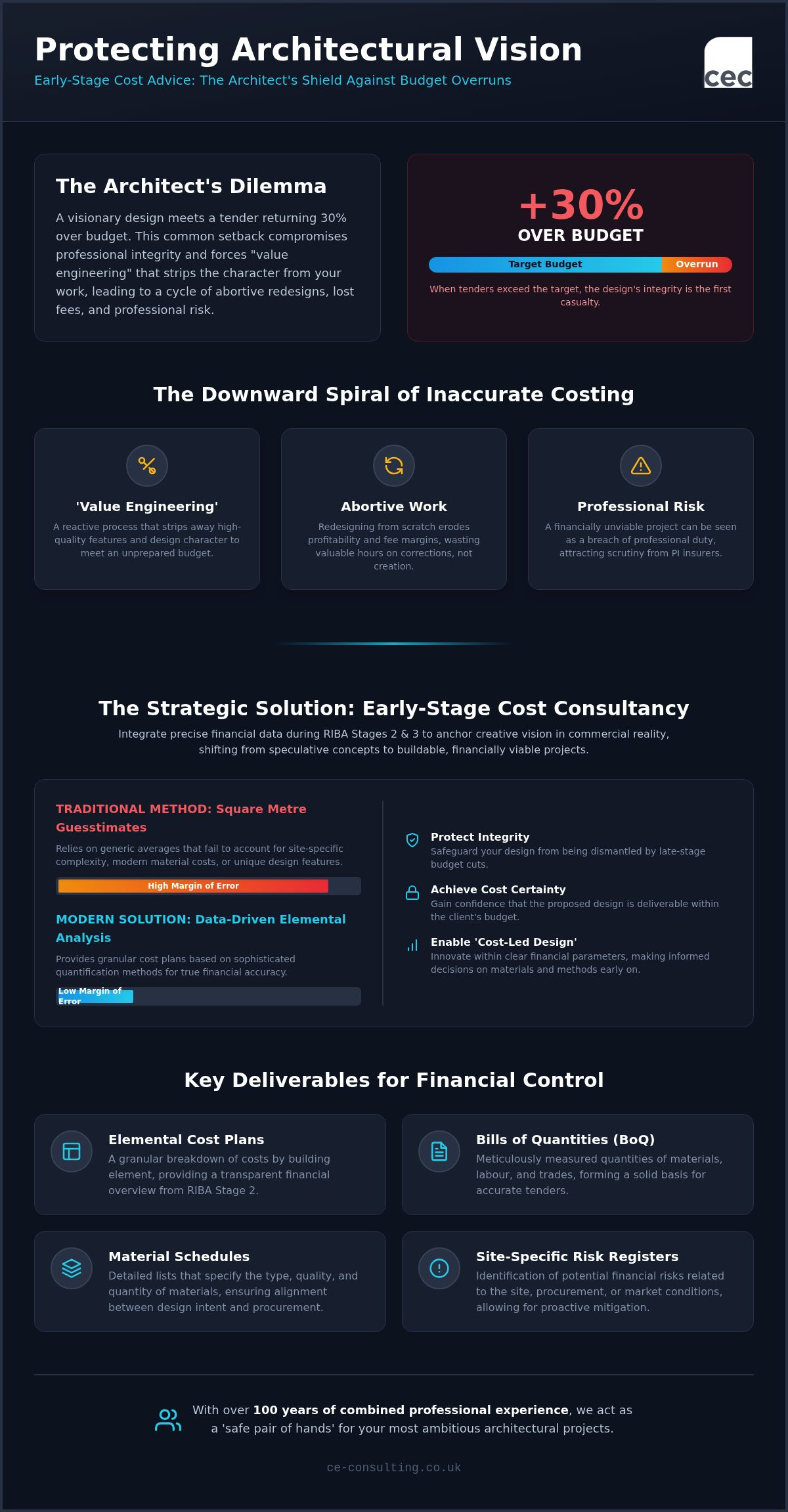
Designing a visionary structure only to see it dismantled by a tender that returns 30% over budget is more than a simple setback; it’s a compromise of your professional integrity. You likely recognise the frustration of “value engineering” that strips the character from your work, yet these redesigns are often the result of insufficient financial anchoring during the initial phases. It’s a particular challenge in complex sectors like healthcare or industrial builds, where limited internal data can lead to significant fiscal blind spots.
This guide explores how early stage cost advice for architects serves as the essential scaffolding for your creativity, ensuring that your most ambitious concepts remain grounded in commercial reality. We’ll examine how the meticulous oversight provided by Consulting Estimating Consultants helps integrate precise financial data into RIBA Stages 2 and 3 to prevent the cycle of abortive work. You’ll discover how to secure budget certainty early in the process, allowing you to focus on design excellence with the confidence that the project is financially viable from concept to completion.
Key Takeaways
- Understand why proactive financial feasibility studies are essential to protect your design’s integrity from the risks of reactive “value engineering.”
- Learn how early stage cost advice for architects replaces generic “guesstimates” with precise, data-driven elemental analysis during RIBA Stages 2 and 3.
- Discover the limitations of traditional square metre rates and how sophisticated quantification methods provide the accuracy required for complex sector-specific builds.
- Identify the strategic deliverables, such as Bills of Quantities and Materials Schedules, that foster client trust by ensuring financial control from concept to completion.
- Recognise how technical mastery and over 100 years of combined professional experience act as a “safe pair of hands” for your most ambitious architectural projects.
The Strategic Value of Pre-construction Cost Advice for Architects
In the current construction environment, architectural vision must be supported by rigorous fiscal discipline. Pre-construction cost advice is not merely a budgetary check; it is a proactive financial feasibility study that ensures a project is viable before significant resources are committed. By securing early stage cost advice for architects, design teams can transition from speculative concepts to buildable realities with confidence. This strategic oversight acts as a safeguard, ensuring that the creative process remains anchored to the commercial constraints of the client’s brief.
Waiting until the tender stage to discover the true price of a design is a high-risk strategy that often leads to catastrophic project delays. In 2026, where the Future Homes and Buildings Standards have introduced complex technical requirements and increased material costs, the margin for error is narrower than ever. If a project returns from tender significantly over budget, the architect faces not only the burden of redesigning but also a potential breach of their professional duty of care. Professional indemnity (PI) insurers increasingly look for evidence of robust cost management as part of an architect’s risk mitigation strategy. A project that is financially unviable from the outset is a professional liability.
Maintaining this level of financial discipline within your own practice is just as important as project-level budgeting. Professional support from Fair View Accounting Services can ensure your firm’s accounts are as precisely managed as your construction estimates.
Modern industry standards have shifted towards “cost-led design.” This approach does not stifle creativity; instead, it provides the parameters within which innovation can safely occur. It allows architects to make informed decisions about materials, massing, and construction methods—often by consulting with energy-efficiency specialists such as Carbon Saving Group—whilst the design is still fluid, rather than being forced into reactive changes later in the project lifecycle.
Bridging the Gap Between Design and Budget
There is often a natural tension between aesthetic ambition and the reality of construction costs. Early intervention helps to reconcile these forces by establishing a clear baseline through professional construction cost planning services. When a designer understands the financial implications of a particular facade system or structural solution at the concept stage, they can justify their choices or pivot to more cost-effective alternatives without compromising the overall vision. A detailed cost estimate provided during the early stages allows for the strategic allocation of funds, ensuring that the most impactful elements of the design are protected whilst secondary components are optimised for value.
Protecting Architectural Integrity from Abortive Work
Abortive work is the hidden drain on an architectural practice’s profitability. It occurs when a team is forced to redesign a project from scratch because the initial scheme proved too expensive to build. This process strips the design of its original integrity and erodes the architect’s fee margin, as hours are spent correcting “mistakes” rather than advancing the project. Early stage cost advice for architects prevents this cycle of “value engineering,” a term often used to describe the late-stage removal of high-quality features to save costs.
Cost certainty at RIBA Stage 2 represents the confidence that the proposed design can be delivered within the client’s defined budget, supported by a granular elemental breakdown rather than speculative estimates. By achieving this certainty early, you protect your professional reputation and ensure that the finished building remains as close to your original vision as possible.
Key Components of Early Stage Cost Consultancy
Effective cost consultancy transforms the pre-construction phase from a period of uncertainty into one of structured financial control. Rather than relying on high-level “guesstimates” or outdated price-per-square-metre averages, professional consultants provide granular deliverables that ground a design in reality. These include elemental cost plans, site-specific risk registers, and procurement strategies that align with current market conditions. By securing early stage cost advice for architects, the project team can move beyond speculative budgeting to a position of informed decision-making.
A meticulous consultant does more than just count materials; they provide a comprehensive overview of the project’s economic landscape. This involves identifying potential fiscal hurdles before they manifest as delays or budget overruns. The shift towards data-driven analysis ensures that every financial assumption is backed by evidence, providing a “safe pair of hands” for the architect’s creative vision. This technical rigour is essential for maintaining client trust during the delicate transition from concept to technical design.
Elemental Cost Analysis and Benchmarking
The core of early stage cost advice for architects lies in elemental analysis. This method breaks the building down into functional components such as the substructure, frame, and envelope. By assigning costs to these specific elements rather than applying a flat rate, designers can see exactly where the budget is being allocated. This level of detail is particularly vital for commercial construction cost management in complex sectors. For instance, a healthcare facility requires vastly different financial considerations for mechanical and electrical services compared to an industrial warehouse or a standard residential build.
Benchmarking plays a critical role in this process. Consultants draw upon historical data from similar national projects to validate current assumptions and ensure the budget is realistic. This process is supported by rigorous frameworks, similar to those found in the Cost Estimating and Assessment Guide, which emphasises the need for comprehensive and accurate data sets to ensure reliability. Using this comparative data, architects can justify design choices to clients with the backing of empirical evidence.
Risk Identification and Contingency Planning
A common pitfall in early design is “optimism bias,” where project teams underestimate the complexity or potential hurdles of a build. Professional cost advice counters this by identifying site-specific risks before the first spade hits the ground. This might include unforeseen ground conditions, utility diversions, or logistical constraints that are unique to the location. Identifying these factors early allows the architect to adjust the design or the client to adjust their expectations without the pressure of an active construction site.
Instead of applying a generic 10% contingency, a meticulous consultant develops a specific risk register. This document quantifies the financial impact of each identified risk, allowing for a more strategic allocation of funds. In 2026, market volatility remains a significant factor, with fluctuating material prices and labour shortages necessitating frequent cost updates to maintain accuracy. If you are looking to secure this level of precision for your next project, you might consider how professional cost planning can stabilise your design process and protect your project’s viability.
Comparing Cost Planning Methodologies: Beyond Square Metre Rates
Reliance on simple square metre (£/sqm) rates is a common but precarious practice in the early design phases. These figures are often derived from historical averages that fail to reflect the nuances of a specific site. They simply cannot account for the technical complexity of a modern brief. Relying on generic data is particularly risky in 2026, where the cost of achieving “zero carbon ready” status under the Future Homes and Buildings Standards can vary significantly depending on the chosen building fabric and renewable technologies. For architects designing these sustainable systems, partnering with experts like Eastern Electric can provide the necessary technical data to ensure solar PV and battery storage are accurately costed from the outset.
Integrating early stage cost advice for architects ensures that the design narrative remains supported by financial fact. Professional consultants move beyond the surface level by employing sophisticated quantification methods that build a project-specific cost model. This approach allows architects to understand the fiscal impact of their design choices in real-time, facilitating a more collaborative and transparent relationship with the client. Bespoke architecture requires a level of financial detail that generic rates cannot provide.
The Limitations of Initial Estimates
“Back of the envelope” calculations are a dangerous foundation for any professional service. Site topography, utility diversions, and logistical constraints are rarely captured in generic rates, yet they can inflate a budget by 15% or more before construction even begins. For those operating within the housing sector, adopting a residential developer quantity surveying methodology provides a more technical assessment of site-specific abnormalities. This rigour is essential for protecting the architect’s fee margin and the project’s overall feasibility.
Developing Robust Cost Frameworks
Establishing a robust cost framework involves building a model that reflects the unique geometry and performance requirements of the project. Using the New Rules of Measurement (NRM) provides a common, standardised language for all parties, ensuring that every element of the building is accounted for. This framework also facilitates life-cycle costing, which is increasingly important in the UK construction industry. Securing early stage cost advice for architects allows for the exploration of material choices not just for their immediate price, but for their long-term impact on the building’s performance and maintenance costs. This strategic oversight ensures that the finished project is both beautiful and commercially viable.
Integrating Cost Consultancy into the RIBA Plan of Work
Aligning financial oversight with the RIBA Plan of Work ensures that cost management is a structural component of the project rather than an afterthought. This integration creates a continuous feedback loop between the architect and the estimator, allowing for real-time adjustments as the design evolves. Rather than working in silos, the project team benefits from a collaborative environment where every design iteration is tested against the budget. By securing early stage cost advice for architects at the inception of a project, you establish a financial framework that supports the technical delivery of the build. It’s a methodical approach that replaces reactive “value engineering” with proactive design optimisation, ensuring that the creative vision is never divorced from fiscal reality.
Stages 0-2: Establishing the Brief and Concept
During the Strategic Definition and Preparation stages, the primary goal is to set a realistic budget before any design work is formalised. This is particularly critical for public sector projects or cost planning for school extensions, where funding is often fixed and regulatory compliance is stringent.
Initial feasibility studies and elemental breakdowns at Stage 2 provide the architect with the parameters needed to explore creative solutions without exceeding the client’s financial limits. At this point, the estimator can provide high-level data on different structural options or facade treatments, allowing the architect to make an informed choice amongst several viable paths. This early intervention prevents the waste of professional resources on unbuildable concepts and ensures that the project starts on a firm financial footing.
Stage 3: Coordinating the Technical Design
As the project moves into Spatial Coordination, the cost plan must be refined to reflect emerging technical details. This stage involves a more granular analysis of the design, ensuring that the “frozen design” remains within the established budget. Refined early stage cost advice for architects at this point ensures that the technical design is actually within the client’s financial reach before the project progresses to the construction phase. It is at this point that the team prepares for the transition to formal bills of quantities, which will form the basis of the tender documents.
Refined data at Stage 3 mitigates the risk of surprises during the procurement phase. When the design and budget are perfectly aligned, the tender process becomes significantly smoother, as contractors are provided with clear, unambiguous documentation. This level of detail reduces the likelihood of contractors adding high risk premiums to their bids, as they have greater confidence in the project’s scope. This precision is what allows a practice to maintain its reputation for delivering on-budget projects. If you require technical mastery to protect your design’s viability, our tender support and cost planning can provide the “safe pair of hands” your project needs.
Partnering with Consulting Estimating Consultants for Precision Estimating
Architectural excellence is rarely achieved in a financial vacuum. It requires a partnership with consultants who possess the technical mastery to translate visionary design concepts into precise, actionable economic data. Consulting Estimating Consultants serves as a “safe pair of hands” for UK practices, offering a level of grounded confidence that only comes from extensive industry experience. With over 100 years of combined professional experience, our team provides the early stage cost advice for architects needed to navigate the complexities of modern construction. We approach every task with a serious, disciplined mindset, ensuring that your project remains commercially viable from the initial brief to final completion. Our role is to provide the financial control that allows your creativity to flourish without the risk of budget overruns or compromised design integrity.
Trust is the cornerstone of our consultancy. We understand that an architect’s reputation depends on the delivery of projects that are both beautiful and buildable. By integrating our expertise into your workflow, you gain a partner who values long-term stability and meticulous detail. This collaborative approach ensures that every financial assumption is tested and validated, providing the peace of mind that comes from knowing your project is anchored by professional rigour. We don’t just provide numbers; we provide the strategic oversight necessary to protect your designs from the pressures of late-stage value engineering. For practice owners looking to apply this same level of financial discipline to their firm’s operations, it can be highly beneficial to explore Business Coaching & Strategy to secure long-term commercial success.
Leveraging Conquest Software for Unrivalled Accuracy
The accuracy of an estimate is inherently linked to the sophistication of the tools employed. We have moved beyond the limitations of basic spreadsheets, utilising Conquest Estimating software to deliver unrivalled precision in our cost planning. This industry-leading platform facilitates digital take-offs and provides access to integrated cost databases that are updated to reflect the volatile market conditions of 2026. For architects, this translates to faster turnaround times and more reliable data points during the critical concept stages. By leveraging this technology, we can identify potential fiscal discrepancies early, providing a level of thoroughness that protects your professional reputation and ensures a seamless transition into the technical design phase. Digital take-offs allow for a more granular analysis of the building’s elements, ensuring that no detail is overlooked in the pursuit of cost certainty.
A National Expertise Across Every Sector
Our expertise is not limited by geography or sector. We provide comprehensive coverage across the UK, supporting architects in the residential, healthcare, education, and industrial sectors. This wide-ranging experience ensures that we can provide nuanced advice regardless of the project’s specific requirements. As a premier quantity surveying consultancy UK, we understand the regulatory and financial pressures facing designers today. Our goal is to act as a dependable guide, offering the strategic oversight and technical detail required to bring ambitious architecture to life. Contact Consulting Estimating Consultants for a meticulous approach to your next project.
Securing the Financial Foundations of Architectural Excellence
Realising an ambitious architectural vision requires more than creative ingenuity; it demands a rigorous commitment to financial feasibility. By transitioning from generic square metre rates to data-driven elemental analysis, you protect your design integrity from the risks of late-stage value engineering. Integrating professional early stage cost advice for architects into the RIBA Plan of Work ensures that every technical decision is supported by commercial reality, preventing the drain of abortive work whilst fostering deeper client trust.
At CE Consulting, we provide the technical mastery required to anchor your most complex projects. With over 100 years of combined industry experience and a specialised focus on Conquest Estimating software, our meticulous, detail-oriented approach ensures that no detail is overlooked. We act as a dependable guide, offering the precision and reliability needed to navigate the evolving regulatory landscape of 2026. Secure your project’s financial future with professional cost advice from CE Consulting and ensure your concepts are buildable from the first sketch to the final handover. We look forward to supporting your next project with the steady, expert oversight it deserves.
Frequently Asked Questions
What is the difference between a cost estimate and a cost plan?
A cost estimate provides a high-level overview of the total project expenditure, often based on historical square metre rates or preliminary data. In contrast, a cost plan is a dynamic, elemental document that breaks the budget down into specific components, such as the substructure or envelope, and evolves alongside the design to maintain financial control.
How much does early stage cost advice typically cost for an architect?
Professional fees for pre-construction advice are typically influenced by the project’s complexity and the specific deliverables required. Some consultants provide fixed-fee packages for individual RIBA stages, whilst others may structure their fees as a small percentage of the estimated construction value to reflect the scope of the work involved.
Can pre-construction cost advice help with planning applications?
Yes, cost advice is instrumental in demonstrating the financial viability of a scheme, which is frequently a requirement for local authority planning departments. This is particularly relevant for projects involving community infrastructure levies or affordable housing contributions, where formal viability assessments are often mandatory to secure approval.
At what RIBA stage should I first involve a quantity surveyor?
Involving a consultant at RIBA Stage 1 or early Stage 2 is considered best practice for modern architectural projects. Securing early stage cost advice for architects at this point allows the budget to act as a design parameter rather than a constraint, ensuring that the concept is buildable before significant resources are invested in technical design.
How does Conquest software improve the accuracy of early cost advice?
Conquest software facilitates digital take-offs directly from architectural drawings, which significantly reduces the margin for human error. It integrates real-time market data and historical benchmarks into a single platform, allowing for faster and more reliable elemental breakdowns compared to traditional manual spreadsheets or basic calculation tools.
What happens if the cost advice shows the project is over budget?
If the project exceeds the initial budget, the elemental breakdown allows the team to identify specific areas where savings can be made without compromising the core design integrity. This proactive approach enables the architect to pivot or re-specify materials whilst the design is still fluid, avoiding the need for costly and time-consuming redesigns later.
Is early stage cost advice necessary for small residential projects?
Small residential projects benefit significantly from early advice because private clients often have very strict financial limits and little room for unforeseen expenses. Even a minor budget overrun can halt a domestic build, making early stage cost advice for architects an essential tool for protecting both the project’s viability and the architect’s professional reputation.
How do you handle market price fluctuations in pre-construction planning?
Market fluctuations are managed through the use of specific risk registers and price inflation allowances that reflect current industry trends. Rather than applying a generic contingency, consultants use real-time market data to adjust the cost plan frequently, ensuring that the budget remains realistic and resilient as the project moves towards the tender stage.