



With construction input prices rising by 6.2% in the first four months of 2026 alone, a single measurement error can now dissolve a project’s entire profit margin before the first spade hits the ground. You likely recognise that inconsistent tender returns and manual measurement errors are no longer just inconveniences; they’re significant liabilities in a volatile market. The pressure to maintain absolute financial control whilst managing complex supply chains has never been higher for developers and contractors across the United Kingdom.
This guide demonstrates how professional boq preparation serves as a strategic financial shield, protecting your commercial interests and ensuring every subcontractor bids on an identical, precise scope of work. By investing in technical rigour at the pre-construction stage, you can secure a highly competitive tender process and eliminate the budget deficits that frequently stem from inaccurate take-offs. We will explore how a meticulous approach to measurement provides a definitive financial roadmap from the initial concept through to final completion, instilling a sense of security and confidence in your project’s long-term commercial viability.
Key Takeaways
- Understand how the systematic itemisation of project components establishes a robust framework for financial control and contract administration.
- Discover why professional boq preparation is vital for creating a level playing field during the tender process, ensuring all parties bid on a precise and identical scope.
- Learn how transitioning from manual spreadsheets to advanced digital tools like Conquest Estimating software allows for rapid, accurate adjustments when design changes occur.
- Recognise the value of sector-specific knowledge and technical mastery in mitigating the risks of litigation and budget overruns on complex projects.
What is Professional BoQ Preparation in Modern Construction?
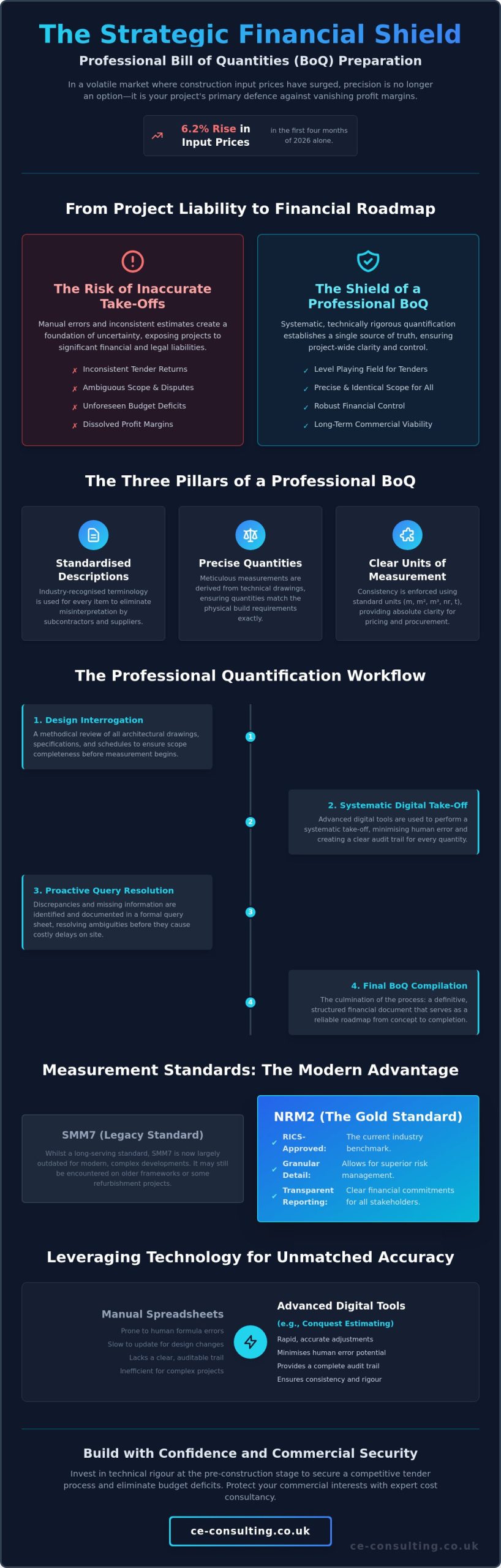
Professional boq preparation is the systematic itemisation of every component within a construction project, transforming complex architectural designs and structural specifications into a structured financial document. It serves as the commercial backbone of a project, providing the necessary detail for both tender documentation and ongoing contract administration. Without this level of precision, a project lacks a reliable baseline for cost control, leaving the developer or contractor vulnerable to unforeseen variations.
To understand the foundational role of this document, one might ask, What is a Bill of Quantities? At its core, it’s a definitive schedule that ensures every tendering contractor prices the exact same scope of work. This eliminates the ambiguity that often arises from “rough take-offs” or hurried estimates produced under time pressure. Whilst a quick estimate might seem efficient in the short term, it frequently leads to budget deficits and legal disputes during the construction phase. Professional preparation provides the “safe pair of hands” that developers and main contractors require to safeguard their margins and maintain project momentum.
The Core Components of a Professional Bill
A high-quality Bill of Quantities is built upon three fundamental pillars that ensure technical rigour and pricing transparency:
- Standardised Work Descriptions: Every item of work is described using industry-recognised terminology to prevent misinterpretation by subcontractors or suppliers.
- Precise Quantities: Every measurement is meticulously derived from the technical drawings, ensuring that the quantities reflected in the document match the physical requirements of the build.
- Clear Units of Measurement: Consistency is maintained through the use of standard units such as linear metres (m), square metres (m2), cubic metres (m3), numbers (nr), or tonnes (t).
Standard Methods of Measurement: NRM2 vs SMM7
In the United Kingdom, the precision of a BoQ depends on the measurement rules applied during its creation. Adhering to the New Rules of Measurement (NRM2) is now considered the industry gold standard for detailed measurement. NRM2 is the RICS-approved suite of rules specifically designed for the professional boq preparation and the quantification of building works.
Whilst SMM7 (Standard Method of Measurement, 7th Edition) served the industry for decades, it’s now largely considered a legacy standard. You may still encounter SMM7 on older frameworks or specific refurbishment projects, yet modern, complex developments demand the granular detail provided by NRM2. This modern standard allows for better risk management and more transparent cost reporting throughout the project lifecycle, ensuring all stakeholders have a clear understanding of the financial commitments involved. For a deeper understanding of how these measurement standards apply in practice, our guide on the bill of quants and construction quantification fundamentals provides essential context for navigating these distinctions.
The Step-by-Step Process of Professional Quantification
Professional quantification is a disciplined workflow that transforms abstract designs into a concrete financial framework. It begins with a methodical interrogation of the architectural and structural design package, where every drawing, specification, and schedule is scrutinised for completeness. This initial review ensures that the estimator understands the project’s unique constraints before the measurement begins. Unlike basic counting exercises, professional boq preparation requires a deep understanding of construction logic and sequence to ensure the final document reflects the reality of the site.
Once the project scope is fully understood, estimators perform a systematic take-off using advanced digital measurement tools. This digital approach minimises human error and provides a clear audit trail for every quantity extracted. During this phase, it is common to identify discrepancies or missing information within the design. These are documented in a formal query sheet, which serves as a vital communication bridge between the design team and the contractor. Resolving these ambiguities during the pre-construction phase significantly Reduces Project Risk by preventing costly delays once works have commenced.
Technical Take-offs and Extraction Accuracy
A hallmark of professional boq preparation is the ability to “read between the lines” of a technical drawing. Amateurs often overlook the “preliminaries” and temporary works, such as scaffolding, site hoarding, or temporary power, which can represent a substantial portion of the project cost. A professional take-off ensures every cubic metre of concrete and tonne of steel is accounted for, alongside the less visible requirements like earthwork support or dewatering. This technical rigour ensures that the contractor’s bid is both realistic and sustainable, protecting the commercial health of the entire supply chain.
The Query Process: Resolving Design Gaps
The query process is perhaps the most undervalued aspect of professional quantification. By identifying missing details or conflicting specifications early, the estimator allows the architect to provide clarification before a contract is signed. This proactive approach reduces the need for expensive “variations” and claims during the construction phase, which are often the primary cause of budget overruns. The resulting Bill of Quantities acts as a definitive bridge between the architect’s vision and the contractor’s commercial reality. Many developers find that engaging early tender support helps to iron out these design gaps before they become financial liabilities.
The final stage of the process involves the production of a draft Bill for client review. This document is not merely a list of materials; it is a strategic asset that allows for precise cost planning and comparison. Once finalised, the Bill of Quantities provides a robust baseline for the tender process, ensuring that every contractor is pricing the exact same scope of work with absolute clarity.
Why Professional BoQ Preparation Reduces Project Risk
A primary benefit of professional boq preparation is the creation of a level playing field for all tendering parties. When every contractor receives an identical, meticulously itemised list of requirements, the element of “guesswork” is effectively removed from the bidding process. This transparency ensures that you aren’t simply selecting the cheapest bid, but rather the most accurate and sustainable one. Without this structured approach, contractors are forced to make assumptions that often lead to inflated contingencies or, conversely, dangerously low bids that result in project abandonment later. Understanding precisely what a bill of quants is and how it eliminates tender price volatility is the first step towards protecting your project’s commercial viability.
You may encounter the argument that “rough estimates” or “percentage-based allowances” are faster during the early stages of a project. Whilst this might save a few days during pre-construction, it frequently leads to expensive litigation once the build commences. Speed at the outset is a poor trade-off for the financial instability that follows. By establishing a definitive commercial baseline, you protect your project from the adversarial relationships that typically emerge when quantities are disputed mid-build. Professional quantification provides a steady, composed foundation that keeps all stakeholders aligned on the project’s financial reality.
Beyond the tender phase, a professional Bill is an essential tool for managing monthly valuations and progress payments. It allows for a methodical assessment of work completed, ensuring that you only pay for what has actually been delivered on-site. This level of oversight provides a psychological advantage when dealing with lenders and institutional investors. Presenting a technical, RICS-compliant document demonstrates a high degree of financial rigour, instilling confidence that the project is under the guidance of a “safe pair of hands.”
Preventing Construction Cost Overruns
Precise quantification is the most effective way to stop “budget creep,” particularly in large-scale residential developments where small errors in unit measurements are magnified across hundreds of plots. While financial control is paramount, developers often seek specialist input for the living spaces themselves; in this regard, you can discover Neil Norton Design for professional consultation on residential interior projects. When your material schedules are derived from a professional Bill, supply chain efficiency improves because procurement is based on fact rather than approximation. Industry professionals frequently observe that a significant majority of construction disputes stem directly from ambiguities in quantity or scope, making technical rigour your first line of defence against overruns.
Standardising Tender Returns
Standardising tender returns allows for a true “apples-to-apples” comparison of prices across different bidders. It prevents the risk of a contractor pulling out of a project because they realised they “under-priced” a scope that wasn’t clearly defined. By providing a professional Bill, you ensure that every subcontractor understands their obligations from day one. This clarity reduces the likelihood of unexpected claims for “extras” and ensures that the financial roadmap established at the start remains viable until the final account is settled.
Leveraging Technology: The Conquest Estimating Advantage
Manual spreadsheets have long been the industry default, yet they represent a significant point of failure in modern commercial projects. A single broken formula or an accidental deletion in a vast Excel workbook can lead to catastrophic financial discrepancies. Professional boq preparation has evolved beyond these fragile systems, moving instead towards robust, industry-leading platforms like Conquest Estimating software. This transition isn’t merely about speed; it’s about establishing an unshakeable audit trail that provides absolute transparency for developers, architects, and stakeholders alike.
By utilising specialised software, estimators can implement rapid adjustments whenever design changes occur. In a market where material costs and lead times fluctuate, the ability to update a Bill of Quantities across all relevant work items simultaneously is a vital strategic advantage. This ensures that the financial roadmap remains current and accurate, rather than becoming a static document that loses relevance as the project progresses. Software-driven BoQs allow for the seamless export of data into procurement programmes, ensuring that the commercial vision established during the tender phase is maintained throughout the build.
Speed vs Accuracy in Digital Estimating
Digital estimating platforms significantly reduce the risk of human error by automating complex calculations and cross-referencing data points. Conquest, currently on version 7.1.3, is often the preferred choice for high-value commercial and industrial tenders because it utilises integrated libraries of work items. These libraries ensure that descriptions remain consistent and compliant with NRM2 standards, preventing the ambiguity that leads to subcontractor disputes. Whilst manual entry might suffice for minor residential works, complex projects require the technical rigour that only a dedicated software solution can provide.
Integrating BoQs with Material Schedules
A sophisticated Bill of Quantities should not sit on a shelf; it should function as a live procurement tool for site managers. Data from a professional Bill can be exported directly into Consulting Estimating Consultants material schedules, allowing for a seamless transition from the tender office to the construction site. This integration allows project teams to link specific quantities to delivery schedules, which is essential for optimising cash flow and managing site logistics. When procurement is driven by verified quantities rather than site-based estimates, the risk of material waste and budget overruns is drastically reduced.
To ensure your project benefits from this level of technical oversight, you can request a professional BoQ consultation to see how digital measurement can protect your margins and provide a clear roadmap for your site team.
Choosing a Strategic Partner for Cost Consultancy
The selection of a consultancy partner is a decision that dictates the financial stability of your entire project. It’s not enough to simply produce a list of quantities; you need a partner who understands the strategic implications of every measurement. Consulting Estimating Consultants brings over 100 years of combined industry experience to every commission, acting as a national partner for professional boq preparation. This collective mastery ensures that your project is handled with the technical rigour and commercial discipline it deserves, providing a level of security that smaller, less experienced firms cannot match.
Independence is a critical factor in cost consultancy. An independent cost consultant provides unbiased financial oversight, acting as a critical check and balance against project optimism or design creep. This objectivity is particularly vital when managing sector-specific requirements. Whether you’re navigating the complex mechanical and electrical requirements of a healthcare facility or the fast-track demands of a retail fit-out, sector-specific knowledge is essential for BoQ accuracy. A generic approach often misses the nuanced cost drivers that define success in specialised environments like education or industrial sectors.
Tailored Solutions for Residential Developers
Large-scale new build projects present unique cost drivers that require meticulous management from the outset. Professional Bills of Quantities are instrumental in supporting project viability assessments for lenders, providing the granular detail they need to release funding with confidence. By engaging with Quantity Surveying for Residential Developers, you ensure that your financial roadmap is robust enough to withstand market fluctuations. This level of professional boq preparation allows developers to maintain control over their margins from the initial land appraisal through to final site completion.
Supporting Main Contractors and Subcontractors
For main contractors and subcontractors, outsourcing quantification frees up valuable in-house resources. Instead of spending weeks on manual measurements, your team can focus on project delivery and site management. Presenting professional, transparent tender data helps you win more bids by demonstrating a high degree of commercial competence to your clients. For a comprehensive analysis of the cost and strategic benefits involved, our guide to deciding whether to outsource bills of quantities provides a detailed framework for evaluating this decision. It’s the “safe pair of hands” approach to tender bid preparation support that transforms a reactive bidding process into a proactive commercial strategy. Relying on a steady, experienced partner ensures that every bid you submit is backed by technical mastery and absolute precision, protecting your reputation and your bottom line.
Securing Your Project’s Commercial Future
Establishing a definitive financial roadmap is no longer a luxury in the United Kingdom’s construction market; it’s a fundamental requirement for long-term project viability. By prioritising technical rigour through professional boq preparation, you effectively eliminate the ambiguity that leads to budget deficits and supply chain disputes. We have explored how systematic quantification and the adoption of advanced platforms like Conquest Estimating provide the transparency lenders and stakeholders demand. This disciplined approach ensures your project remains commercially sound from the initial tender through to the final account.
Our team brings over 100 years of combined professional experience to every commission, offering national coverage across all construction sectors. As specialists in Conquest Estimating software, we provide the meticulous oversight needed to protect your margins and instill confidence in your delivery team. You can request a professional BoQ preparation quote from our expert team today to secure the commercial health of your next development. We look forward to acting as your trusted partner in achieving absolute financial control.
Frequently Asked Questions
What is the difference between a Bill of Quantities and a take-off?
A construction take-off is the raw process of measuring and counting the materials required from a set of drawings. In contrast, professional boq preparation involves taking those measurements and organising them into a formal document with standardised descriptions and units. Whilst a take-off is a necessary step, the Bill of Quantities is the comprehensive commercial framework used for tendering and contract administration.
How much does professional BoQ preparation cost for a mid-sized project?
The cost of quantification services is typically determined by the project’s complexity, the quality of the design information, and the total number of work items involved. Most consultancies provide bespoke quotations after an initial review of the architectural and structural packages. This ensures that the fee accurately reflects the technical rigour and level of detail required to protect your project’s specific profit margins.
Is a Bill of Quantities mandatory for all UK construction tenders?
A Bill of Quantities isn’t a legal requirement for every tender, but it’s often mandatory for specific contract forms, such as the JCT Standard Building Contract with Quantities. For high-value or complex developments, most UK developers and local authorities insist on a professional Bill. This ensures all contractors bid on an identical scope, which significantly reduces the risk of commercial disputes during the build.
Can a BoQ be prepared from a BIM model or 3D drawings?
Modern quantification processes frequently utilise BIM models and 3D CAD data to improve extraction accuracy. Specialised BIM and VDC studios, such as CRAYDL, provide the technical framework necessary to generate high-fidelity models for quantification. Advanced software like Conquest allows estimators to integrate this digital data directly, which reduces the “human error” factor in complex calculations. Even when using digital models, a professional estimator will still interrogate the data to ensure that temporary works and site-specific preliminaries are correctly accounted for in the final document.
How long does it typically take to produce a professional Bill of Quantities?
The timeline for production depends on the scale of the project, but a professional Bill for a mid-sized commercial development usually takes between two and four weeks. This duration allows for a methodical review of the design package, the systematic take-off, and the essential query process. Rushing this pre-construction phase often leads to the very inaccuracies that a professional document is designed to prevent.
What happens if there is an error in the Bill of Quantities after the contract is signed?
The resolution of errors depends on the chosen form of contract. Under a “with quantities” contract, the employer generally carries the risk for any inaccuracies in the Bill, which can lead to variations and an increase in the contract sum. This highlights why investing in technical rigour during the pre-construction stage is a vital risk management strategy for any developer or main contractor.
Why should I outsource BoQ preparation instead of doing it in-house?
Outsourcing provides access to a “safe pair of hands” with specialist experience across multiple sectors that an in-house team may not possess. It allows your internal staff to focus on project delivery whilst ensuring your tenders are compliant with the latest NRM2 standards. External consultants often identify design gaps and ambiguities more effectively, providing an unbiased level of financial oversight that protects your commercial interests. For a detailed cost-benefit analysis of this decision, our strategic buyer’s guide to outsourcing bills of quantities examines the fixed-price and risk-management advantages of working with a specialist consultancy.
Does a professional BoQ help with securing project finance from banks?
Lenders and institutional investors view a professional BoQ as a sign of high-level financial discipline and project readiness. Presenting a technical, RICS-compliant document demonstrates that the project’s costs have been calculated with precision, which reduces the bank’s perceived risk. It also provides a clear, transparent roadmap for monthly valuations, making it easier for monitoring surveyors to approve funding drawdowns as the project progresses.