



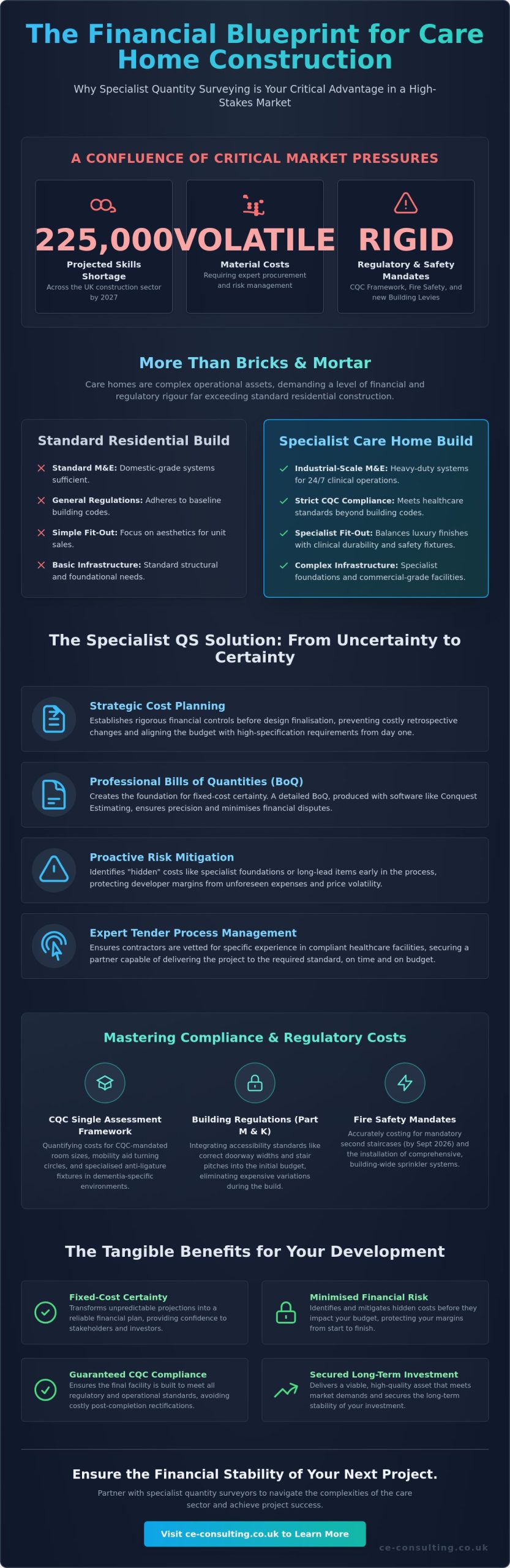
With a projected skills shortage of 225,000 workers across the UK by 2027 and material costs remaining stubbornly volatile, a care home development can shift from a viable asset to a financial liability before the first brick is laid. Specialist quantity surveying for care home construction is no longer a luxury; it’s a fundamental requirement for any developer navigating the complexities of the modern market. You understand that the margin for error is non-existent when balancing high-specification M&E requirements against the rigid demands of the CQC’s Single Assessment Framework.
We recognise the pressure of maintaining commercial viability whilst meeting the September 2026 fire safety mandates for second staircases and the existing requirements for comprehensive sprinkler systems. This guide reveals how precise cost planning and expert oversight provide the financial control necessary to manage these variables. You’ll discover how accurate Bills of Quantities and strategic tender support minimise risk and ensure the delivery of a CQC-compliant facility. We will explore the methodologies that transform unpredictable projections into fixed-cost certainty, securing the long-term stability of your investment.
Key Takeaways
- Understand why the high-stakes financial landscape of care home development requires significantly more rigour than standard residential construction.
- Learn to accurately quantify the costs associated with stringent CQC spatial standards and specialised infection control infrastructure.
- Discover how specialist quantity surveying for care home construction establishes fixed-cost certainty through the production of professional Bills of Quantities.
- Identify the strategic advantages of using advanced Conquest Estimating software to ensure precision in complex healthcare take-offs.
- Master the tender process by learning how to vet contractors with specific experience in delivering compliant healthcare facilities.
The Strategic Importance of Quantity Surveying in Care Home Construction
The financial landscape for UK care home developments in 2026 is defined by extreme precision. Developers face a unique set of pressures, including the new Building Safety Levy due in October 2026 and a projected construction skills shortage of 225,000 workers by 2027. Unlike standard residential blocks, care homes are operational assets where every square metre must generate value whilst adhering to strict CQC standards. This is why quantity surveying for care home construction is the pivot point for project success. It moves the process beyond simple estimation into the realm of strategic financial engineering.
A professional Quantity surveyor provides more than just a list of costs. They act as a seasoned partner who ensures commercial viability from the earliest feasibility stages. By implementing rigorous cost planning before the design is finalised, developers can avoid the catastrophic expense of retrospective changes. In a sector where mid-level refurbishment costs can reach £1,500 per m², failing to account for specific healthcare requirements early on is a risk few can afford. Our role is to provide the grounded confidence that your capital is being deployed effectively.
Navigating High-Spec Construction Requirements
Care facilities demand a level of specification that standard residential estimating cannot capture. Dementia-friendly design requires specific acoustic treatments and lighting levels that carry distinct price points. We must also quantify the heavy-duty infrastructure for commercial kitchens and laundries, which differ significantly from domestic equivalents. The challenge lies in balancing luxury finishes, which attract self-funding residents, with the industrial-grade durability required for 24/7 clinical operations. Meticulous cost planning ensures these high-spec elements don’t erode the project’s bottom line.
Risk Mitigation in Care Sector Developments
Risk in this sector often hides beneath the surface. Specialist foundations required for heavy medical equipment or structural frames designed for enhanced fire safety can lead to unforeseen expenses if not identified early. A specialist QS identifies these “hidden” costs during the initial construction take-offs. Additionally, long-lead items for specialised healthcare fit-outs, such as nurse call systems or anti-ligature fixtures, require early procurement strategies to manage price volatility. Protecting developer margins in 2026 requires a disciplined approach to risk, ensuring that every contingency is backed by technical data rather than guesswork.
Navigating Regulatory Costs: CQC Standards and Specialized Infrastructure
Compliance is the most significant cost driver in modern care home construction. The Care Quality Commission (CQC) Single Assessment Framework, alongside the stricter registration process implemented in February 2026, requires developers to demonstrate a level of safety and operational readiness that generalist estimators often overlook. Quantity surveying for care home construction must go beyond basic materials to quantify the financial impact of CQC spatial requirements. Whilst the CQC doesn’t set construction standards directly, its operational mandates dictate room sizes, turning circles for mobility aids, and the installation of anti-ligature fixtures in dementia-specific environments.
Adherence to Building Regulations Part M and Part K is equally critical, influencing everything from doorway widths to the pitch of stairs. Professional cost management ensures these requirements are integrated into the initial budget rather than added as expensive variations later. The role of the surveyor involves meticulous contract negotiation and ensuring projects meet these statutory obligations, a responsibility detailed by the UK government’s National Careers Service. This oversight prevents the “compliance gap” that often leads to budget overruns during the final inspection stages.
M&E Complexity in Care Environments
The mechanical and electrical (M&E) requirements for care facilities are industrial in scale. Specialist quantity surveying for care home construction must account for high-spec HVAC systems with advanced air filtration for infection control, alongside medical gas infrastructure and backup power solutions. Fire suppression is another major premium; since March 2025, all new care homes require comprehensive sprinkler systems, whilst buildings over 18 metres must include a second staircase from September 2026. Integrating smart monitoring and nurse-call systems adds further layers of technical detail that require precise quantification to maintain financial control.
Sustainability and Future-Proofing Costs
Achieving BREEAM “Excellent” or “Outstanding” ratings is increasingly becoming a requirement for planning approval and investor backing. Whilst the initial cost of energy-efficient building envelopes and renewable energy systems is higher, the long-term operational savings provide a compelling return on investment. Meticulous cost planning allows developers to weigh these capital expenditures against future utility reductions. Regulatory compliance directly correlates to project contingency sizing, as any deviation from statutory safety or care standards necessitates immediate, high-cost remedial work.
Bills of Quantities and Cost Planning: The Foundation of Financial Control
Precision in the pre-construction phase is the only way to safeguard a project’s margin. In the specialised field of quantity surveying for care home construction, the margin for error is exceptionally slim. This is why professional bills of quantities (BoQ) are considered non-negotiable for any serious care home tender. A robust BoQ provides a level playing field for contractors, ensuring that every tender return is based on identical, meticulously measured data. Without this, developers risk “front-end loading” or hidden exclusions that lead to disputes and cost overruns once the project is underway.
Our approach leverages the power of Conquest Estimating software to handle the intricate requirements of healthcare facilities. This technology allows us to manage complex healthcare take-offs with a level of detail that manual methods simply cannot match. From quantifying every individual grab rail and anti-slip floor finish to accounting for specialised acoustic light fittings, we ensure nothing is missed. By utilising Conquest, we translate architectural complexity into a structured financial framework that leaves no room for ambiguity. Precision is paramount.
Achieving Precision with Construction Take-offs
The process of translating complex architectural drawings into accurate material lists is a core discipline. Meticulous construction take-offs reduce waste and prevent the common pitfall of over-ordering materials, which is vital when managing high-cost specialised items. An independent take-off serves as a “second pair of eyes” for main contractors, identifying potential discrepancies in the design before they manifest as physical errors on site. This methodical measurement ensures that the materials schedule aligns perfectly with the project’s technical requirements.
Strategic Cost Planning for Care Home Viability
Effective cost planning moves beyond initial budget estimates to provide a detailed roadmap for the project’s financial journey. We provide architects with real-time cost data to inform design decisions, ensuring that aesthetic choices don’t compromise the facility’s commercial viability. In a market where inflation and supply chain volatility can impact the cost of specialised healthcare components, our strategic oversight allows for proactive adjustments. This disciplined approach to quantity surveying for care home construction ensures that the final design is both high-quality and financially sustainable.
Optimising the Tender Process for Care Home Developments
The tender stage represents the critical juncture where strategic planning meets market reality. Ambiguity here is expensive. In the field of quantity surveying for care home construction, the role of the surveyor is to translate complex design intent into a robust set of tender documents that leave no room for contractor guesswork. By providing a comprehensive package, we ensure that every bidder understands the technical nuances of the project, from the specific acoustic requirements of dementia-friendly spaces to the industrial-grade infrastructure of commercial laundries. This clarity reduces the volume of tender queries and prevents the project from being stalled by avoidable technical clarifications.
Identifying and vetting the right partners is equally vital. A contractor with a stellar reputation in standard residential construction may lack the specific expertise required for a healthcare facility. We scrutinise potential bidders for a proven track record in the care sector, ensuring they possess a deep understanding of the CQC’s operational requirements and the latest fire safety mandates. When bids arrive, we perform a meticulous “apples for apples” comparison. This is particularly critical for complex M&E packages, where we ensure that every essential component, such as nurse-call systems or specialised HVAC filtration, is fully accounted for in the bid price.
Tender Support for Main Contractors and Subcontractors
Winning a healthcare tender requires a bid that reflects the true complexity of the build whilst remaining competitive. We assist contractors by identifying risks in the tender drawings, such as potential clashes between medical gas routing and structural frames, before they manifest as on-site variations. By providing accurate cost data and detailed construction take-offs, we help bidders protect their profit margins and present a transparent, reliable proposal to the developer. Our expertise ensures that your bid is grounded in technical reality rather than optimistic estimation.
Negotiating the Final Contract Sum
Value engineering is a delicate balancing act in the care sector. We use our detailed cost plans as a lever during negotiations to find financial efficiencies that do not compromise CQC compliance or resident safety. It’s also essential to ensure that provisional sums for specialised items are realistic and based on current market data rather than placeholders. A well-prepared BoQ significantly reduces the likelihood of post-contract disputes by providing an agreed-upon, transparent basis for all future valuations and variations. Secure your project’s financial future with our professional tender support services.
Partnering with Consulting Estimating Consultants for Care Sector Success
The successful delivery of a modern care facility requires a synthesis of technical expertise and financial rigour. As the regulatory and economic pressures on the UK construction sector intensify, the need for a seasoned partner becomes paramount. We offer over 100 years of combined professional experience in UK construction, providing the “safe pair of hands” that developers and contractors require. Our quantity surveying for care home construction services are built on a foundation of technical mastery, ensuring that every project we touch is grounded in financial reality.
We provide a comprehensive suite of services, including detailed construction take-offs and strategic cost planning, tailored specifically to the healthcare market. By outsourcing these critical functions to our technical specialists, you gain access to a level of detail that internal teams may struggle to replicate. We support architects, developers, and contractors nationwide, acting as a disciplined extension of your pre-construction department. Our meticulous approach using Conquest software ensures that your data is accurate, your tenders are robust, and your margins are protected.
Why Choose Our Specialist Care Home Estimators?
Our team possesses a deep understanding of healthcare-specific procurement and the unique cost drivers that define the sector. We don’t just measure materials; we quantify the complexities of compliance and specialised care infrastructure. This commitment to precision provides the financial peace of mind required for large-scale healthcare investments. When the stakes involve CQC registration and long-term asset value, having a partner who values accuracy over speed is a strategic advantage. We ensure your care home project is delivered within budget whilst maintaining the high standards expected by residents and regulators alike—a standard of excellence also championed by the Quality Comprehensive Health Center.
Next Steps for Your Care Home Development
Integrating our expertise into your pre-construction programme is a straightforward process designed to add immediate value. Whether you require a professional Bill of Quantities for a complex tender or a detailed cost plan to secure funding, we provide the clarity you need to proceed with confidence. Every project begins with a thorough review of your requirements, followed by a bespoke fee proposal that reflects the specific scope of your development. Take the first step towards securing your project’s commercial viability and enquire about our care home quantity surveying services today. Our disciplined approach to quantity surveying for care home construction is the safeguard your investment deserves.
Securing the Financial Future of Your Care Facility
Success in the care sector requires a disciplined approach to financial oversight that generalist estimating cannot provide. We’ve explored how meticulous cost planning and the production of accurate Bills of Quantities mitigate the risks associated with volatile material prices and stringent CQC mandates. By integrating specialist quantity surveying for care home construction, you ensure that complex M&E requirements and fire safety regulations are fully quantified before the first contractor is engaged. This level of detail is the only way to maintain commercial viability in an increasingly regulated market.
Our team brings over 100 years of combined industry experience and technical mastery in Conquest Estimating software to every project. We maintain a proven track record across both residential and healthcare sectors, acting as a dependable guide through the tender process and beyond. This precision provides the grounded confidence needed to deliver a compliant facility whilst protecting your capital investment. It’s about providing a safe pair of hands for your project’s financial journey.
Secure your care home project margins with professional quantity surveying. We look forward to ensuring your development remains a stable and profitable asset for years to come.
Frequently Asked Questions
What is the role of a quantity surveyor in care home construction?
A quantity surveyor acts as the financial manager and regulatory guide throughout the build process. Their role in quantity surveying for care home construction involves producing accurate Bills of Quantities, managing tender processes, and ensuring the project remains commercially viable whilst meeting CQC standards. They provide the technical oversight necessary to balance high-specification requirements with strict budget constraints, acting as a seasoned partner for developers and architects.
How much does it cost to build a care home per square metre in the UK?
Current data for 2026 indicates that new, purpose-built care homes in the UK typically cost between £2,000 and £3,500+ per square metre. Alternatively, this is often expressed as a range of £120,000 to £180,000+ per bed. These figures reflect the high level of specification required for modern healthcare environments, including advanced fire suppression systems and specialised infection control measures that are now standard requirements.
Why do care home construction projects often go over budget?
Projects often exceed their budgets due to a combination of material price volatility and the complexity of healthcare-specific infrastructure. Unforeseen expenses frequently arise from evolving regulatory standards, such as new fire safety mandates for second staircases or updated CQC spatial requirements. Without meticulous initial cost planning and robust tender documentation, these technical details can manifest as expensive variations during the construction phase.
Can a general quantity surveyor manage a healthcare construction project?
Whilst a generalist can manage standard builds, the care sector demands a specific understanding of medical infrastructure and regulatory compliance. Specialist quantity surveying for care home construction identifies unique cost drivers, such as nurse-call systems and anti-ligature fixtures, that generalists might overlook. This sector-specific expertise is vital for protecting developer margins and ensuring that the final facility meets all statutory healthcare standards.
What are the most expensive elements in a care home construction budget?
Mechanical and electrical (M&E) services represent some of the most significant expenditures in any care home budget. This includes complex HVAC systems for air filtration, comprehensive sprinkler systems, and integrated assistive technologies. Other high-cost elements include specialist dementia-friendly fit-outs, commercial-grade kitchens and laundries, and the structural enhancements required to meet the latest fire safety regulations for residential care environments.
How does Conquest software improve the accuracy of care home tenders?
Conquest software allows for a level of technical precision that manual estimating methods cannot achieve. It enables our team to process complex healthcare take-offs with extreme accuracy, ensuring every specialised component is captured within the Bill of Quantities. This prevents the ambiguity that often leads to tender queries, providing contractors with a clear, reliable basis for their bids and reducing the risk of post-contract disputes.
When should I involve a quantity surveyor in my care home development?
You should engage a quantity surveyor at the earliest feasibility stage of your development. Early involvement allows for strategic cost planning that informs the architectural design, preventing the need for costly retrospective changes. By establishing financial control from the outset, you can ensure that the project is commercially viable and compliant with CQC standards before significant capital is committed to the build.
Do I need an independent quantity surveyor if my contractor has their own?
Yes, an independent quantity surveyor is essential for protecting the developer’s interests. Whilst a contractor’s surveyor focuses on their own firm’s profitability, an independent consultant provides impartial advice and a “second pair of eyes” on construction take-offs. This independence is particularly valuable during tender comparisons, ensuring that you receive a transparent, “apples for apples” bid analysis that reflects the true market value of the project.