



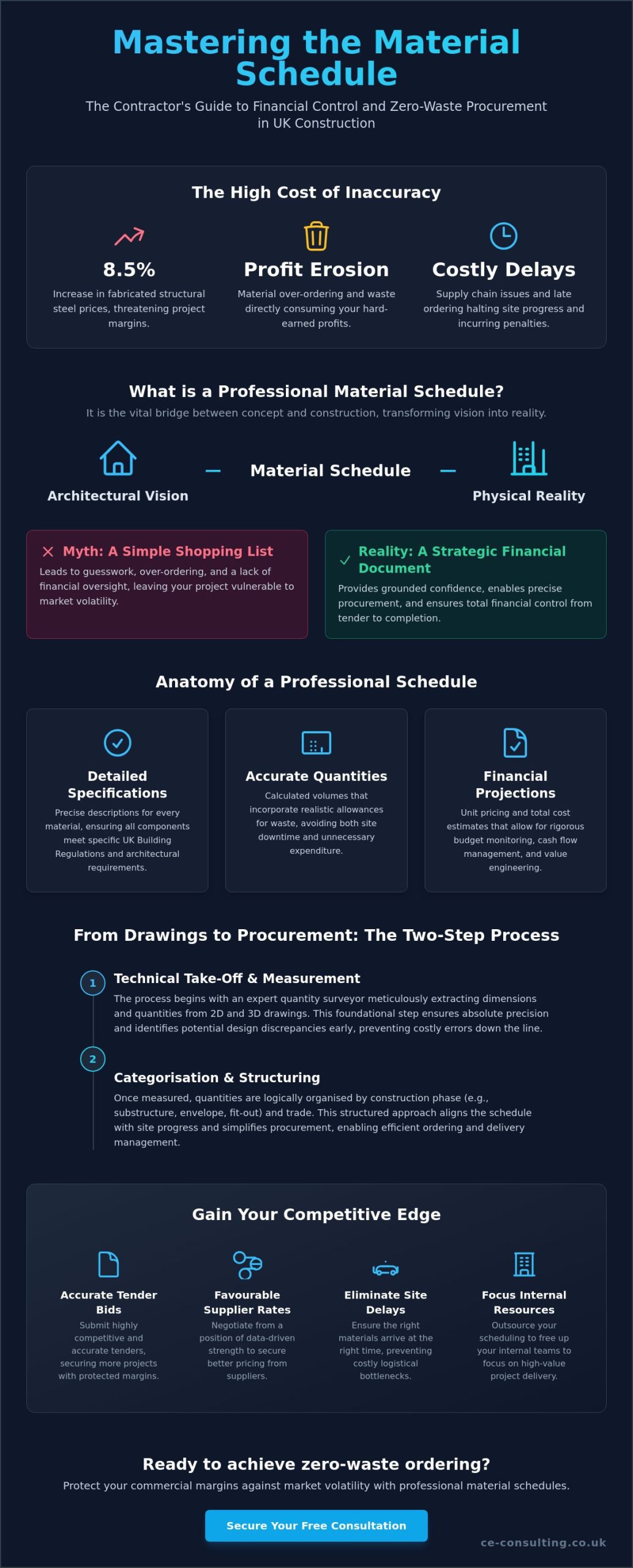
A material schedule is far more than a simple shopping list; it’s a strategic financial document that determines the ultimate viability of your project and the success of your tender. With fabricated structural steel prices rising by 8.5% in the year to April 2026, you’re likely aware that even minor inaccuracies in the material schedules for contractors can lead to significant project losses. It’s a common frustration to see material waste eating into your hard-earned profits or to face supply chain delays because of late ordering. You understand that in the current UK market, precision isn’t just a preference; it’s a necessity for commercial survival.
This guide will help you master the art of material scheduling to eliminate waste and maintain total financial control over your construction projects. We’ll show you how to move from reactive ordering to a streamlined, disciplined procurement process that ensures your tender documentation is both highly competitive and accurate. By the end of this article, you’ll have a clear roadmap for achieving zero-waste material ordering and protecting your commercial margins against ongoing market volatility.
Key Takeaways
- Understand why a comprehensive breakdown of build components is essential for maintaining financial control throughout the project lifecycle.
- Learn the methodical process of converting complex architectural specifications into a functional tool for streamlined procurement.
- Discover why manual spreadsheets often fail and how professional material schedules for contractors eliminate hidden costs and data entry errors.
- Gain a competitive edge by using precise material data to secure accurate tender bids and negotiate more favourable rates with suppliers.
- Explore how outsourcing your scheduling to an independent expert frees internal resources to focus on high-value project delivery.
What is a Material Schedule in the UK Construction Industry?
In the UK construction sector, a material schedule represents the vital bridge between architectural vision and physical reality. It isn’t merely an inventory of items; it’s a comprehensive breakdown of every component required for a build, from the structural steelwork to the final ironmongery. While some might view it as a simple shopping list, seasoned professionals recognise it as a critical instrument of financial control. A material schedule is a technical document derived from precise construction take-offs to ensure procurement accuracy.
Its role begins long before the first spade hits the ground. During the pre-construction phase, material schedules for contractors form the basis of a robust tender, ensuring that every cost is accounted for and margins are protected. Throughout the project lifecycle, the schedule evolves into a live procurement tool. It allows site managers to cross-reference deliveries against original estimates, preventing the common issue of over-ordering or, conversely, facing mid-project shortages that halt progress. There’s a sharp distinction between a generic list and a professionally measured schedule; the former often leads to guesswork, while the latter provides the grounded confidence needed to manage complex supply chains.
The Components of a Professional Schedule
- Detailed Specifications: Precise descriptions for every material type, ensuring all components meet specific UK Building Regulations and architectural requirements.
- Accurate Quantities: Calculated volumes that incorporate realistic allowances for waste and breakage, ensuring you don’t pay for more than you need whilst avoiding site downtime.
- Financial Projections: Unit pricing and total cost estimates that allow for rigorous budget monitoring and cash flow management.
Why Contractors Rely on Accurate Scheduling
Reliability is the foundation of a profitable site. Accurate material schedules for contractors ensure the right materials arrive at the right time, effectively eliminating costly site delays and logistical bottlenecks. They provide a transparent, data-driven basis for subcontractor quotes, allowing you to negotiate from a position of strength rather than estimation. For residential and commercial developers, these documents facilitate detailed elemental cost analysis. This level of oversight makes it easier to identify opportunities for value engineering, ensuring the project remains commercially viable without compromising on structural integrity or finish quality.
The Process: From Construction Take-offs to Final Schedules
Converting architectural drawings into a functional procurement tool is a methodical journey that demands technical precision and industry experience. It’s not a task of simple observation; it’s a deep interpretation of complex specifications to ensure every component is captured accurately. These material schedules for contractors don’t exist in a vacuum. They integrate seamlessly with the wider Bill of Quantities (BoQ), providing the granular data needed to justify costs and manage commercial risk. Identifying long-lead items, such as bespoke glazing or specialised mechanical components, early in this process is vital to maintain the project timeline and avoid costly site stand-stills.
Step 1: Technical Take-off and Measurement
The process begins with extracting dimensions and quantities from 2D and 3D drawings with absolute precision. Experienced quantity surveyors play a pivotal role here, as they possess the technical mastery to spot design discrepancies or clashes that automated software might overlook. By applying industry-standard measurement rules, we ensure consistency across the entire project. If you require support with this initial phase, our expert construction take-offs provide the reliable foundation your project needs to proceed with confidence.
Step 2: Categorisation and Structuring
Once quantities are extracted, they must be organised logically. We structure the schedule by construction phase, substructure, envelope, and fit-out, to align with the site’s physical progress. Grouping materials by trade simplifies the procurement process, allowing for efficient ordering and delivery management. Every description is meticulously checked to ensure it matches current UK building regulations and performance standards, ensuring that what’s ordered is exactly what’s required for compliance.
Step 3: Validation and Software Integration
The final stage involves rigorous validation to ensure total financial control. We use advanced tools like Conquest Estimating software to cross-reference data and eliminate human error. This final review ensures the schedule aligns perfectly with the project budget and construction programme. The result is a robust, ready-to-use document that forms the backbone of a highly competitive tender bid, providing the financial rigor necessary for commercial success in a volatile market.
Why Excel Templates Often Fail Modern Contractors
It’s a common misconception that standard spreadsheet software is sufficient for managing the commercial complexities of a modern build. While Excel is a versatile tool, relying on manual templates to produce material schedules for contractors is a high-risk strategy that often leads to significant financial leakage. In an industry where margins are increasingly thin, the perceived cost savings of using a basic spreadsheet are quickly erased by the hidden expenses of human error and administrative inefficiency. Professional software is the only way to achieve 100% accuracy in take-offs, providing a level of rigor that manual methods simply cannot replicate.
Manual entry introduces a lack of version control that can be disastrous in a fast-moving construction environment. When drawings are revised, updating a static spreadsheet is a laborious, error-prone task that often results in different team members working from conflicting or outdated information. This lack of a “single source of truth” undermines the reliability of your procurement process, creating a fragile foundation for your project’s financial management. Transitioning to a professional system ensures that every stakeholder is aligned with the most current data, instilling a sense of security and commercial discipline across the entire project team.
The Risk of Human Error in Manual Entry
The financial impact of a simple clerical error shouldn’t be underestimated. A single misplaced decimal point in a quantity column can lead to thousands of pounds in losses, either through the procurement of excessive stock that cannot be returned or by under-budgeting for critical components. Manual schedules are notoriously difficult to update when design changes occur, often requiring a complete re-measurement that consumes valuable time. Because manual take-offs depend on individual interpretation, they are frequently inconsistent across different team members, leading to fragmented data that makes accurate cost planning nearly impossible.
The Advantage of Conquest Estimating Software
Professional platforms like Conquest Estimating software provide the strategic oversight required for modern construction projects. This software ensures every measurement is traceable and verified, creating an audit trail that supports financial accountability. The speed and efficiency of automated take-offs far exceed manual methods, allowing your team to respond to tender opportunities with greater agility and precision. Conquest software allows for the seamless transition from measurement to material schedule with zero data loss. By removing the manual “middleman” from the data entry process, you eliminate the primary source of error, ensuring your material schedules for contractors are robust, reliable, and ready for site implementation. For firms weighing the costs of internal licensing against external expertise, understanding the full strategic case for outsourced Conquest estimating services can help clarify the most commercially sound approach for your business.
Optimising Your Supply Chain and Tender Accuracy
Achieving a competitive edge in the UK construction market requires more than just technical skill; it demands commercial foresight. Precise material schedules for contractors provide this advantage by transforming the procurement process from a series of reactive purchases into a disciplined strategic operation. When you eliminate the guesswork, you’re able to negotiate from a position of authority, ensuring that your supply chain is both resilient and cost-effective. This transition from estimation to precision allows you to maintain total financial control even when market conditions are volatile.
Transparency is equally beneficial for your subcontractors. By providing them with data-backed schedules, you allow them to submit bids that are grounded in reality rather than speculation. This clarity fosters a collaborative environment where every party understands the project requirements, significantly reducing the likelihood of disputes or unexpected variations during the build. Furthermore, precise ordering plays a vital role in meeting modern sustainability standards. By ordering exactly what’s required, you drastically reduce on-site waste, which not only protects your margins but also lowers the project’s environmental footprint. This is increasingly important as UK regulations continue to tighten around waste management and energy performance.
Securing Better Terms with Suppliers
Having accurate quantities allows you to secure bulk-buy discounts and fixed pricing, providing a vital shield against the 3.2% increase in material prices seen in early 2026. Suppliers value the clarity of a professional schedule because it allows them to manage their own inventory more effectively. As many of these firms transition to digital platforms to further streamline operations, you may wish to visit NB eCommerce & Design to see how expert Shopify development supports modern business growth. By providing clear lead-time requirements for long-lead items, you ensure material availability and eliminate the need for expensive, last-minute emergency orders that can quickly erode your profits. This methodical approach builds long-term reliability within your supply chain, ensuring that your projects remain on track and within budget.
Winning More Bids with Precise Cost Data
Accurate schedules allow for more confident bidding. When you know exactly what the build requires, you can reduce the “risk margin” that often makes tenders uncompetitive. This level of detail improves trust with clients, as it demonstrates a meticulous approach to their project’s financial health and technical requirements. If you’re looking to enhance your procurement strategy and increase your success rate, our professional tender support services can help you secure more work with highly accurate, data-driven documentation that stands up to the closest scrutiny.
Outsourcing Material Schedules: The Competitive Edge
Outsourcing the production of material schedules for contractors is a strategic decision that directly enhances project viability and commercial performance. By partnering with an independent cost consultancy, you gain access to a level of technical rigor that is often difficult to maintain within a busy internal team. This collaborative approach ensures that your procurement strategy is guided by a “safe pair of hands”, backed by over 100 years of combined industry experience. It represents a disciplined way to manage commercial risk, providing the financial clarity needed to protect your margins in a fluctuating market.
When you delegate the complex task of measurement and scheduling to external experts, your internal staff are freed to focus on what they do best: project delivery and site management. This redistribution of resources improves operational efficiency, as your site managers are no longer bogged down by administrative data entry or technical measurements. Instead, they receive a finished, verified procurement tool that they can trust implicitly. Professional oversight instils a sense of security across your entire organisation, knowing that the project’s financial foundation is built on accurate, expert-led data.
Access to Expert Quantity Surveyors
Our team provides meticulous attention to detail across a diverse range of sectors, from complex healthcare facilities to high-end retail developments. By outsourcing, you benefit from the specialised knowledge of dedicated quantity surveyors who understand the specific regulatory and material requirements of each build. This model allows you to reduce fixed overheads significantly, as you only pay for professional services when your project pipeline requires them. It ensures that every material schedule is measured with the same high level of precision, regardless of project scale. This flexibility is vital for maintaining a lean and responsive business model in the current UK construction landscape.
Next Steps for Your Project
Beginning the process is a structured and straightforward journey. Once you provide your architectural drawings, our consultants undertake a comprehensive technical take-off to produce your final material schedule. We maintain a methodical and collaborative rhythm throughout the process, ensuring the final document aligns perfectly with your specific procurement goals and construction programme. Our typical turnaround is designed to keep your project moving at a steady pace, providing the data you need exactly when you need it to make informed commercial decisions. To secure your commercial success and gain total financial control over your next build, contact Consulting Estimating Consultants to organise your professional material schedule today.
Securing Your Commercial Future through Precise Procurement
Transitioning from fragmented, manual spreadsheets to robust, software-driven data is the only way to ensure absolute accuracy in your project’s financial planning. By integrating professional material schedules for contractors into your workflow, you move beyond simple estimation to a position of strategic oversight. This level of precision allows you to negotiate fixed pricing with confidence and present highly competitive tender bids that protect your commercial margins against market volatility.
Our team brings over 100 years of combined professional experience to every project, acting as a dependable partner across the residential, commercial, and industrial sectors. We’re specialists in Conquest Estimating software, ensuring that every measurement is both traceable and verified for your peace of mind. It’s time to eliminate unnecessary waste and reclaim total control over your procurement process. Get a Professional Quote for Your Material Schedules to secure the financial health of your next build. You’ve built your reputation on the quality of your delivery; let us help you build your future on the strength of your financial precision.
Frequently Asked Questions
What is the difference between a material take-off and a material schedule?
A construction take-off is the initial process of measuring and extracting quantities from architectural drawings. In contrast, a material schedule is the structured final document that organises these quantities into a functional procurement tool. While the take-off provides the raw data, the schedule categorises materials by trade or phase. This allows site managers to order exactly what is required for each specific stage of the build.
How accurate are professional material schedules compared to manual ones?
Professional material schedules for contractors offer a level of precision that manual spreadsheets simply cannot match. By using advanced estimating software and expert oversight, we eliminate the risk of clerical errors and formula discrepancies that often plague manual entry. This digital approach ensures that every measurement is traceable and verified, providing a robust foundation for your project’s financial management and reducing the likelihood of costly over-ordering on site.
Can a material schedule help with my construction tender bid?
A precise schedule is a vital asset during the tender process. It allows you to submit a bid that is grounded in verified data rather than loose estimations, which significantly reduces the risk margin in your pricing. This level of detail instils confidence in potential clients, demonstrating that you have a meticulous grasp of the project’s technical requirements and financial commitments, ultimately making your tender more competitive and professional.
Do I need a quantity surveyor to create a material schedule?
Engaging a qualified quantity surveyor is essential for creating an accurate and reliable schedule. A surveyor possesses the technical mastery required to interpret complex specifications and spot design discrepancies that automated tools or less experienced staff might overlook. This professional oversight ensures that your material schedules for contractors are compliant with UK building regulations and performance standards, providing the commercial security needed to manage high-stakes construction projects.
What software is best for creating material schedules for contractors?
Conquest Estimating software is widely regarded as the industry standard for professional material scheduling. It allows for a seamless transition from initial measurement to the final procurement document with zero data loss. Unlike generic spreadsheets, this specialised software provides a verified audit trail and automates complex calculations, ensuring that every quantity is accounted for. This technological advantage is crucial for maintaining precision and efficiency in a fast-moving construction environment.
How much does it cost to outsource material scheduling in the UK?
The cost of outsourcing material scheduling in the UK varies depending on the scale and complexity of the project. Most consultancies provide bespoke quotes based on the number of drawings and the depth of the specification required. Whilst prices differ across the industry, the investment is typically offset by the significant savings made through reduced material waste and more accurate tender bids. It is advisable to request a project-specific assessment to understand the exact requirements.
Can you provide material schedules for large-scale residential developments?
We provide comprehensive material scheduling services for large-scale residential developments, including multi-unit housing schemes and apartment blocks. Managing procurement for these projects requires a high level of logistical coordination and financial rigor. Our expertise ensures that materials are scheduled accurately across multiple phases, allowing developers to maintain steady cash flow and avoid the site stand-stills that often occur due to poor supply chain management on large developments. For developers seeking to understand the full scope of precise material takeoff for residential construction, our dedicated guide covers the technical standards and strategic advantages of rigorous cost planning in detail.
How do material schedules help in reducing construction waste?
Material schedules are a primary tool for reducing construction waste and improving a project’s environmental footprint. By ordering the exact quantities required for each phase, you eliminate the surplus stock that often ends up in skips or is damaged whilst stored on site. This disciplined approach to procurement not only supports modern sustainability standards but also protects your commercial margins by ensuring you only pay for the materials actually used in the build.