



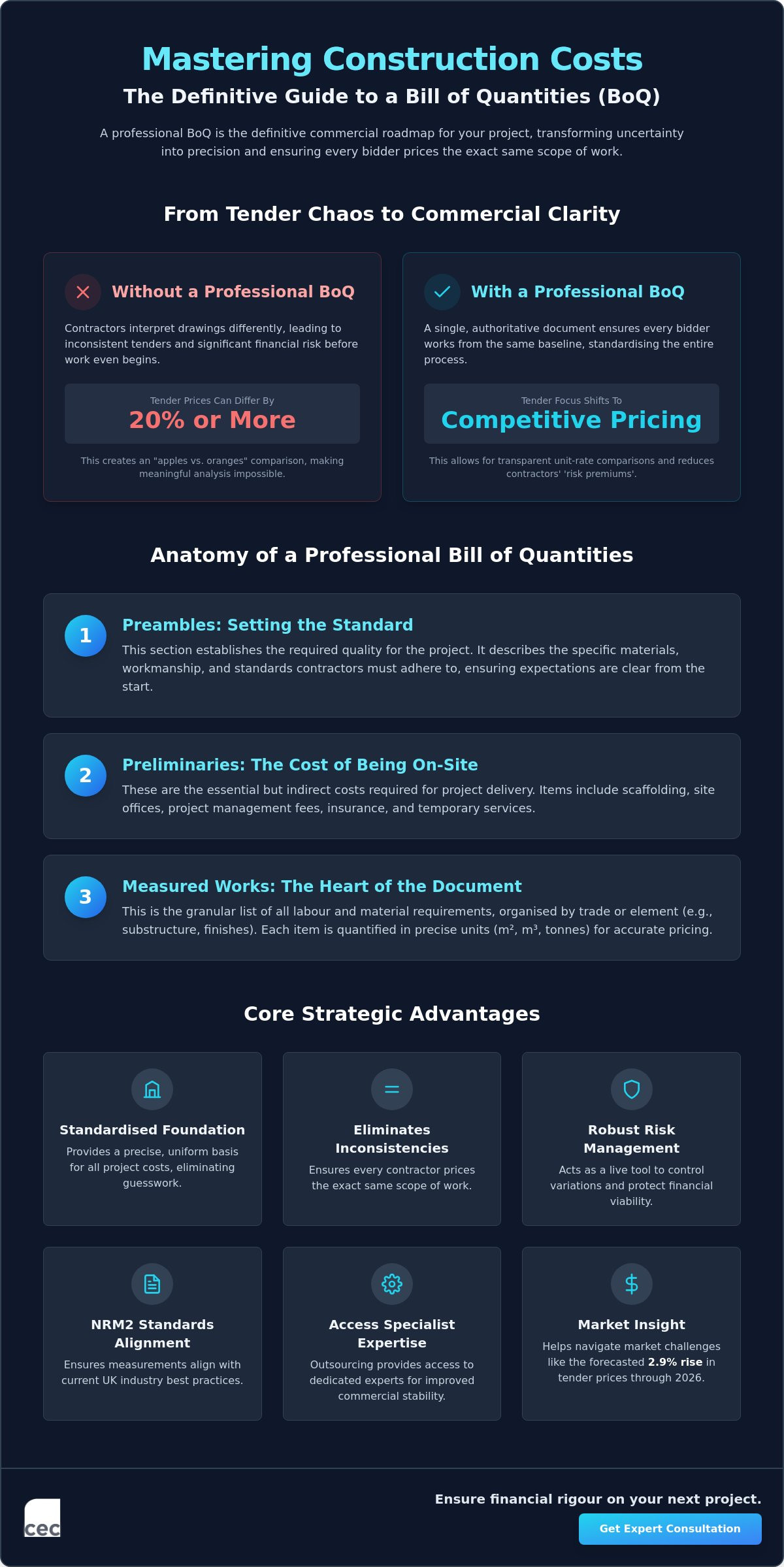
Why do two contractors, looking at the exact same architectural drawings, often return tender prices that differ by 20% or more? This volatility usually stems from a lack of clarity in the measurement process, creating significant financial risk before the first spade hits the ground. To eliminate this uncertainty, a professional bill of quants acts as the definitive commercial roadmap for your project. It ensures that every bidder is pricing the exact same scope of work, providing the grounded confidence you need to manage your capital with absolute precision.
You’ve likely experienced the frustration of inconsistent tender returns or the confusion caused by conflicting measurement standards like NRM 2 and SMM7. We understand that these discrepancies aren’t just administrative hurdles; they’re direct threats to your project’s commercial viability in a market where tender prices are forecasted to rise by 2.9% through 2026. This guide will help you master the fundamentals of construction quantification to ensure financial rigour and robust cost control. You’ll gain a clear understanding of BoQ components, learn how to manage variations with ease, and discover how to identify a quantity surveying partner who serves as a dependable guide for your investment.
Key Takeaways
- Understand the fundamental role of a bill of quants in providing a precise, standardised foundation for all construction project costs.
- Learn how to eliminate tender inconsistencies by ensuring every contractor prices the exact same scope of work through a formal Bill of Quantities.
- Master the application of NRM2 standards to ensure your measurements align with current UK industry requirements and professional best practices.
- Discover how to utilise a live BoQ as a strategic risk-management tool to control variations and protect your project’s financial viability.
- Evaluate the operational benefits of outsourcing your construction take-offs to access specialist expertise and improve long-term commercial stability.
What is a Bill of Quants? Defining the Foundation of Construction Costs
A bill of quants serves as the primary document for quantifying construction work, acting as a vital bridge between the architect’s vision and the contractor’s bottom line. Whilst often referred to by this shorthand on-site, its formal designation is the Bill of Quantities (BoQ). This document is meticulously prepared by a qualified Quantity Surveyor or Cost Consultant who possesses the technical expertise to translate complex architectural drawings and specifications into a structured financial format. By providing a granular list of every material and labour requirement, it transforms abstract designs into a tangible basis for commercial decision-making. To understand the broader context of this document, one might ask, What is a Bill of Quants? At its core, it is the financial backbone of any major build, offering a level of detail that protects the project’s budget from the outset.
The Essential Components of a Professional Bill
A professional BoQ isn’t merely a list. It’s a hierarchical document structured to provide absolute clarity across three main areas. First, the Preambles set the quality standards. They describe the materials and workmanship required, ensuring contractors don’t just price for “brickwork” but for the specific grade, mortar mix, and finish you expect. Second, the Preliminaries cover the “cost of being on site.” This includes items like scaffolding, site offices, and project management fees that aren’t tied to a specific wall but are essential for project delivery. Finally, the Measured Works represent the heart of the document. These are organised by trade or element, such as substructure or internal finishes. Each item is quantified in precise units like square metres or tonnes, allowing for an accurate and transparent pricing process.
BoQ vs. Bill of Quants: Understanding the Terminology
Terminology often varies depending on who you’re speaking with in the industry. You’ll frequently hear the term bill of quants amongst site managers, tradespeople, and subcontractors. It’s a functional shorthand that reflects the document’s practical daily use on the ground. However, in formal contracts and professional consultancy, the full title “Bill of Quantities” remains the standard. Regardless of the label used, the requirement for absolute accuracy remains paramount to avoid the measurement errors that lead to cost overruns. For a deeper dive into these professional distinctions, you can explore our resource on BoQ vs Bill of Quants: Understanding the Terminology. Maintaining this precision ensures that your project remains commercially viable from the first estimate to the final account.
The Strategic Purpose: Why Tenders Depend on Precise Quantification
The tender stage is the most critical phase for securing a project’s financial future. Without a professional bill of quants, developers often find themselves in a state of commercial uncertainty. When contractors are asked to price based solely on “spec and drawings,” they must perform their own take-offs. This leads to wildly varying interpretations of the project scope. One contractor might overestimate the concrete volume to cover their risk, whilst another might miss a key element entirely. A central BoQ eliminates this chaos by providing a single, authoritative set of quantities. It ensures that every bidder is working from the same baseline, moving the focus from “who measured best” to “who offers the most competitive price.”
Standardising the Bidding Landscape
Tendering without a structured bill often results in an “apples vs oranges” comparison that makes meaningful analysis impossible. When you provide a comprehensive bill of quants, you remove the burden of measurement from the contractor. This is a strategic move. By reducing the contractor’s uncertainty, you also reduce the “risk premium” they typically add to unquantified tenders. Contractors can price with greater confidence, leading to more aggressive and transparent bids. This transparency allows you to compare unit rates for specific items, such as the cost per square metre of brickwork, across all bidders with absolute clarity.
Enabling Accurate Tender Analysis for Developers
A priced BoQ is an invaluable diagnostic tool for cost consultants. It allows for a forensic examination of how a contractor has distributed their costs across the project timeline. We use these documents to identify “front-loading,” where a contractor artificially inflates the cost of early-stage works to improve their cash flow at your expense. By adhering to established Methodology and Standards: NRM2 and Software-Driven Accuracy, we ensure that every line item is measured according to industry best practices. This level of detail confirms that the chosen tender represents genuine value for money rather than a hidden financial trap.
Ensuring your project starts on the right footing requires more than just a list of materials. It demands a holistic approach to commercial management. Integrating these insights into your wider Construction Cost Planning Services allows you to maintain control from the initial feasibility study through to the final account. If you’re looking to secure your next project’s budget, our team can provide the tender support necessary to achieve a fair and accurate result.
Methodology and Standards: NRM2 and Software-Driven Accuracy
Precision in a professional bill of quants isn’t accidental. It relies on a rigorous adherence to industry-recognised standards that provide a shared language for all project stakeholders. Without a common rulebook, measurement becomes subjective, leading to the cost overruns and tender inconsistencies that threaten project viability. In the UK, the definitive framework for this work is the RICS New Rules of Measurement 2 (NRM2). By following these rules, we ensure that every item is measured, described, and coded in a way that is universally understood, providing a secure foundation for financial control and project stability.
From SMM7 to NRM: The Evolution of Measurement
The transition from the legacy SMM7 (Standard Method of Measurement) to NRM2 reflects the industry’s need for more sophisticated cost management. SMM7 served its purpose for decades but eventually became misaligned with modern construction techniques and complex procurement routes. NRM2, which was reissued as practice information in October 2022, offers a more flexible and comprehensive approach. It better accommodates contemporary building services and the detailed requirements of modern management. Architects and developers must ensure their consultants use these up-to-date RICS standards. Relying on ‘approximate’ or non-standardised methods often results in “valuation gaps” where the work on site doesn’t match the measured quantities, inevitably triggering disputes and budget leaks.
The Role of Conquest Software in Modern Quantification
Whilst the methodology provides the rules, technology provides the engine. We utilise specialist software such as Conquest to integrate our construction take-offs directly with the Bill production process. This digital synergy significantly reduces the risk of human error that historically plagued manual spreadsheets. When a quantity is measured on a digital drawing, it flows directly into the bill of quants, maintaining a clear and transparent audit trail. This level of technical mastery ensures that the data is not only accurate but also easily verifiable by all parties.
This software-driven approach offers benefits that extend beyond simple arithmetic. It allows us to generate detailed material schedules that provide a secondary layer of data for procurement teams. By having an automated, precise breakdown of quantities, your project benefits from enhanced strategic oversight. It ensures that the financial data used for tendering remains robust throughout the entire project lifecycle. This combination of traditional expertise and modern software provides our clients with the peace of mind that their project’s commercial foundation is built to withstand the pressures of a fluctuating market.
Managing Project Lifecycle Risks with a Live Bill of Quants
The utility of a professional bill of quants doesn’t expire once the contract is signed. Whilst many project stakeholders view it primarily as a tendering tool, its most significant value often emerges during the construction phase. It transforms from a bidding document into a “live” commercial instrument that governs the financial relationship between the developer and the contractor. By providing a pre-agreed framework for every item of work, it ensures that project managers maintain absolute control over the budget as the build progresses on-site.
Valuations and Variation Management
Interim valuations are the heartbeat of project cash flow. Using the bill of quants, we can accurately value the work completed each month by comparing on-site progress against the measured quantities in the document. If 60% of the substructure is complete, the payment is calculated using the exact unit rates agreed at the tender stage. This methodical approach provides a level of financial security that “lump sum” contracts often lack.
Variation management is where the BoQ truly proves its worth. Construction projects rarely proceed without changes, but these don’t have to lead to budget collapses. The “Schedule of Rates” within the Bill provides a pre-negotiated price for additional works. This prevents contractors from “price gouging” when a change is requested mid-project, as the cost for an extra cubic metre of concrete or an additional linear metre of drainage is already fixed. In the event of a commercial dispute, this transparency serves as your most robust defence, providing a clear audit trail that is difficult to challenge.
How Precise Quantities Mitigate Cost Overruns
Budget certainty for developers is directly proportional to the accuracy of the initial take-off. When a Bill is prepared with technical mastery, it significantly reduces the likelihood of “claims” for missing items or unforeseen works. Contractors often look for gaps in the tender documentation to recoup margin; a comprehensive Bill closes these gaps before they can be exploited. This proactive risk management is essential for maintaining project viability in a market where building costs are forecasted to rise by 3.8% through 2026.
Achieving this level of oversight requires a meticulous approach to documentation. Our Professional BoQ Preparation: A Guide to Financial Control details how these documents act as the final authority during the settlement of the final account. By resolving quantity discrepancies early, you avoid the protracted and expensive disputes that often occur at the end of a project. If you are looking to secure your next project’s commercial future, our team at CE Consulting provides the expert Bills of Quantities and construction take-offs needed to ensure total financial rigour.
The Strategic Advantage of Outsourcing Your Bill of Quants
Maintaining a permanent in-house estimating department often creates a rigid overhead that doesn’t align with the fluctuating workloads of modern construction. Whilst many firms traditionally relied on internal resources, the complexity of 2026’s measurement standards and the need for absolute financial precision have shifted the operational landscape. Outsourcing your bill of quants allows you to access a deeper level of technical mastery whilst maintaining a lean, agile business model. This strategic shift ensures that your pre-construction phase is handled by specialists who are dedicated solely to the rigour of quantification and cost control. For a comprehensive breakdown of the financial and operational case for this approach, our guide to how to outsource bills of quantities examines the full spectrum of benefits available to developers in 2026.
Choosing an external partner provides more than just a document; it offers a sense of security that stems from extensive industry experience. At CE Consulting, we provide a “safe pair of hands” backed by 100 years of combined experience in the construction sector. This depth of knowledge is particularly vital for complex projects where measurement errors can lead to catastrophic budget overruns. By partnering with seasoned experts, you ensure that every take-off is performed with a serious, meticulous mindset, instilling a sense of financial control in your project from day one.
Accuracy, Speed, and Technical Mastery
Specialist estimators produce Bills with a level of speed and technical rigour that generalist in-house staff often cannot match. Because our primary focus is quantification, we have refined our processes to eliminate the inefficiencies that lead to delays. Independent verification is a critical component of this process. When a third-party consultant prepares your bill of quants, they provide unbiased data that serves as a neutral foundation for all commercial negotiations. Architects and developers value this objectivity, as it removes any internal bias and ensures that the tender documents are as robust and transparent as possible.
Integrating BoQ Data into Broader Cost Planning
A professional Bill of Quantities is not an isolated document; it is the engine room of your project’s financial management. The data captured during the measurement process feeds directly into long-term financial planning and project viability assessments. There is a powerful synergy between detailed material schedules, accurate take-offs, and professional tender support. When these elements are integrated, they create a seamless workflow that protects your capital throughout the project lifecycle. This holistic approach ensures that the initial quantities remain relevant and useful for everything from procurement to final account settlement.
If you are ready to secure the commercial future of your next project with precision and reliability, our team is here to help. Contact Consulting Estimating Consultants for professional BoQ services and ensure your project is built on a foundation of technical excellence and financial rigour.
Securing Commercial Stability for Your Next Project
Mastering the fundamentals of a bill of quants is no longer just a technical requirement; it’s a strategic necessity for any developer or architect aiming for project success in 2026. By standardising the tender process and adhering to RICS NRM2 standards, you eliminate the measurement errors that lead to costly variations and disputes. This methodical approach ensures that your project budget remains robust from the initial feasibility study through to the final account settlement.
At CE Consulting, we act as a safe pair of hands, offering over 100 years of combined professional experience. As specialists in Conquest Estimating software, we provide national UK coverage across both the residential and commercial sectors. Our meticulous approach ensures that your construction take-offs and material schedules are delivered with absolute technical rigour. Secure your project’s financial future with a professional Bill of Quantities from Consulting Estimating Consultants. We look forward to helping you achieve total commercial control over your next build.
Frequently Asked Questions
What is the difference between a Bill of Quantities and a Bill of Quants?
The term bill of quants is simply a common industry shorthand used amongst site managers and contractors. In a formal professional context, the document is officially known as a Bill of Quantities (BoQ). Both terms refer to the same primary document that provides a detailed, itemised list of materials and labour required for a construction project, ensuring every stakeholder understands the project scope.
Who is responsible for preparing the Bill of Quantities in the UK?
In the UK, a qualified Quantity Surveyor or an independent Cost Consultant is responsible for the preparation of this document. These professionals possess the technical mastery required to interpret complex architectural drawings and specifications. By translating these designs into a structured financial format, they ensure that the measurement process adheres to the rigorous professional standards expected in modern construction management.
Is a Bill of Quants always necessary for a construction project?
Whilst not a legal requirement for every build, a bill of quants is highly recommended for any project involving significant complexity or capital. It acts as a vital risk-management tool that protects the project budget during the tender and construction phases. For very small or simple projects, a basic schedule of works may suffice, but larger developments demand the precision that only a formal Bill provides.
What are the New Rules of Measurement (NRM2)?
NRM2 is the current industry standard for the detailed measurement of building works in the UK. Developed by the Royal Institution of Chartered Surveyors (RICS), it provides a consistent and universally recognised methodology for preparing a Bill of Quantities. It replaced the legacy SMM7 system to better accommodate modern construction techniques, ensuring that all project stakeholders communicate using a shared, accurate financial language.
Can a contractor prepare their own Bill of Quants?
Contractors often prepare their own internal quantities if a formal Bill isn’t provided at the tender stage. However, this process is prone to measurement errors and leads to inconsistent bids that are difficult for developers to compare. Providing a professionally prepared Bill ensures all contractors bid on the exact same scope, which reduces the “risk premium” often added to unquantified tenders.
How much does it cost to have a professional BoQ prepared?
The cost of professional preparation depends on the project’s overall scale, the complexity of the design, and the level of detail required. Large-scale commercial developments or complex residential builds naturally require more extensive measurement work than smaller projects. Investing in a professional Bill provides long-term commercial value by reducing the likelihood of expensive disputes and budget overruns during the construction phase.
How does a BoQ help in managing construction variations?
It provides a pre-agreed Schedule of Rates that serves as the definitive basis for valuing any changes on-site. When a variation occurs, the project manager uses the unit rates established in the Bill to calculate the cost. This transparent approach prevents contractors from inflating prices for extra works and ensures that the final account is settled fairly, based on the original contract rates.
What is an approximate Bill of Quantities?
An approximate Bill is used in the early stages of a project when the design is not yet fully detailed. It allows for a tender to be based on estimated quantities, which are later re-measured and adjusted as the final design is confirmed. This is a useful strategic tool for developers who need to secure a contractor and establish a preliminary budget whilst the design is still evolving.