



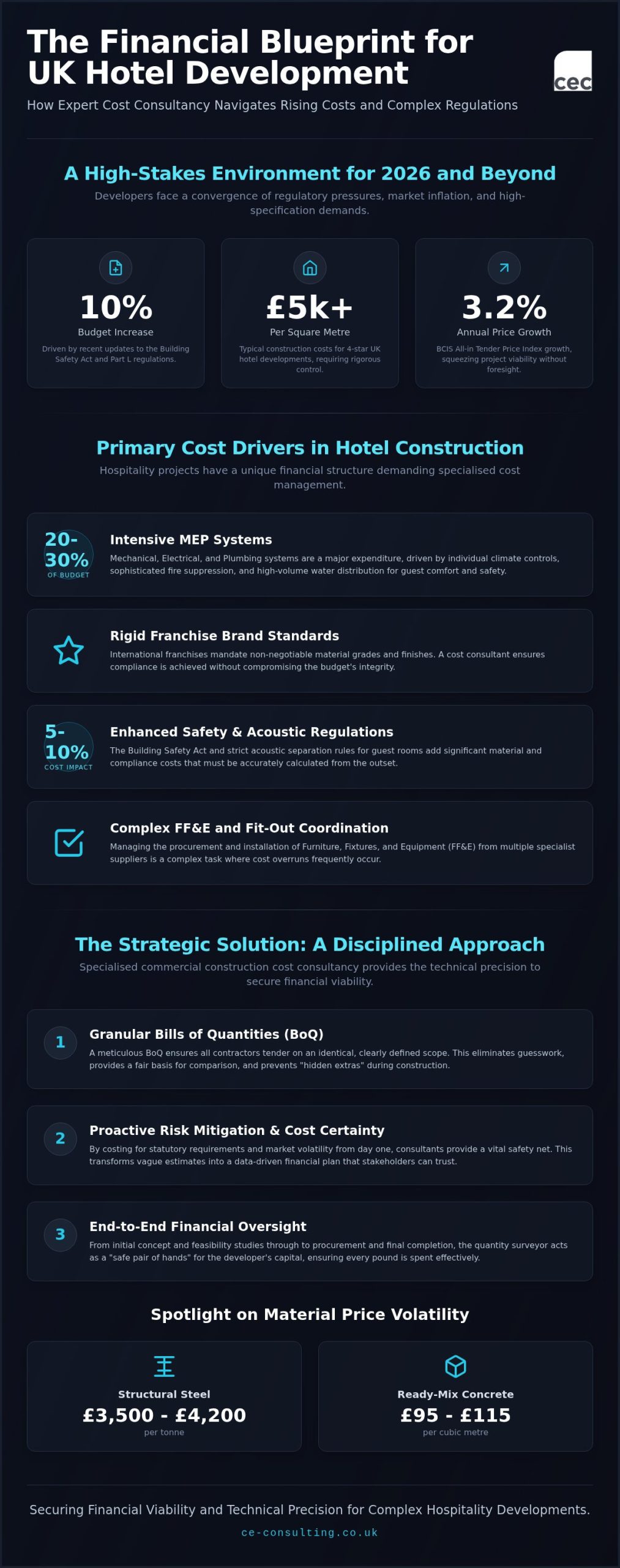
Did you know that recent updates to the Building Safety Act and Part L regulations are now estimated to add up to 10% to the total budget of a UK hotel development? In an environment where 4-star construction costs often exceed £5,000 per square metre, expert commercial construction cost consultancy UK services provide the financial rigor needed to protect your margins. You’re likely already managing the delicate balance between volatile material prices and the rigid brand standards required by international franchises. It’s a high-pressure scenario where technical precision is the only way to ensure your investment’s long-term commercial health.
This guide explains how professional cost consultancy secures financial viability and technical precision for complex hospitality developments across the UK. By prioritising accurate tender documentation and granular cost planning, you can achieve absolute cost certainty for your stakeholders whilst meeting every technical requirement. We’ll explore the specific methodologies, from meticulous Bills of Quantities to FF&E procurement coordination, that reduce the risk of project overruns and ensure your 2026 development remains both profitable and compliant.
Key Takeaways
- Understand how specialised quantity surveying secures the financial lifecycle of your development whilst maintaining the original design intent.
- Identify the unique cost drivers of hospitality projects, including high-specification MEP systems and non-negotiable franchise brand standards.
- Discover how a detailed Bill of Quantities provided by a commercial construction cost consultancy UK partner ensures all contractors bid on a uniform scope to eliminate hidden extras.
- Learn strategies for managing complex FF&E and fit-out expenditures to prevent budget overruns when coordinating multiple specialist suppliers.
- Gain insights into maintaining project viability from the concept stage through to completion with rigorous financial reporting and pre-construction advice.
What is Hotel Development Cost Consultancy?
Hotel development cost consultancy is a specialised branch of quantity surveying that focuses exclusively on the financial lifecycle of hospitality assets. Unlike general construction, hotel projects involve intricate layers of Mechanical, Electrical, and Plumbing (MEP) systems, bespoke fit-outs, and strict brand-standard compliance. The primary objective of a commercial construction cost consultancy UK partner is to achieve absolute cost certainty whilst protecting the developer’s original design intent. It serves as the essential bridge between an architect’s creative vision and the hard commercial reality of the construction market.
In 2026, the necessity for this precision has never been greater. With the BCIS All-in Tender Price Index showing a 3.2% annual growth as of June 2026, developers face a landscape where even minor miscalculations can jeopardise project viability. Whether you’re planning a new-build luxury site or a high-specification refurbishment, professional cost consultancy provides the technical backbone needed to navigate these complexities. It transforms vague estimates into rigorous, data-driven financial plans that stakeholders can trust.
Risk Mitigation in Hospitality Construction
Identifying financial pitfalls before the first spade hits the ground is the first line of defence in any successful development. We’ve seen how volatile material costs, such as structural steel ranging from £3,500 to £4,200 per tonne, can quickly erode margins if not managed with foresight. A disciplined consultant ensures that all statutory requirements, including the 5-10% cost increase associated with the Building Safety Act and Part L energy efficiency regulations, are accurately costed from the outset. This meticulous approach provides a vital safety net against market volatility and sudden price hikes in essential materials like ready-mix concrete, which currently sits between £95 and £115 per cubic metre.
The Role of the Quantity Surveyor in Hotel Projects
A quantity surveyor acts as a “safe pair of hands” for a developer’s capital, providing the independent oversight necessary during the tender and procurement phases. To understand the full scope of this profession, one might ask, What is a Quantity Surveyor? In the context of hospitality, their role is to manage the delicate balance between high-end luxury finishes and strict budget constraints. For 4-star and 5-star developments where costs often exceed £5,000 per square metre, the consultant ensures that every pound spent aligns with the project’s commercial goals. By producing precise Bills of Quantities and managing tender support, they ensure that contractors aren’t just guessing, but are bidding on a clear, technical reality. This level of detail is what prevents the “hidden extras” that so often plague complex builds.
Primary Cost Drivers in Modern Hotel Construction
Hotel developments are defined by a unique financial structure that separates them from other commercial assets. Unlike a standard office block or residential scheme, a hotel requires an intensive level of services and finishes within a relatively confined footprint. A commercial construction cost consultancy UK specialist understands that the repetition of bedroom units demands extreme precision in room-by-room take-offs, whilst communal areas like lobbies and restaurants require a different approach to fit-out expenditure.
MEP (Mechanical, Electrical, and Plumbing) systems represent one of the most significant cost drivers in the hospitality sector. These systems often account for 20% to 30% of the total construction budget. This high percentage is driven by the need for individual climate control, sophisticated fire suppression systems, and high-volume water distribution. Additionally, the Building Safety Act has introduced more rigorous compliance pathways for high-occupancy buildings, often increasing regulatory costs by 5% to 10%. Achieving acoustic separation between guest rooms also adds a layer of material specification that must be costed accurately to avoid post-completion remedial work.
Key cost drivers include:
- Intensive MEP requirements for guest comfort and safety.
- Rigid brand standards that dictate specific material grades.
- Enhanced acoustic and fire safety regulations for high-occupancy sites.
- The complexity of coordinating specialist FF&E suppliers.
MEP and Operational Efficiency
Investing in high-efficiency HVAC systems is no longer just a sustainability goal; it’s a financial necessity under Part L of the Building Regulations. Whilst the initial capital expenditure for energy-efficient plant machinery is higher, it significantly reduces long-term operational costs for the hotel owner. Integrating smart room technology, such as automated lighting and occupancy sensors, must be factored into the early budget. These systems require complex wiring and software integration that, if not properly accounted for in the initial take-off, can lead to substantial variations during the fit-out phase.
Brand Standards and Material Specification
Adhering to strict franchise requirements is a non-negotiable aspect of hotel development. Utilising professional construction cost planning services allows developers to quantify these brand standards with technical accuracy before committing to a contract. Luxury brands often demand “signature” design elements, such as specific stone finishes or bespoke joinery, which carry a significant price premium.
The challenge lies in balancing these aesthetic requirements with the need for durability in high-traffic environments. A meticulous consultant will help you choose materials that meet the brand’s visual identity whilst offering the longevity required to minimise future maintenance cycles. When developers partner with a commercial construction cost consultancy UK, they gain a partner capable of translating complex brand manuals into line-item costs. For developers looking to secure their project’s commercial viability, engaging with expert cost planning early in the design phase is the most effective way to manage these competing priorities.
The Importance of Accurate Bills of Quantities in Hotel Tenders
A robust tender process relies on every participant bidding against an identical set of data. In the hospitality sector, where a single project involves hundreds of room types and complex communal spaces, the risk of scope gaps is exceptionally high. Engaging a commercial construction cost consultancy UK firm to produce a formal Bill of Quantities (BoQ) eliminates this ambiguity. It ensures that when you compare main contractor prices, you’re looking at a true “apples-to-apples” comparison. This precision doesn’t just aid the initial selection; it provides a fixed framework for valuing monthly progress payments and managing any variations that arise during the build.
Without a detailed BoQ, contractors are often forced to make assumptions about the design intent. These assumptions frequently lead to “hidden extras” or aggressive claims once the project is underway. By quantifying every element of the build, from the structural foundations to the final coat of paint in a luxury suite, the consultant removes the guesswork. This level of detail also facilitates an easier comparison of subcontractor quotes for complex fit-out packages, ensuring that specialist trades are priced competitively and accurately.
Leveraging Conquest Software for Precision
Technical software is superior to standard spreadsheets for managing the thousands of individual line items found in a hotel development. We utilise Conquest Estimating software to maintain absolute consistency across the entire project scope. This technology allows for the production of a highly granular bill of quantities that standardises data across different building blocks. The speed and accuracy of Conquest-driven material schedules are vital for modern procurement; they allow developers to lock in material prices early, protecting the budget from the 3.2% annual growth in tender prices we’re currently seeing in the UK market.
Improving Tender Compliance
Professional BoQ preparation significantly reduces the risk of receiving incomplete or non-compliant bids. High-quality main contractors prefer projects where the documentation is clear and meticulous; it signals that the developer is a “safe pair of hands” and has a disciplined approach to financial management. By ensuring that hospitality-specific requirements-such as commercial kitchen equipment, high-speed lift specifications, and specialised fire safety systems-are fully captured, the commercial construction cost consultancy UK partner protects the project’s viability. This standardisation attracts more reliable contractors, creating a competitive environment that ultimately benefits the developer’s bottom line.
Managing Fit-out and FF&E Expenditure
FF&E (Furniture, Fixtures, and Equipment) represents the final, and often most volatile, financial hurdle in a hotel development. Whilst the structural shell follows a predictable path, the fit-out involves coordinating hundreds of disparate suppliers under a single, rigid budget. A commercial construction cost consultancy UK firm provides the strategic oversight required to manage this complexity. They ensure that the transition from shell construction to interior fit-out is seamless, preventing the costly remedial works that occur when architectural drawings and interior design specifications aren’t perfectly aligned. This interface is a high-risk zone where technical precision saves thousands in avoided delays.
Managing this expenditure requires a deep understanding of the hospitality supply chain. It’s not just about the cost of a chair or a light fitting; it’s about the logistics, storage, and installation sequences that drive the final bill. Without a meticulous material schedule, FF&E costs can easily leak through poor procurement timing or unforeseen storage fees. A disciplined consultant acts as a partner in protecting your capital during these final, high-pressure months of the build.
FF&E Procurement Strategies
Technical procurement strategies must differentiate between fixed joinery and loose furniture. Joinery is typically handled by the main contractor, whilst loose FF&E might be sourced through a separate specialist. In the 2026 market, assessing the financial implications of international versus domestic supply chains is essential. With global logistics costs remaining unpredictable, domestic sourcing can often offer better value when you factor in lead times and potential storage fees for items that arrive before the site is ready. Precise take-offs help you quantify these needs early, allowing you to lock in prices and avoid the sting of late-stage inflation.
Lifecycle Costing for Hospitality
A professional consultant looks beyond the initial capital expenditure to evaluate the “total cost of ownership.” In high-traffic environments like hotel lobbies or restaurants, choosing the cheapest material often results in a false economy. For example, a lower-grade carpet might save £15,000 upfront but require replacement three years earlier than a high-specification alternative. Using data-driven cost planning, developers can justify investments in more durable, sustainable materials that align with BREEAM requirements and reduce long-term operational pressure. This approach ensures your hotel remains commercially viable long after the grand opening.
To ensure your fit-out budget is managed with technical precision, consider professional FF&E cost planning to secure your project’s financial future.
Strategic Cost Management: From Concept to Completion
Strategic cost management isn’t a one-off exercise; it’s a continuous thread that safeguards a project’s financial integrity from the initial concept through to the final account. Engaging a commercial construction cost consultancy UK partner early ensures that the initial vision is grounded in commercial reality. This pre-construction advice is vital for establishing project viability, allowing developers to make informed decisions before significant capital is committed. As the build progresses, ongoing financial reporting keeps all stakeholders informed of the “cost to complete,” providing a transparent view of the remaining budget and any potential risks that might impact the bottom line.
During the construction phase, rigorous commercial oversight prevents budget creep. It’s about maintaining a disciplined approach to variations and ensuring that every change is justified and costed with technical precision. The process concludes with final account negotiation. This is where a seasoned consultant ensures the project finishes within the agreed financial framework, resolving any outstanding claims or adjustments with professional authority. This “safe pair of hands” approach ensures that the project doesn’t just open on time, but does so without a tail of unresolved financial liabilities.
Feasibility and Elemental Cost Analysis
Early-stage budgeting often relies on “cost per key” or GIA (Gross Internal Area) metrics to provide a high-level view of feasibility. As the design evolves from RIBA Stage 2 through to Stage 4, these estimates are refined into a detailed elemental cost plan. This evolution is critical for ensuring the project remains bankable for lenders and attractive to investors. By providing granular data at each milestone, the consultant builds a narrative of financial control that instils confidence. It’s this level of detail that allows developers to navigate the 3.2% annual growth in tender prices whilst maintaining their target margins.
Collaborating with Architects and Developers
The best results are achieved when cost management is integrated into the wider project management team from the outset. Professional quantity surveying for architects protects the aesthetic vision whilst ensuring it remains within the developer’s financial boundaries. It’s a collaborative effort that balances creativity with commercial rigor. By choosing a quantity surveying consultancy UK service that prioritises ROI, developers gain a strategic partner dedicated to the long-term profitability of their asset. This technical backbone allows the creative team to push boundaries without compromising the project’s ultimate viability.
Securing Your Hospitality Investment for 2026 and Beyond
The landscape of UK hotel development in 2026 requires more than just a standard budget; it demands a technical blueprint for financial success. By prioritising granular Bills of Quantities and rigorous FF&E coordination, you eliminate the ambiguity that leads to project overruns. A disciplined approach to commercial construction cost consultancy UK ensures that your development remains resilient against market volatility and strict regulatory shifts. This technical oversight transforms architectural vision into a bankable reality that protects your stakeholders’ interests.
Our team brings over 100 years of combined professional experience to every project. We provide national UK coverage for developers and architects. As specialists in Conquest Estimating software, we deliver the precision required for complex hospitality take-offs and cost planning. We act as a steady partner throughout the construction lifecycle. Contact our expert hospitality estimators for a bespoke cost plan and secure the future of your next development. With the right expertise, your vision for a world-class hotel can become a profitable, enduring asset.
Frequently Asked Questions
What is the difference between a general quantity surveyor and a hotel cost consultant?
A hotel cost consultant possesses specialised knowledge of hospitality-specific cost drivers that a general quantity surveyor may overlook. Whilst a generalist manages standard building elements, a hospitality expert focuses on the intensive MEP requirements, complex FF&E procurement, and rigid brand standards unique to the sector. This specialised commercial construction cost consultancy UK service ensures that the 20% to 30% of the budget typically allocated to services is managed with technical precision.
How much does hotel development cost consultancy typically cost?
Professional fees for cost consultancy are usually structured as a percentage of the total construction value or as a fixed fee based on the project’s complexity. For most UK hospitality developments, these fees reflect the level of technical oversight required to manage high-specification builds. It’s standard practice for developers to budget for professional services that align with RICS benchmarks, ensuring the project receives the financial rigor necessary to protect a multi-million pound investment.
At what stage of the hotel development should I appoint a cost consultant?
You should appoint a cost consultant as early as possible, ideally during RIBA Stage 1 or 2. Engaging a consultant at the feasibility stage allows for accurate “cost per key” estimates and elemental analysis before design decisions become locked in. Early appointment ensures that your project remains bankable for lenders and that the initial architectural vision is grounded in a realistic commercial framework from the very beginning.
Can a cost consultant help with hotel brand standard compliance?
Yes, a cost consultant plays a vital role in translating complex brand manuals into quantifiable material schedules and line-item costs. We ensure that every non-negotiable specification set by the franchise is captured within the initial budget and tender documentation. This proactive approach prevents the costly mid-project variations that often occur when brand standards are not fully integrated into the early cost planning process.
How do you manage cost overruns in hotel refurbishments?
Managing overruns in refurbishments requires a combination of rigorous technical surveys and disciplined “cost to complete” reporting. Unlike new builds, refurbishments carry higher risks related to existing building fabrics and hidden MEP issues. We utilise detailed Bills of Quantities to provide a clear financial baseline and maintain a robust contingency plan. This steady oversight allows developers to address unforeseen site conditions without compromising the project’s overall commercial viability.
What is the “cost per key” and how is it calculated?
The “cost per key” is a primary benchmarking metric in hotel development calculated by dividing the total project cost by the number of guest bedrooms. This figure includes everything from the structural shell to the final FF&E fit-out and professional fees. It’s an essential tool for developers to assess the feasibility of a site and compare the projected expenditure against industry averages for 3-star, 4-star, or luxury 5-star assets.
How does Conquest software improve the accuracy of hotel estimates?
Conquest software provides a level of technical precision that standard spreadsheets simply cannot match for complex hospitality projects. It allows us to manage thousands of individual line items with absolute consistency, ensuring that every room-by-room take-off is accurate. This specialised commercial construction cost consultancy UK tool also automates the production of material schedules, which helps developers lock in prices early and avoid the impact of tender price inflation.
Do you provide cost consultancy for boutique hotels as well as major chains?
We provide comprehensive cost consultancy services for both independent boutique hotels and major international chains across the UK. Boutique projects often require a more bespoke approach to fit-out and “signature” design elements, whilst major chains demand strict adherence to global brand manuals. Our team applies the same level of financial rigor and technical mastery to every project, regardless of the brand’s size or the development’s scale.