



A high-spec retail design is only as viable as the financial framework supporting it. When you’re managing premium finishes and compressed delivery windows, the margin for error in procurement is virtually non-existent. You likely understand the frustration of seeing a project’s commercial viability threatened by inaccurate take-offs or unexpected material costs that only surface once work has begun. It’s a common challenge, yet professional bills of quantities for retail projects provide the necessary rigour to prevent these budget overruns before they occur.
This guide explores how professional Bills of Quantities provide the financial precision required to deliver high-spec retail fit-outs on time and within budget. We’ll examine how meticulous quantification ensures cost certainty before you start on-site, facilitates transparent tender comparisons, and manages the risks associated with volatile material prices. By the end of this article, you’ll have a clear roadmap for using structured data to maintain control over your most ambitious retail developments.
Key Takeaways
- Understand how professional bills of quantities for retail projects provide the financial rigour needed to manage high-spec finishes and complex structural alterations.
- Learn how to facilitate transparent, like-for-like tender comparisons amongst fit-out contractors to ensure you’re getting the best value without compromising on quality.
- Discover the advantage of using NRM2-compliant measurement and industry-leading Conquest software to achieve absolute accuracy in your digital take-offs.
- Identify how early-stage BoQ preparation uncovers design gaps before they become costly variations, even within the most compressed retail delivery schedules.
- Explore why partnering with estimators who possess over 100 years of combined experience can transition your project from a reactive cost model to a proactive strategy.
What are Bills of Quantities for Retail Projects?
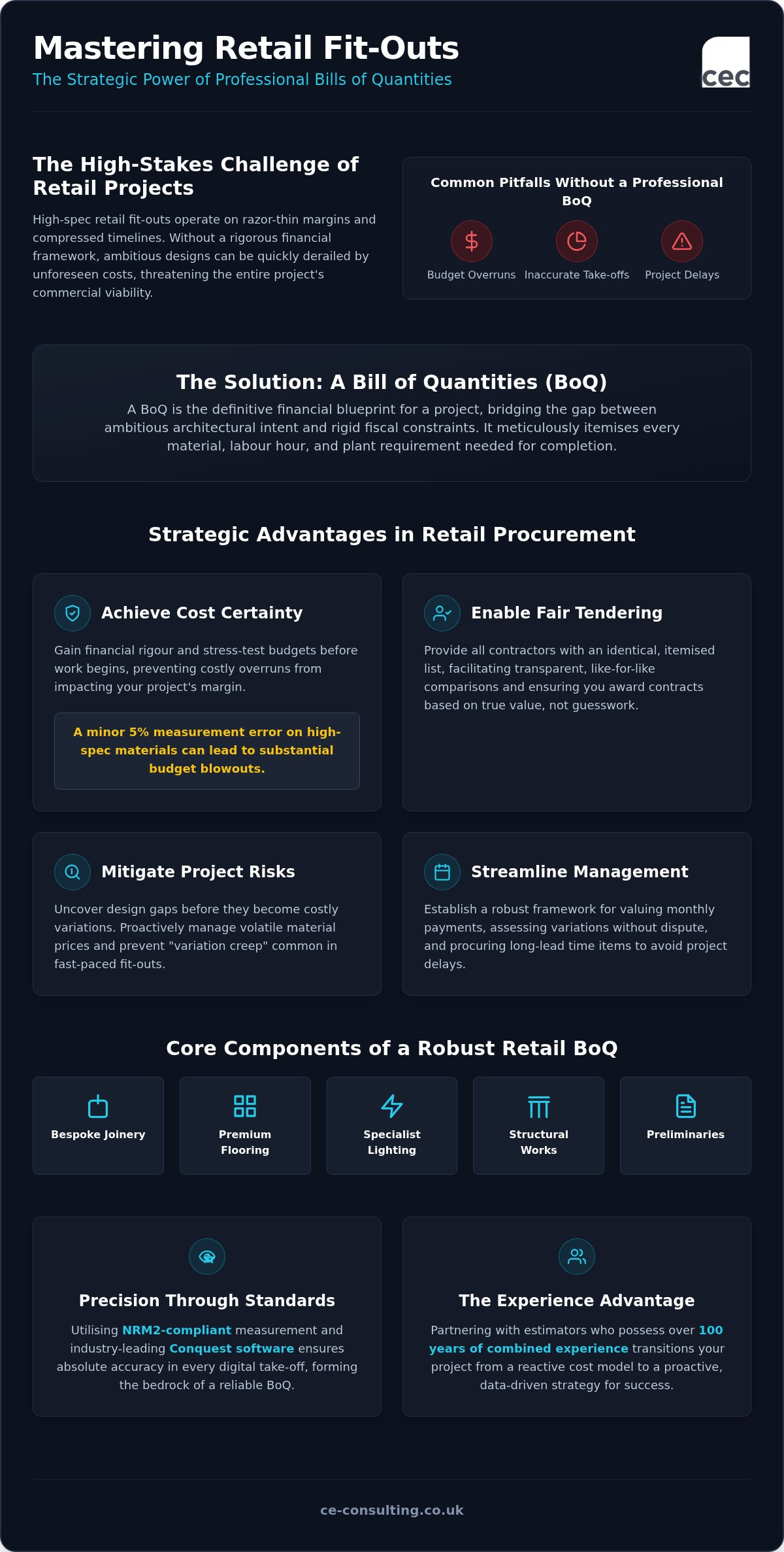
A Bill of Quantities (BoQ) represents the definitive financial blueprint for any commercial development. In its simplest form, it’s a meticulously itemised document that accounts for every material, labour hour, and plant requirement necessary to bring a project to completion. However, for those managing bills of quantities for retail projects, the document serves a far more strategic purpose. It bridges the gap between ambitious architectural intent and the rigid fiscal constraints of a commercial rollout. By providing a standardised framework, it allows multiple contractors to price their tenders on a strictly like-for-like basis. This level of transparency is vital for ensuring that the final contract award is based on true value rather than guesswork or hidden contingencies.
Professional BoQ preparation, particularly when adhering to NRM2 standards, allows for accurate cost planning from the very early design stages. It transforms a set of drawings into a quantifiable list of assets, giving developers and architects the ability to stress-test their budgets before a single brick is laid or a fixture is ordered. In the retail sector, where brand identity is tied to physical finishes, this document is essential for managing the high-spec fit-outs and structural alterations that define modern shopping environments.
The Core Components of a Retail BoQ
Retail environments are uniquely complex, often requiring a blend of structural engineering and high-end interior design. A robust BoQ for this sector must account for more than just basic building materials. It includes detailed descriptions of bespoke joinery, premium floor coverings, and specialist lighting systems that are central to the brand experience. Beyond the visible finishes, the document quantifies structural works required for high-street unit conversions, such as mezzanine installations or structural openings. Crucially, it also covers preliminaries, including site set-up and waste management logistics within restricted shopping centres where access is often limited to specific hours.
Why Retail Fit-out Estimating Demands Precision
The retail sector operates on razor-thin margins and punishingly fast timelines. Precision isn’t just a preference; it’s a commercial necessity. Because retail projects frequently utilise expensive, high-spec materials, even a minor 5% measurement error can lead to substantial budget overruns. Meticulous bills of quantities for retail projects prevent the “variation creep” that often plagues fast-paced fit-outs. When every item is accurately measured from the outset, you gain the foresight needed to procure long-lead items, such as bespoke signage or imported stone, without risking project delays. This level of detail instils confidence amongst stakeholders and provides the financial control required to protect your project’s margin.
The Strategic Role of BoQs in Retail Procurement
Procurement in the retail sector isn’t merely about securing the lowest price; it’s about establishing a reliable financial baseline. Professional bills of quantities for retail projects act as a vital equaliser during the tendering phase. By providing every contractor with an identical, itemised list of requirements, you eliminate the ambiguity that often leads to inconsistent bids. This transparency allows for true like-for-like tender comparisons, ensuring that the project is awarded to the contractor with the most realistic understanding of the scope, rather than the one who made the fewest assumptions.
Beyond the initial tender, a well-prepared BoQ provides a robust framework for managing the project’s financial health. It serves as the primary tool for valuing monthly progress payments and assessing variations. In the fast-paced retail environment, where design changes can occur mid-fit-out, having pre-agreed unit rates prevents disputes and keeps the project moving. Detailed BoQs also facilitate early engagement with specialist subcontractors. For complex MEP (mechanical, electrical, and plumbing) services, having quantified data early allows for more accurate specialist pricing, which is critical for high-spec retail environments where climate control and bespoke lighting are paramount.
This level of detail also discourages contractors from “front-loading” their bids. When uncertainty is removed, there’s no longer a need for contractors to inflate early-stage costs to protect their margins against unforeseen risks. Over time, these documents become a valuable historical cost database. For retailers planning future roll-outs or franchises, this data is essential for predicting the commercial viability of new sites based on proven expenditure. The same principles that underpin rigorous retail cost management are equally critical in other high-value sectors, as explored in our guide to commercial construction cost consultancy UK services for hotel development.
Achieving Cost Certainty in Shopping Centre Fit-outs
Fitting out a unit within a major shopping centre presents unique logistical hurdles. Landlords often impose strict delivery windows and require all noisy work to be conducted out-of-hours. These constraints carry significant cost implications that must be quantified from the outset. Using professional construction cost planning services ensures that these specific site preliminaries are priced accurately within the main tender. This foresight protects the developer from the logistical “hidden costs” that frequently erode project contingency funds.
Streamlining the Tender Process for National Roll-outs
For brands pursuing national expansion, standardised BoQ templates are indispensable. They allow multi-site retailers to speed up the procurement process by using a consistent measurement format across every location. This approach enables developers to compare regional cost variations with precision. A fit-out in a central London location will naturally command higher labour and logistical rates than a similar project in the North. By linking these BoQs to detailed materials schedules, brands can ensure their supply chain is fully prepared for a multi-site programme. Engaging with expert tender support early in the planning phase can provide the historical cost data needed to validate the commercial viability of future franchises.
Industry Standards and the Power of Conquest Software
Technical mastery in retail development is underpinned by a commitment to rigorous industry standards. Whilst the conceptual design of a flagship store may be fluid, the financial data supporting it must be absolute. Adhering to the Royal Institution of Chartered Surveyors (RICS) New Rules of Measurement (NRM2) provides this essential framework. By following these rules, we ensure that every professional involved in the project, from the lead architect to the institutional investor, speaks an identical financial language. This standardised approach to bills of quantities for retail projects eliminates the ambiguity that often leads to budget disputes during the construction phase.
The industry has moved beyond the limitations of traditional manual take-offs. In a sector where design iterations occur almost daily during the pre-construction phase, manual calculations are simply too slow and prone to human error. Transitioning to digital precision through Conquest Estimating software represents a significant leap in reliability. This technology allows for the detailed extraction of quantities directly from architectural drawings with high fidelity, ensuring that even the most complex bespoke elements are captured accurately. It provides a level of technical rigour that manual methods cannot replicate, instilling a sense of security in the project’s commercial viability.
Why NRM2 is the Gold Standard for Retail Measurement
NRM2 provides a clear, elemental structure for cost analysis that is particularly suited to the retail environment. It allows developers to break down expenditure into logical categories, such as shopfitting, structural alterations, and specialist MEP services. This granular level of detail is vital for institutional investors who require transparent auditing and robust financial reporting. By using NRM2, we ensure that the BoQ isn’t just a list of items, but a strategic document that facilitates clear communication amongst all stakeholders. It provides the grounded confidence needed to manage the high stakes of a commercial fit-out.
The Conquest Advantage: Speed and Accuracy
Utilising Conquest Estimating software allows for a seamless transition from measurement to procurement. The software enables the detailed integration of BoQs with material schedules for contractors, ensuring that the supply chain is aligned with the project’s specific requirements from day one. This digital workflow reduces the margin for error in complex retail calculations, such as those required for intricate joinery or specialist floor finishes. Conquest software facilitates the rapid re-measurement of works whenever retail layouts are adjusted, ensuring the budget remains aligned with the latest design iteration. This agility is crucial in the fast-paced retail sector, where staying on schedule is as important as staying on budget.
Mitigating Risks in Fast-Track Retail Developments
The speed of retail delivery is often cited as a reason to bypass formal measurement. In a sector where a four-week fit-out is standard, there’s a common misconception that professional bills of quantities for retail projects create a bottleneck in the programme. The reality is the opposite. Whilst the measurement process requires an initial investment of time, it identifies design gaps and missing specifications before they manifest as expensive on-site variations. By resolving these issues during the pre-construction phase, you protect the project from the frantic and costly “firefighting” that often occurs during the final stages of completion.
Managing risk also involves handling uncertainty when final specifications are still pending. In such instances, we utilise “approximate” BoQs based on historical data and design intent. This approach provides a structured financial framework that can be refined as details emerge, preventing the project from starting with a completely unquantified budget. This methodical oversight ensures cost control is maintained even amongst the most aggressive delivery schedules, allowing the project team to focus on quality rather than commercial disputes. To secure your project’s financial future, contact our team for expert BoQ preparation.
Preventing Cost Overruns on the High Street
High street unit conversions are notorious for hidden structural requirements that only become apparent once the strip-out begins. Meticulous pre-construction measurement helps to identify these risks early, allowing for the quantification of structural alterations and the impact of specialist finishes on the overall project viability. By defining the scope with technical rigour, we reduce the likelihood of disputes between developers and fit-out contractors. This level of detail is essential for maintaining the commercial margin, especially when mid-tier retail fit-outs in 2026 are seeing costs range from $90 to $180 per gross square foot.
Protecting Design Intent for Architects
Architects face the perpetual challenge of delivering high-end aesthetic goals within rigid commercial constraints. Professional quantity surveying for architects ensures that design intent remains affordable through accurate contingency quantification. By providing a clear financial buffer within the BoQ, we support architects during value engineering exercises. This allows for the selection of alternative materials or methods that preserve the retail brand identity without exceeding the budget. It transforms the estimator from a cost-cutter into a strategic partner who safeguards the creative vision through financial precision.
Choosing Professional BoQ Preparation for Retail Success
Success in retail construction is rarely accidental; it is the result of disciplined financial planning and technical rigour. In an industry defined by razor-thin margins and aggressive delivery windows, the ability to transition from a reactive to a proactive financial strategy is what separates profitable developments from those plagued by overruns. Choosing professional bills of quantities for retail projects ensures that your commercial strategy is built on a foundation of technical mastery. By identifying costs with absolute precision before work commences on-site, you gain the grounded confidence required to navigate the complexities of modern retail procurement.
Engaging a specialist estimator provides more than just a list of materials. It offers a “safe pair of hands” for high-stakes commercial tenders. Our team brings over 100 years of combined professional experience to every project, ensuring that even the most intricate high-spec finishes are quantified with meticulous detail. This level of expertise is vital when managing the significant capital investment required for flagship stores or national roll-outs. When the commercial viability of a project is at stake, relying on seasoned professionals who understand the nuances of the retail sector is the most effective way to protect your margin.
Collaborating with Consulting Estimating Consultants
Our national approach allows us to support architects, developers, and main contractors across the UK with consistent, high-quality documentation. We leverage our technical mastery of Conquest Estimating software to deliver digital take-offs that are both rapid and reliable. This software-driven precision ensures that your retail fit-out estimating is based on high-fidelity data, reducing the risk of human error in complex calculations. Our commitment to accuracy serves as a protective barrier for your commercial interests, allowing you to focus on design excellence and operational delivery whilst we manage the fiscal details.
Securing Your Project’s Financial Future
The return on investment for a robust Bill of Quantities is found in the disputes avoided and the variations prevented. By establishing a clear, itemised baseline for all works, you create a transparent environment for tender comparisons and monthly valuations. To integrate this level of financial control into your next development, the first step is to request a professional take-off or BoQ production that aligns with NRM2 standards. This ensures your project begins with a definitive financial blueprint. For those seeking further strategic guidance, our guide on Construction Estimating for Architects UK provides deeper insights into protecting design intent with financial precision. Secure your project’s future by choosing a partner dedicated to technical excellence and commercial stability.
Advancing Your Retail Development with Financial Precision
The commercial success of a retail environment depends upon the rigour of its financial foundation. By prioritising professional bills of quantities for retail projects, you move beyond the uncertainty of approximate estimates and embrace a strategy rooted in technical mastery. We have explored how NRM2-compliant measurement and digital precision identify design gaps early, ensuring that even the most ambitious high-spec fit-outs remain commercially viable throughout the construction phase. This methodical approach transforms the BoQ from a simple itemised list into a strategic asset that safeguards every stakeholder’s interest.
Our consultancy provides a nationwide service for architects and developers, backed by over 100 years of combined professional experience in the commercial sector. As specialists in Conquest Estimating software, we offer the meticulous oversight and grounded confidence needed to protect your project’s margin in an increasingly volatile market. Enquire about our professional Bills of Quantities for your next retail project to ensure your architectural vision is supported by absolute cost certainty from the outset. We look forward to acting as your dependable guide in delivering retail excellence.
Frequently Asked Questions
What is the difference between a Bill of Quantities and a schedule of rates in retail?
A Bill of Quantities provides specific, measured quantities for a defined scope of work, whereas a schedule of rates only lists unit prices for various tasks without quantifying the total volume. In the retail sector, BoQs offer far greater cost certainty for fixed-price contracts. Schedules of rates are typically reserved for maintenance or reactive works where the final extent of the job isn’t known at the outset.
How long does it typically take to produce a BoQ for a retail fit-out?
The production timeline for a retail fit-out BoQ typically ranges from five to ten working days, depending on the complexity of the bespoke joinery and structural alterations. Utilising industry-leading Conquest software allows us to deliver high-fidelity take-offs within these compressed delivery windows. This speed ensures that the tendering process can commence without delaying the project’s fast-track programme.
Can a BoQ be prepared if the retail design is not 100% complete?
You can certainly prepare a Bill of Quantities when a retail design is incomplete by utilising “approximate” quantities based on design intent. This approach establishes a preliminary financial framework that can be refined as the final specifications are confirmed. It prevents the project from starting without a quantified budget and allows for earlier engagement with fit-out contractors.
Why should retail developers outsource BoQ preparation instead of doing it in-house?
Outsourcing ensures your bills of quantities for retail projects are prepared with a level of technical rigour and impartiality that’s difficult to replicate in-house. Specialist firms possess over 100 years of combined experience and use dedicated software like Conquest to eliminate human error. This provides a “safe pair of hands” for high-stakes tenders, allowing your internal team to focus on core project management tasks.
Does a Bill of Quantities help with value engineering in retail projects?
A Bill of Quantities is an essential tool for value engineering as it provides the granular data needed to compare alternative materials or construction methods. By having every item quantified, architects can easily see where budget reallocations can be made without sacrificing brand identity. This transparency ensures that aesthetic goals remain affordable whilst protecting the project’s commercial margin.
What measurement standard is most commonly used for UK retail BoQs?
The Royal Institution of Chartered Surveyors (RICS) New Rules of Measurement (NRM2) is the industry standard for UK retail BoQs. This standard provides a consistent, elemental structure that ensures all parties speak the same financial language. Adhering to NRM2 facilitates easier auditing and financial reporting, which is particularly important for institutional retail investors and large-scale commercial roll-outs.
How do BoQs help in managing variations during a fast-track retail build?
BoQs manage variations by providing a pre-agreed schedule of unit rates that can be applied to any changes in scope. In a fast-track retail build, this prevents time-consuming negotiations over costs mid-fit-out. When a design change occurs, the impact on the budget is calculated instantly using the existing BoQ data, maintaining financial control and preventing project delays.
Are BoQs necessary for small-scale retail unit renovations?
Whilst often associated with flagship developments, bills of quantities for retail projects are highly beneficial for small-scale renovations. Even minor unit updates involve expensive finishes and strict timelines where measurement errors lead to disproportionate cost overruns. A professional BoQ ensures that even modest projects benefit from transparent tender comparisons and absolute cost certainty before work begins on-site.