



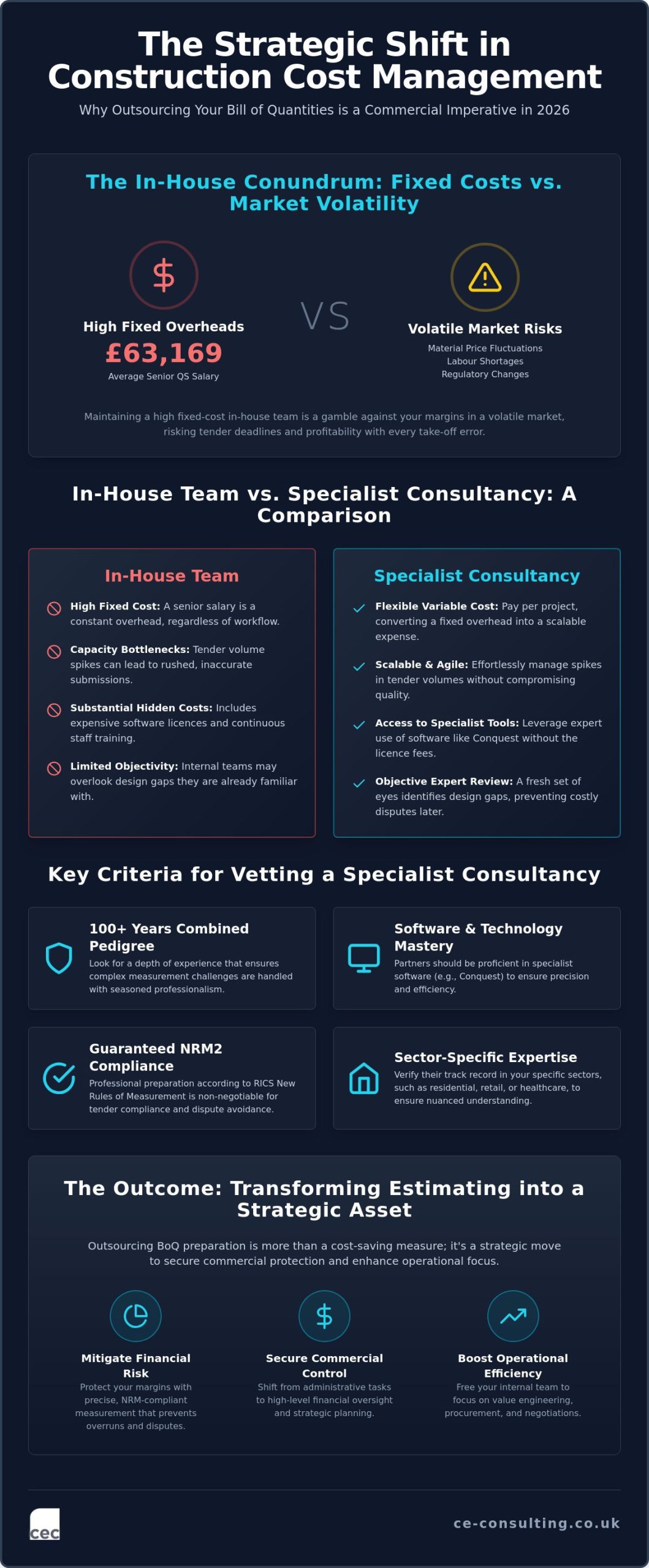
Is the £63,169 average salary of a senior quantity surveyor actually the most expensive way to manage your pre-construction workflow? In an industry where material price volatility and labour shortages remain the 2026 standard, maintaining high fixed costs for an in-house team often feels like a gamble against your own margins. You’re likely all too familiar with the pressure of missing tender deadlines or the quiet dread of a discovered take-off error that erodes project profitability before the first spade is in the ground.
Deciding to outsource bills of quantities is no longer just a temporary fix for capacity issues; it’s a sophisticated risk-management strategy. We understand that precision is the foundation of your financial security. This guide explores how transitioning to a specialist consultancy provides the technical rigour you need through fixed-price estimating and professional, NRM-compliant documentation. We’ll examine the strategic advantages of accessing specialist software like Conquest whilst navigating the complex 2026 regulatory landscape, including the new Building Safety Levy. By the end of this article, you’ll understand how to transform your estimating process from a volatile overhead into a precise, dependable asset that protects your commercial interests.
Key Takeaways
- Understand the strategic shift from administrative BoQ preparation to high-level financial oversight to protect your project margins in a volatile market.
- Discover how to outsource bills of quantities effectively to replace high fixed overheads with a flexible, project-based cost model.
- Identify the essential criteria for vetting a consultancy, focusing on software mastery and a collective professional pedigree of at least 100 years.
- Master the step-by-step procurement process to ensure your documentation is fully NRM-compliant and structured for maximum tender accuracy.
- Gain insights into mitigating financial risk across specialised sectors, including residential, retail, and healthcare developments.
The Strategic Case for Outsourcing Bills of Quantities in 2026
In the current construction climate, the role of a Bill of Quantities has evolved far beyond a simple list of materials. It’s now a critical instrument for financial governance. As material prices fluctuate and regulatory requirements like the Building Safety Act tighten, the decision to outsource bills of quantities represents a fundamental shift from administrative necessity to strategic oversight. You aren’t just buying a document; you’re securing a layer of commercial protection that shields your project from the “silent costs” of margin creep and unforeseen variations.
Relying on a variable cost model allows your business to remain agile. When tender volumes spike, your internal capacity shouldn’t be the bottleneck that forces a rushed, inaccurate submission. By partnering with external specialists, you convert the fixed, high overhead of a senior estimator’s salary into a scalable expense that aligns perfectly with your pipeline. This financial flexibility is essential for maintaining stability whilst pursuing growth in a competitive market.
External consultants also bring a degree of objectivity that’s often lost in-house. A fresh set of eyes, detached from the initial design phase, is more likely to identify discrepancies or gaps in the drawings. Addressing these design gaps before the contract is signed is the most effective way to prevent costly disputes during the final account settlement. It’s about finding the error on the page before it becomes a problem on the site.
Mitigating Financial Risk through Professional Measurement
Precision in measurement is your first line of defence against project overruns. Utilising professional boq preparation ensures that every element of the work is captured according to the RICS New Rules of Measurement (NRM2). This standardisation is vital for modern tender compliance. It provides a level playing field for contractors and creates a transparent framework that simplifies the valuation of variations. When your documentation is robust and NRM-compliant, the likelihood of adversarial claims diminishes significantly, protecting your bottom line from start to finish.
Operational Efficiency and Scalability
The operational burden of maintaining a top-tier estimating department is substantial. Between the rising costs of specialist software licences and the continuous training required for staff to stay current, the investment is considerable. When you outsource bills of quantities, these costs are absorbed by the consultant. This allows your internal commercial teams to step away from the time-consuming minutiae of take-offs. Instead, they can focus their expertise on higher-value activities such as value engineering, procurement strategy, and subcontractor negotiations. This shift doesn’t just meet aggressive tender deadlines; it improves the quality of your entire commercial operation.
Evaluating a Specialist Consultancy: Key Criteria for BoQ Accuracy
Selecting the right partner to outsource bills of quantities is a decision that directly impacts your project’s financial integrity. It’s not merely a matter of finding a service provider; it’s about identifying a “safe pair of hands” capable of navigating high-stakes tender environments. When the margin for error is non-existent, the primary benchmark for selection must be a proven track record of technical mastery. You should look for a consultancy that offers a combined professional pedigree of 100 years or more. This depth of experience ensures that the team has encountered and resolved the complex measurement challenges inherent in diverse developments, from high-density residential blocks to intricate industrial facilities.
Sector-specific expertise is equally vital. A consultant who understands the nuances of healthcare construction, for instance, will be far more adept at identifying the specialist requirements that generalists might overlook. This professional intuition, built over decades, allows them to act as a strategic advisor rather than a simple data processor. If you’re looking for a partner who brings this level of seasoned insight to your next project, you might consider how professional quantity surveying support can stabilise your commercial outcomes.
The Software Advantage: Conquest vs Basic Take-offs
In 2026, software proficiency is the clear dividing line between a modern consultancy and a legacy firm. Manual spreadsheets are a significant liability in contemporary procurement; they’re prone to formula errors and lack the transparency required for complex material schedules. Utilising advanced platforms like Conquest Estimating software provides a level of consistency that manual methods simply cannot match. These tools allow for automated data extraction, which significantly increases the speed of delivery whilst maintaining absolute precision. This technological rigour ensures that your materials schedules are robust, reliable, and ready for immediate use in the procurement phase.
Adherence to RICS and NRM Standards
The fundamental meaning of bill of quantity has shifted towards a requirement for total standardisation under the RICS New Rules of Measurement (NRM2). Your chosen partner must demonstrate a deep commitment to these standards. Standardised measurement isn’t just a regulatory hurdle; it’s the mechanism that allows for fair and transparent tender comparisons. When every contractor bids against the same precisely measured quantities, you eliminate the risk of “front-loading” and ensure that the prices you receive are genuinely comparable. Fully compliant documentation is the only way to provide your stakeholders with the financial certainty they demand.
Outsourced vs In-House Quantity Surveying: A Cost-Benefit Analysis
Maintaining an internal estimating department is often perceived as a way to retain control, yet it frequently introduces significant financial rigidity. When you analyse the true cost of a senior in-house professional, the figures extend far beyond the basic salary. You must account for National Insurance contributions, pension provisions, and the escalating costs of professional indemnity insurance. Additionally, there’s the capital expenditure for high-end software and the ongoing cost of CPD to consider. For many firms, these fixed overheads become a burden during periods of lower tender activity, draining resources that could be better allocated elsewhere.
By choosing to outsource bills of quantities, you effectively neutralise these fixed expenses. You shift your financial model from a rigid monthly liability to a flexible, project-based investment. This transition ensures that your commercial department is never over-resourced during quiet spells or under-staffed when multiple high-value tenders arrive simultaneously. It removes the capacity bottleneck that often leads to rushed submissions and compromised accuracy, allowing your business to scale its bidding activity without increasing its permanent headcount.
This strategy of converting fixed overheads into variable costs is equally effective across other administrative functions. For instance, many growing businesses also choose to outsource their financial record-keeping to specialists like K Cloud Accounting Pte Ltd, allowing them to maintain a lean, agile operation while focusing their internal resources on core project delivery.
Fixed vs Variable Cost Models
Engaging a quantity surveying consultancy UK provides a level of cost certainty that is difficult to achieve with an internal team. You pay for the technical production you require, precisely when you require it. This variable cost model is particularly advantageous in 2026, where market fluctuations demand lean operations. The ROI of this approach is found in the elimination of error-filled spreadsheets; a single significant measurement error can cost far more than the consultancy fee for a professionally prepared BoQ. Precision is not just a standard; it’s a financial safeguard.
Specialist Knowledge on Demand
An in-house hire, no matter how experienced, is limited by their individual career history. In contrast, when you outsource bills of quantities to a consultancy, you tap into a collective intelligence. This gives general contractors the confidence to bid for specialist projects in sectors like healthcare or retail, knowing they have access to experts who understand the specific supply chain volatility and market rates of those industries. You gain a dedicated partner for complex elemental cost analysis, ensuring that your bids are competitive and, more importantly, commercially viable. This on-demand expertise allows you to diversify your portfolio with minimal risk.
The Procurement Process: How to Successfully Outsource Your BoQ
A successful partnership with an external consultancy relies on a structured procurement process that prioritises clarity and technical detail. When you decide to outsource bills of quantities, the transition from internal management to external production must be handled with the same rigour you apply to your on-site operations. This methodical approach ensures that the final documentation is not only accurate but also fully integrated into your commercial strategy. The process typically follows five distinct stages:
- Step 1: Defining the Scope. You must determine the required level of detail at the outset. This usually involves choosing between NRM1 for early-stage cost planning and NRM2 for detailed procurement.
- Step 2: Preparing the Information Pack. Provide a comprehensive set of tender drawings, specifications, and any relevant site reports. The quality of the output is directly linked to the quality of the input.
- Step 3: Establishing Milestones. Set clear deadlines for draft reviews and final delivery to ensure the BoQ aligns with your tender submission programme.
- Step 4: Technical Review. Conduct a thorough examination of the draft take-offs and material schedules to ensure all project-specific nuances have been captured.
- Step 5: Final Integration. Incorporate the validated quantities into your estimating software or tender documents for final pricing.
Preparing the Brief for Your Consultant
Precision begins with the brief. To ensure an accurate production of bills of quantities, your consultant requires a complete documentation set, including architectural and structural drawings, MEP specifications, and any specialist subcontractor requirements. It’s vital to communicate specific project constraints or unusual material specifications early. If you’re working on a site with restricted access or heritage considerations, these factors must be reflected in the measurement logic. Clear expectations regarding the final document format, whether it’s a Conquest-compatible file or a standardised Excel export, will prevent technical friction during the final submission phase.
Reviewing and Validating the Output
Validation is the final safeguard for your project margins. When you outsource bills of quantities, you should treat the first draft as a collaborative document. Check key areas such as substructure measurements and complex elemental take-offs to ensure they align with the construction cost planning services established during the pre-tender phase. A professionally prepared BoQ serves as more than just a pricing tool; it becomes a vital reference for variation management once the project moves on-site. By ensuring the document is robust at the procurement stage, you provide your site teams with a dependable baseline for financial control. For a meticulous review of your current project requirements, you can engage our professional tender support services to ensure absolute accuracy.
Why Consulting Estimating Consultants is Your Safe Pair of Hands
When you decide to outsource bills of quantities to our team, you’re securing more than just a measurement service. You’re accessing over 100 years of combined professional experience in UK cost consultancy. This depth of knowledge allows us to function as a dependable guide, providing the grounded confidence required to navigate the high stakes of modern construction. We’ve built our reputation on a commitment to technical mastery and financial rigour. Every project we undertake is approached with a serious, meticulous mindset, ensuring that your commercial interests are protected through every stage of the tender process. We don’t just deliver documents; we deliver the peace of mind that comes from knowing your data is robust and reliable.
Our commitment to excellence is reflected in our disciplined workflow. We understand that in the tender environment, timing is as critical as accuracy. By integrating our expertise directly into your pre-construction phase, we help you mitigate financial risk before a single contract is signed. Our team acts as a seasoned partner, dedicated to the commercial viability of your projects. This professional reassurance is why developers and contractors across the UK trust us to handle their most complex quantification requirements.
The Conquest Advantage for Contractors
The precision of our work is underpinned by our use of Conquest Estimating software. This advanced platform serves as our core production tool, allowing us to generate material schedules with a level of detail that manual methods cannot replicate. By leveraging automated data extraction, we eliminate the human errors that often lead to procurement waste and margin erosion. Our Bills of Quantities are highly regarded by main contractors and developers across the UK because they provide a clear, transparent basis for pricing. This technical edge doesn’t just improve your tender accuracy; it gives you a distinct competitive advantage in a crowded market.
Sector-Specific Estimating Excellence
The complexities of 2026 construction demand a partner who understands the nuances of different built environments. Our team provides specialist expertise across the residential, retail, healthcare, and education sectors. We understand that a fast-track retail fit-out requires a different commercial approach than a highly regulated healthcare facility. For large-scale developers, our residential project cost planning services provide the essential financial oversight needed to maintain margins amidst material price volatility. This sector-specific intuition allows us to identify potential risks early, ensuring that your bids are both competitive and commercially viable. Having a partner who recognises the unique challenges of your specific sector provides a level of reassurance that generalist firms cannot match. It’s this disciplined approach to sector-specific measurement that makes us a trusted extension of your commercial team.
Securing Your Commercial Future in 2026
Adopting a variable cost model is no longer just an operational choice; it’s a strategic necessity for maintaining financial control in an unpredictable market. By choosing to outsource bills of quantities, you replace the burden of senior-level payroll with the precision of on-demand expertise. You’ve seen how NRM-compliant documentation and advanced software like Conquest act as your first line of defence against tender inaccuracies and procurement waste. This transition ensures your commercial team remains focused on high-value strategy whilst we handle the technical rigour of quantification.
As a partner with over 100 years of combined industry experience and full national UK coverage, we provide the steady, disciplined oversight your projects deserve. We ensure that every material schedule and take-off serves as a reliable baseline for your long-term commercial success. Contact Consulting Estimating Consultants today for a professional BoQ quote and take the first step towards absolute cost certainty. We’re ready to help you navigate the complexities of the 2026 construction landscape with confidence and technical mastery.
Frequently Asked Questions
What is the main benefit of outsourcing my bills of quantities?
The primary advantage when you outsource bills of quantities is the immediate reduction in fixed commercial overheads. By transitioning to a project-based cost model, you gain access to senior-level expertise without the long-term financial commitment of a permanent hire. This flexibility is essential for managing fluctuating tender volumes whilst maintaining absolute precision in your submissions.
How long does it take to produce a professional BoQ?
Production timelines are determined by the complexity and scale of the development. A standard residential or commercial project typically requires between one and three weeks for a comprehensive, tender-ready document. We establish firm milestones at the outset of every engagement to ensure your documentation is delivered in strict alignment with your procurement programme.
Is an outsourced BoQ compliant with RICS and NRM standards?
Every document we produce is fully compliant with the latest RICS New Rules of Measurement (NRM) standards. Adhering to NRM2 ensures that your quantities are measured using a recognised, professional framework that is the industry standard for 2026. This standardisation is vital for providing transparency to stakeholders and facilitating fair tender comparisons amongst bidding contractors.
Do I need to provide my own software licences to the consultant?
You don’t need to provide any software licences or technical infrastructure to our team. We utilise our own professional-grade platforms, including Conquest Estimating software, to produce meticulous material schedules and take-offs. This removes the capital expenditure and training burden from your business whilst ensuring you benefit from the most advanced data extraction tools available.
Can an external quantity surveyor understand my specific construction methods?
Specialist consultants leverage a broad range of industry experience to interpret your specific construction methods accurately. Through a structured briefing process, we capture the nuances of your preferred build systems and material choices. Our team’s deep understanding of UK construction standards allows us to translate your technical requirements into precise, professionally measured quantities that reflect your project’s reality.
How are fees usually structured for outsourced BoQ services?
Fees are typically structured on a fixed-price basis, tailored to the specific scope and complexity of your project. This approach provides you with total cost certainty from the start of the engagement. We provide a detailed proposal after reviewing your tender drawings and specifications, ensuring there are no unforeseen costs during the production phase of the work.
What happens if there are design changes whilst the BoQ is being prepared?
Design changes are managed through a methodical revision process that maintains the integrity of the measurement data. If drawings are updated whilst we are working, we track the variations and adjust the quantities accordingly. This ensures that your final tender submission reflects the most current design information, significantly reducing the risk of financial discrepancies once the project moves on-site.
Can you provide BoQs for both main contractors and subcontractors?
We provide tailored services for both main contractors and subcontractors across the UK. For main contractors, we focus on comprehensive, NRM-compliant documentation for large-scale procurement and tender management. For subcontractors, we deliver precise material take-offs and trade-specific schedules that allow for the accurate pricing of individual packages, ensuring commercial viability for every party involved.